
Historical Setting: 610 C.E., Vosges Mountains
Father Columbanus was taken away by soldiers in the night. He wants no soldiers to follow. He specifically asked for me, probably because he knows I won’t bring on a fight. I hope his ask was not because he knows me by my actual name. That would imply he thinks this mission is deadly dangerous, and here I am with two of my sons and one of their lovers jumping headlong into this.
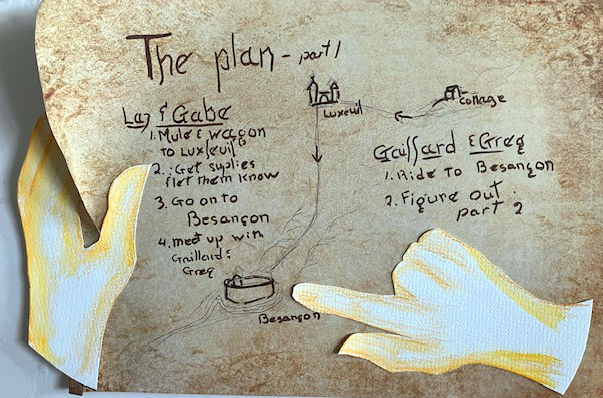
Gaillard argues his qualifications to make a plan because he says, “In a family of holy people everyone learns chants and bible stories; in a family of noble warriors children are set in the library to learn the fortresses of Burgundy. So, I know that Besançon is less than a day’s ride on a fast horse south by the River Daub. And I can assume that is where they’ve taken the Father.”[Footnote]
We all want to know his plan.
Gailliard explains, “I am sorting out the knowns from the things we still need to learn, and I’m considering whatever resources we have with only four of us to free someone from a prison probably having chains and lots of guards.”
“What about the risk? What are you expecting of us?” Greg asks aloud what we all are wondering.
Gaillard unwinds his plan in small pieces according to our need to know. It requires our unfathomable trust in this man whom I’ve noticed carries a sword, though he may have never used it — even to butcher a lamb or take a hen. I want to ask Greg if he trusts Gaillard completely or if he is just going along with it because …
“Don’t worry Papa, Gaillard is good at this.” Greg knows my thoughts.
To begin Gaillard starts with the ending. “The expectation of the Father, and also, of the soldiers who captured him, is that someone named Ezra will show up for him. The Father knows who Ezra is but the soldiers don’t know if Ezra is a monk or a soldier with a huge army, or maybe even a commoner farmer, as he is. What do you think the Father is expecting you to do?”
“I think he wants prayers and no weapons.” I answer.
“So that is your part in this.” Gaillard explains. “You bring this expectation of the man, Ezra, now dressed as a monk and make yourself known at the main gate of the fortress. Tell them you are Brother Ezra, and you want to pray with the father.”
Footnote: Besancon was the headquarters for the archbishop of Burgundy when Columbanus was captured, presumably to await execution by King Theodoric and his grandmother.(Ibid. Jonas) The Catholic Encylopedia (accessed via https://en.wikipedia.org/wiki/Roman_Catholic_ Archdiocese_of_Besancon #To_1000 retrieved 2-27-23) leaves a bit of confusion over the archbishop at this time. After “Vitalis I, would come St. Rothadius, a monk at Luxeuil, then Nicetas who died c. 611.” Marilyn Dunn’s text The Emergence of Monasticism possibly offers clarification that the Luxeuil monks were archbishops at Besancon following this incident of taking St. Columbanus captive p. 160.
(Continues tomorrow)
 Lazarus Ink