
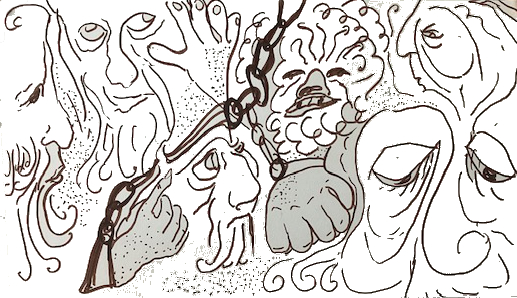
Historical Setting, 610 C.E. Besançon Fortress
“So we might be releasing dangerous men into Besançon?” asks Gabe.
I answer, “As far as I know, people usually end up in chains due to poverty; often the crime is theft or unpaid debt. So maybe these prisoners are just poor people.” [Footnote]
“Or maybe they are demoniacs.” suggests Gabe.
Greg dismisses this worry, “The reason why they are prisoners isn’t our concern. Our mission is to free the Father. Gaillard told us logistically, if the chains are broken the prisoners can become a distraction and possibly helpful.
So, we light torches and go back into the tunnel – three matching Celtic monks, all named Brother Ezra. Gaillard will wait for us with the wagon at the campsite in the wood ready to take the Father to safety even if we aren’t being pursued. May no one draw a sword.
It is much easier passing through a tunnel with other people and lit torches.
Now Gabe mentions he isn’t comfortable cutting prisoners free.
“They could be demoniacs. And without Jesus around to drive out the demons, it might be best to keep them in chains.”
“Is that what they do with demoniacs at Luxeuil?”
“We’ve never dealt with it that I know of” Gabe answers. “The most important thing in any kind of healing is to preserve the soul of the person. So I would suppose we would be more helpful offering prayer than cutting chains.”
“Well, Gabe,” I answer, “as one who was assigned forever to be a physical metaphor for spiritual life, I don’t appreciate the simplicity of separating the soul from the physical body then only offering prayer. But I hear your concern. Maybe I should be the one to release the prisoners and you go pray with the Father.”
“Oh, thank you Papa. I’m so much better at prayers than I would be cutting wild prisoners loose.” He’s relieved and gladly passes the tool for opening chain-links onto me. So, we’ve made a little revision in Gaillard’s plan.
Now we come to that place with a space in the wall of the cave, and with a torch I can see this is just a dead end or a boarded up side tunnel. I’m glad I didn’t waste time exploring it in the dark.
First it was Gabe, now Greg has concerns about his assignment too.
[Footnote] Geltner, G., The Medieval Prison: A Social History Princeton University Press, 2008 provides a resource confirming the significance of poverty as a cause for imprisonment in the Merovingean era.
(Continues tomorrow)
 Lazarus Ink