
Historical Setting, 610 C.E. Luxeuil
The Irish farmer, who loaned his horse to the Abbot for his escape from Besançon answers the soldiers who are now requiring an explanation for the sword they’ve found here in these guest quarters we share.
The farmer explains, “My farm is some distance from here, so I brought that with me on this pilgrimage in case of robbers. I found the sword on my farm but there was no sign of a soldier who would’ve lost it so I assume he escaped with his life. But if you do know who lost it, please take it now, and return it rightfully to its owner.”
The soldiers take the sword. Maybe they know how it was lost—that it was once delivered to the demons. They continue down the hallway checking each room. That band of armed men only just left Luxeuil as it is time for the prayers in darkness.
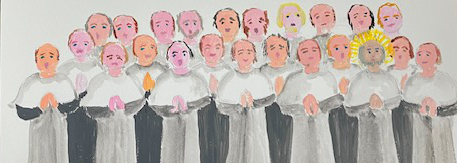
No one has slept this night, at least no one sleeps now until after matins. We notice there is an extra monk in the choir this morning, gray-haired, familiar to us all, but apparently wasn’t recognized by the soldiers. I wonder what the soldiers thought they were searching for? Were they expecting to see the great man of God, the abbot here, seated on a throne with a halo shining around his head? Even the presence of Jesus is often overlooked by those who only know the rumors of magic and have no thought of earthly goodness.
Apparently, they searched the study where Father Columbanus was quietly reading a book. They searched each of the shelves in that room, examining every volume, but the studious monk, seated in the middle of them went unnoticed. How will this oversight by the soldiers become known beyond this place is not clear. Was it a joke on the soldiers or a miracle, or a simple fact that ignoring a person makes them invisible? [footnote] Whichever, the father responded to the threat as though the soldiers were invisible, and in turn he was also amazingly unnoticed.
This morning the farmer leaves for his home with two horses, and I ride home with the mule wagon, alone in the morning light. The creek path is stilled and polished in white with winter. Dancing eddies of snow crystals transfigure an old reliable earthen path into a fantasy. It is the blank slate for the new earth, in case we should dare to take notice. It is the first of the lengthening days.
[footnote] This little story of the guards searching for Father Columbanus who was there all the time is told in the hagiography by Jonas the “Life of St. Columban” used here is from “Translations and Reprints from The Original Sources Of European History –edited by Dana Carlton Munro, A.M.
(Continues tomorrow)
 Lazarus Ink