
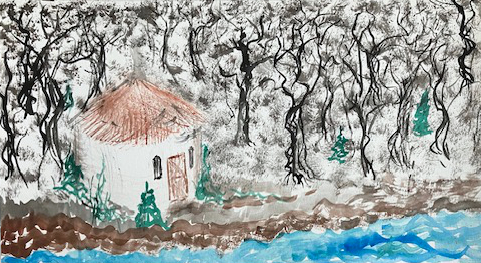
Historical Setting, 626 C.E. A creek valley in the Vosges
Haberd is very definitely the head of the household. He and his wife have taken on the major tasks of the family farm with the others of us helping out as farm hands when needed. A larger table is needed now up at the old cottage, because that is where we all still share the feasts and ale, as family. Brandell and Haberd tell our old stories now with funny punchlines.
Ana and I have a small cottage of daub and wattle, with a round of thatch for a roof. It is Creekside in the valley so Ana doesn’t have to end every jaunt to visit the sick by climbing the farm hill. Hannah is keeping the healing gardens. She’s the one called on most often to travel off for a midwife’s duty or an outbreak of illness in a distant village.
So, what of the youngest daughter? Layla makes her friends with the castle farmers of Metz. Dear God, be with her. She seems to seek out tales of adventures told and told again by those who have been hunters all their generations.
But, Luxeuil has changed with the times. Gabe, as the keeper of birds, knows all that happens among the order. After Father Columbanus was set free from prison awaiting execution, he agreed to leave Gaul by ship and return to his native island. He could only take those followers who had first come with him from Ireland. They traveled on to Nevers, then on the Loire to Nantes where his ship was ready to carry him off to his native island, but like Jonah, when setting out by ship to go to the wrong place, the captain was frightened, believing that this was against God’s will so he refused to take the Father into exile. [Footnote]
In the meantime, the Father’s nemesis, Queen Brunhilde, who wanted him dead in the most brutal Merovingian style, was herself, brutally executed. The change in rulers allowed the Father to renew his mission work in Gaul. He came back to bid farewell to his followers, then continued setting several more communities to life dotting Gaul with Celtic monasteries.
When all the remembrances are sorted out for the hagiographers to write everything on timeless vellum, it will be known that Father Columbanus continued into the mountain wilderness across the Alps to Bobbio where he established yet another community of devoted Christians nearer to Rome. And it was in Bobbio that he passed away, only a decade ago.
[Footnote]The source from which most other sources are drawn is the Hagiography by the later Bobbio monk, Jonas. This blogger references Munro, Dana Carlton, editor and translator Translations and Reprints from The Original Sources of European History – Life of St. Columban by Jonas.
(Continues Tuesday, January 9,2024)
 Lazarus Ink