
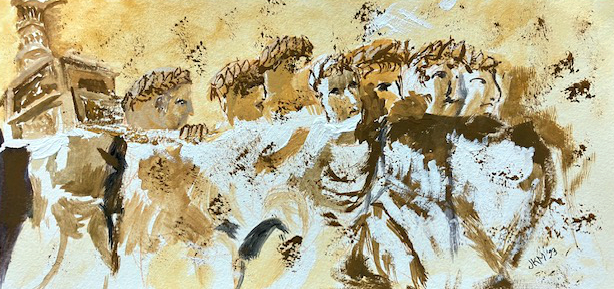
Art Notes: This gouache painting is this artist’s interpretation of a detail of the relief from the Arch of Titus (in ruin) showing the Roman looting of the Temple in Jerusalem.
Historical Setting, 626 C.E. The farm in the Vosges
Brandell asks me, “So Did Rome ever conquer the Jews?”
“Rome is gone and Jewish people still worship one God as they always have.” That’s an easy, but incomplete answer, that seems to break open a ray of light into Brandell’s deep darkness. He nearly smiles.
So, I throw a little more history into that darkness. “The Romans used every warring way they knew to try to subdue the Jews. They infiltrated the leadership with their own puppet king and even the appointment of the Sadducee, high priest, required Roman approval. When a popular leader arose from the people and went around teaching the old law of God’s love, it was an impossible challenge to imperial pride — to love one’s neighbor as self — so they crucified him. They sacked and burned the Temple built with stone. Before that, they massacred the Jewish people at Sepphoris. [Footnote] When flat-out killing people and destroying the temple didn’t make Jews dissolve away into Roman, rumor and propaganda hammered away at truths to make Jews seem to be devils.
“Even when Rome took thousands of Jewish lives and their property, they couldn’t break their deep bonds of faith and obedience to God’s law that made them a people together. The Jews could never become Rome’s war prize. Rome would have had to separate the people of the Hebrew root from God and the law that made them/us, a people together. All the conquering Rome could muster could never twist these people into Roman to worship a pantheon of imaginary gods, or even a serial monotheism of flesh and blood Caesars.
Brandell wonders, ”What do I do with a song about a Jewish Grandpapa? Is he still beloved by God when the Church follows the king’s edict against the Jews?”
I can affirm, “It is the broken bonds of love among people that surely must break God’s heart. Brandell,” I ask, “what do you suppose is in the extravagant resilience of Judaism that so wrankled the Romans and now annoys the Church?”
“You are going to tell me, aren’t you, Papa?”
“It was pure obstinate faithfulness that was taught us by our mothers and our prophets. It was the story of God’s love for all the followers as a whole people with God always goading us through each wilderness.”
“So, how was it that Romans conquered all these tribes of Gaul and never conquered the Jews?” Brandell asks.
[Footnote] Carroll, James Constantine’s Sword: The Church and the Jews, A History, [Boston, New York, Houghton Mifflin C. A mariner Book, 2001.] p. 83
(Continues tomorrow)
 Lazarus Ink