
Historical Setting: 793 C.E. Jutland
Here I am so far in the future where my language is only spoken by slaves. Here the god that is God isn’t known and writing isn’t valued because no one reads.
Dear God, maybe people always imagine a future inventing a life that will be the same or better than the present. Then, here I’ve come into the future, and now I find the world has gone Pagan. Are you still here with us, God?
This is one of those prayers where I ask God to show presence with me. And God answers, not with a vision, but with my vision and so I am suddenly seeing beauty all around in everything. These strangers were feasting with me, laughing, singing, smiling, nearly welcoming if only they could welcome a stranger – surely God is here, even unseen.
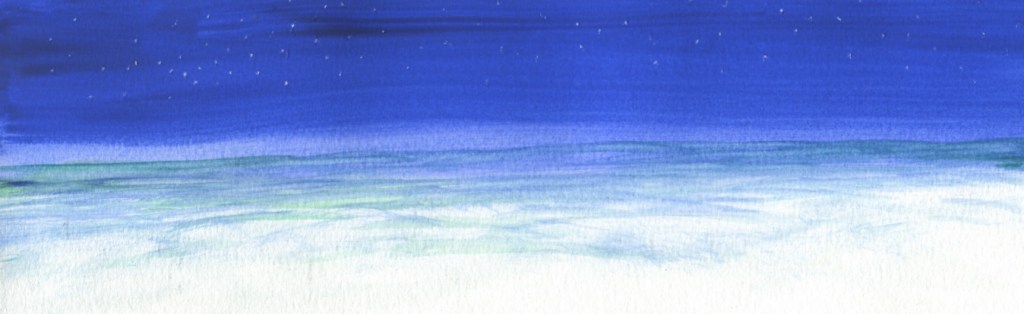
Here the cold waters of the sea are rising up in all their translucence, tumbling onto the shore in foam with every next breath of sea – surely God is stirring the waters, yet unseen. And at night when the sky is still stained with lost sun on the western horizon and a glitter of stars spread in the east – surely God is setting each in place to guide the sailors and comfort night shepherds with an eternity, yet unseen. Thank you, God, I knew you were here all along. Let me not forget.
My questions are hard ones and not easily answered with the simplicity of words even if I knew the words.
May the seiðr be my source for understanding this strange new world. Marian and I sit down in her house and Marian translates my first question.
“I see lots of art work done in the style used by Christian monks in copying manuscripts. Do people also read and write in this time and place?”
The woman doesn’t answer with words. She rises from her great chair and walks slowly to the wall rack with cloak and the wineskin. She takes another long swig from the wine skin and hangs it back on the hook, then brings the walking staff to this bench where Marian and I are seated, and she points to the carvings on the staff.
It could be letters for making words, but it looks to me, more like a numbering system because each little mark was spaced and spread out like numbers were independent of the others, for the meanings.
(Continues tomorrow)
 Lazarus Ink