
Historical Setting: 793 C.E. Jutland
The seiðr is taking me north up the shore and now we have come to a river to cross on this path flowing into the sea. I’m hoping she doesn’t intend to wade this river, as cold as it is. But, we don’t. We walk back from the shore where a drydocked row of boats is set as a fortress wall around a village. She calls up to the guard and asks if we may enter. Had I tried to find this way alone I would have missed the protocol here. But I would have brought firewood for these people.
The seiðr tells me to stay close behind her and to speak to no one, so no one will know I’m a stranger.
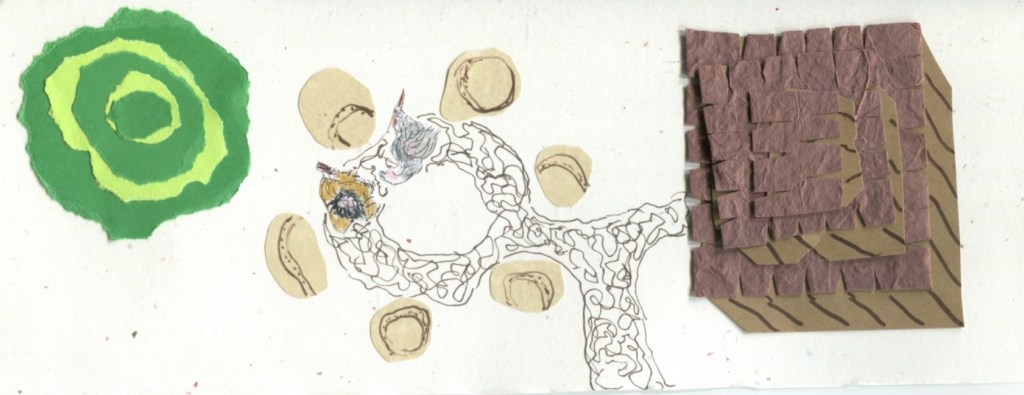
We still haven’t had to cross the river because here is a path laid low between the river and the bank to follow along until now we come to a crossing place with a fallen log as a bridge. Here, in this river lowland is a pagen temple made of planned wood boards. It is stacked up like a house on a house, with each little house higher and smaller, until the temple is a towering edifice reaching skyward. She leads me behind the structure where there are several of these rune stones, weighty enough to demand a circle of strong men just to put them in place. Yet each is as precisely set as the pillars of a Greek temple.
She places her walking stick aside on the ground before she enters; I follow her, laying my tree branch aside also. We enter the circle of stones which is clearly sacred. There is no starting place or most prominent stone but the seiðr goes immediately to a stone that is familiar to her. She moves her fingers over the markings in the way I’ve seen an abbot read a precious scripture freshly copied onto velum. Maybe the abbot was touching velum, imagining stone.
I know she isn’t reading this for the first time, but, as happens with any familiar touchstone, she is reading it through the fog of time, adding carved lines to the straight with all the memories of meaning in her own recollections of names and events. She brings to it her own voice in the years since the carving.
Does it clear the fog of time to have the stories of a god and a people detailed with the inks, or are lines cut into rock all that is needed to speak the forever stories?
(Continues tomorrow)
 Lazarus Ink