
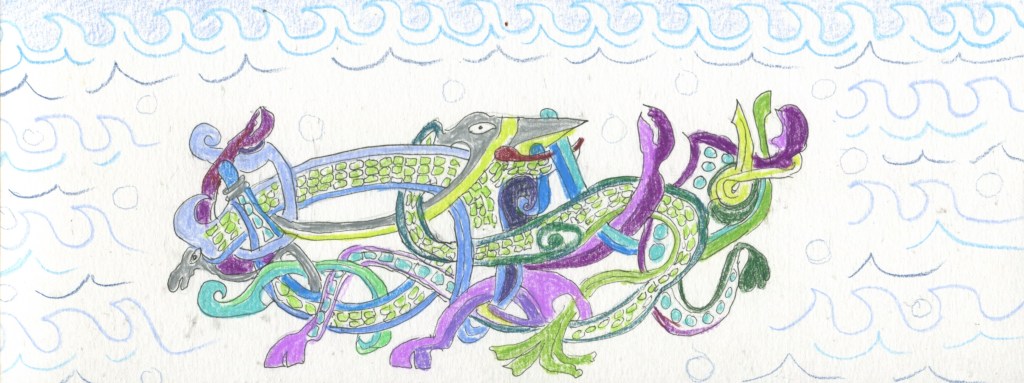
Historical Setting: 793 C.E. Skåne
Apparently, the god who is God agrees with the seiðr, that no matter how righteous my opinion may be, or how terrible the practice of sacrificing girl children is, addressing this evil must only be spoken with empathy. The difference between judgment and empathy sounds like nothing more than inflection in blaming; but it is a vast chasm between empathy and judgement in the consequences. I was given no holy words, only a reprimand for letting a moral rule stand in the way of my ability to sort through the personal pain of this to find the frail little ravel from the love thread.
My prayer is dismissed with silence. So, I argue more to God. “But, dear God, how can I bring empathy and caring when even she knows herself only by purpose and not as a beloved being?”
I know she’s heard rumors of Christians, and we are known for seeking sins and judging others. So, she made fun of her own human nature telling me she is “Eve” a motherless any-woman slotted by Christians as a sin source.
“You are nothing like Eve,” I tell her. “You had a mother who wanted her girl child to survive, placing a rock in your mouth for breath, rather than a suffocating cloth that could pretend to be a breast.”
“It is no rock, it is a precious jade pendant. It was probably all my mother had left from before she was captured.”
“So, your carved sea-monster pendant tells you that you were once someone’s beloved child?”
“I imagine my mother waited here, then the old wood carver, Auld Bjorn — The one you bring wood to — he was once a coxswain on a fine longship. That ship stopped here and gathered up an infant to carry across the sea and live in his house as young Marian does now.”
“But Marian wasn’t an abandoned infant. She was stolen, kidnapped from Gaul already knowing her own name and family traditions.” She told me this.
“And she isn’t a goddess or a seer either. And the old man doesn’t command a ship anymore. Things change. So, you can call me Sjókona, because I belong to the sea, and my spawn are the dragons, and monsters. That is how Sjókona is known.”
“Is that how you wish to be known? With your children magical and feared?”
“In truth, I have no children. If I had children, they would be immortal gods.” [footnote]
[footnote] sjókona — Old Norse word for meremaid. Call it a meremaid, merewuf, siren, or follow the wikipedea rabbit hole and find many more.
(Continues tomorrow)
 Lazarus Ink