
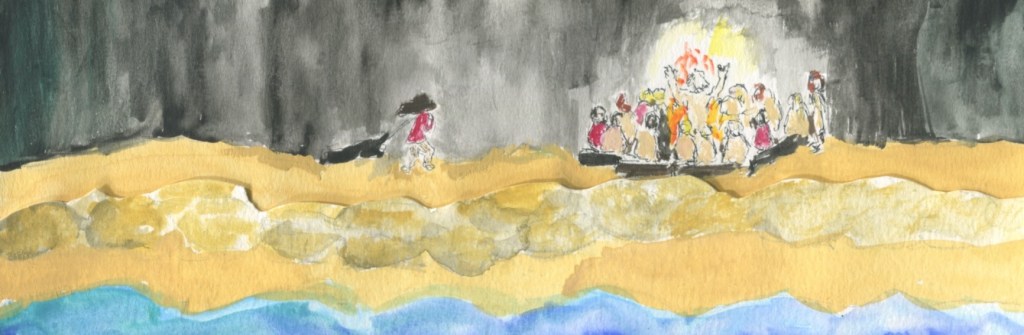
Historical Setting: 793 C.E. Moorings at Bergenshalvoyen
Content warning – for sexual implications as told in a campfire story.
Be careful what you ask for. Asking prayers bring the likelihood that God will turn the petition back on one’s own conscience. So, when asking for God to watch over the sick or the lonely the answer might be given by sending the one who asks to be the caring hands for the need.
When I walked away from Sjókona and left her alone in a house with no door to close behind me, with her longing for a child, it still weighs on my conscience. But my own grief then kept me from touching her. I prayed for her and the prayer was turned back on me. I told the sailors who would be passing by there that she was alone. Of course, they stopped there – a boat load of adventure seeking norsemen finding one woman, needy and starving.
And now, I dared to ask if she was returned safely to her homeland. The answer begins with a playful grin that pours into the story that tonight promises to entertain this lot of men gathered around the fire. It’s already being told all around.
This storyteller moves around the bonfire to address each cluster of men on the upwind side of the smoke.
“This thrall here who gathers the wood asked what became of Sjókona, mermaid, woman of the sea. He told one of those who has yet to return that she was alone on the rocks singing her sorrowful song, waiting for sailors to find her and fill her longing for a child with the seed of …!”
He is drowned out by loud guffaws and cheers– obscenities in colors befitting the display of lights in the northern night skies. He shouts for quiet so he can continue. This ritual is nothing sacred like a priestly call for psalm response and tender affirmations of “amens.”
The crowd turns deadly silent to hear what happens next.
“Now this wood gathering slave asks what’s become of her.”
Listeners’ imaginations elicit more whooping and shouting. Even my own imagination paints the story with lurid imagery. And for me, this telling touches the terrible pain of my own bad conscience. We all imagine Sjókona laid out on the rocks with her tunic turned back exposing her woman’s nakedness – a house with no door. This image taunts the story and haunts my conscience, leaving Sjókona so vulnerable.
The storyteller promises to tell us something more.
(Continues tomorrow)
 Lazarus Ink