
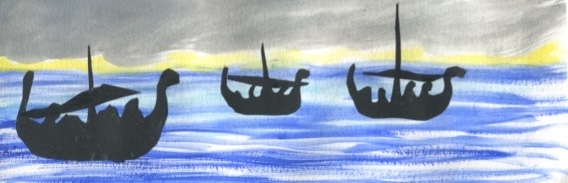
Historical Setting: 793 C.E. The far shore of the North Sea
Several days and nights of sailing and rowing – now swells of stubborn waves on a calming sea are breaking ahead of us and were it not nighttime, we might see the dark line on the far horizon is the foreshadowing of land.
“Drop the sails and secure the beam. Man the oars. Silence.”
Among the Norsemen, anticipation is building like a lidded pot on a blazing hearth, ready to boil over with the howls and cries of battle – but silence is ordered as we move swiftly and quietly, closer, ever closer to the shore. If a wandering monk were saying his matin prayers by the sea this morning he might notice shadows — shadows between the cresting waves — like logs floated onto shore from a distant storm-fallen forest. We are so many here, but even looking from one longship to the next, we are no more than deep darkness between the breaking waves. The shore waves are hitting us broadside now.
The first ship with the officers and slave masters has a wooden navigating wheel to capture sun shadows and so maintain our direction for navigation. [Footnote] Now, with the sighting of land confirmed we see the leaders of this fleet have, indeed, navigated well. We are clearly approaching a large island populated with the hovels of monks around a central building high on the land overlooking the sea. This is one of the Christian monasteries said to be on the islands off East Anglia. Closer now, we draw in the oars and drift with the shore-bound breakers. The warriors, still shirtless for rowing, gird themselves in chain-mail and weapons and pluck their shields from the hooks on the gunwales.
The thralls are given the signal and I find the water cold and nearly waist deep, though we are very close to the shore. We walk the boat onto the rocks in the wash of the waves. As the last boat is ashore, the raiders are screaming their terrors and running toward the little mounds where humble monks are probably just rising for their morning watch.
We thralls, holding the lines for the boats, now are making the sign of the cross with our shared Christian prayers, not for the Norsemen but for their victims so brutally awakened this morning. Probably all of us who are slaves were captured from Christian lands. And now we wait here on the edge of the sea.
[Footnote] Vikings used a predecessor to more modern navigational tools, a Norse Bearing-Dial A drawing of this is on page 193 of Gwyn Jones’s A History of the Vikings Rev. Ed. (Oxford University Press, 1984)
(Continues Tuesday, June 10)
 Lazarus Ink