
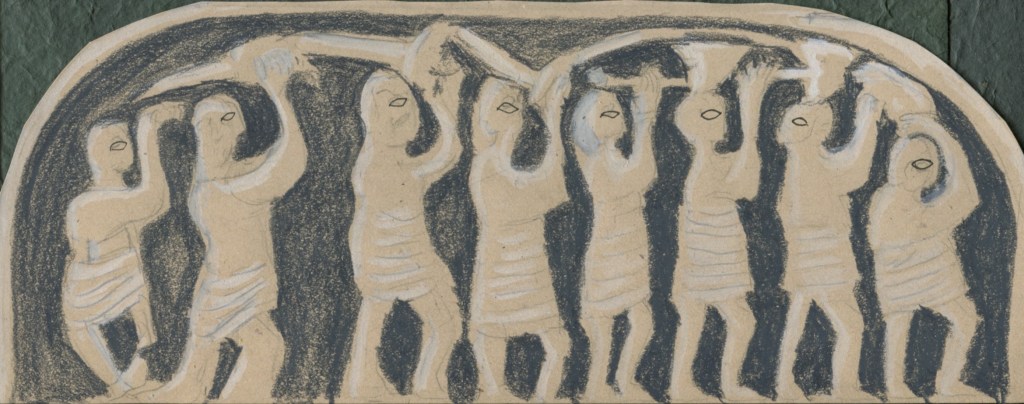
Art Note: This is a rough rendition of the military procession on the verso of the so called “Domesday stone,” now in the Lindisfarne museum. This blogger chose to draw it, rather than print out a copy, in order to gain a better personal understanding of the artwork .
Historical Setting: 793 C.E. Lindisfarne Monastery
This is our second day for assessing the horror. Brother Ealdwin splits off a piece of sandstone from a layered rock. With a chisel and a hammering rock, he is chipping a picture into the stele.
“Carving a stone honors those slain.”
On one side he’s marked his plan with a scratch of a rock. I ask if those men with weapons are the Vikings.
“No, Vikings weren’t that orderly. This army is the last earthly thing.”
Then he shows me the other side of his rock. In a lower section he is using runes to inscribe the names of those we buried here.
It’s a remembrance, but also, it is something for him to do with his hands to share his grief for ever and ever. It is a marker here, for any others who return searching. He says he has yet to carve the panel above the names. That will be the heaven side of earthly life.
He says, “If I were more skilled in the craft I would make a large cross for this garden of graves, and it would have deep pictures of these who are lost and would tell this story far better.”
“I think the story is told well just with the sorrow that is left here. And from what I’ve seen of runestones, this one is very fine.”
“A runestone maybe, but have you not seen the high crosses on the mainland?”
“No, I’ve not visited any Christian lands in these times. I was taken from Gaul by happenstance and landed among the Norsemen. I’ve only recently learned of runes when I was asking for books. And there I saw the Norsemen carving boarders in wood similar to the illuminations in the great books inked here and in the monasteries founded by Irish saints. I assumed Norse people had some kind of writing. But they are pagans there. So of course, there are no crosses but I also found no writing other than rune stones. Now I suppose writing on vellum is just a Christian thing.”
“I’m sure some of the Norsemen are Christian. They are known to come in numbers to trading cities and line up for baptism. Did you not meet all the Christians there?”
“I met no Christians except for one little girl who was a slave captured from a Christian land.”
Footnote: O-Sullivan, Deirdre, and Robert Young. Lindisfarne Holy Island. (London:B.T. bateford Ltd. English Heritage 1995.)
(Continues tomorrow)
 Lazarus Ink