
Historical Setting: 793 C.E. Past lives on the Loire
I know the teacher toiled over what to say to the bishop, distressed and grieving. I fear Alcuin failed to curb the tone of didactic instruction. Or maybe it isn’t a failure to subdue the instructor’s voice, but an intention to offer reprimand. That could be considered a fine quality in teaching in these post-Greek times without dialogue. Here, the instruction was for “correction,” maybe away from “gentleness,” he encourages them to “fight bravely.” And so much for the Jesus pacifism.
Then by addressing the material losses, lecturing the grieving churchmen over their victimization by stranger Pagans, Alcuin is giving them a means or a demand to change themselves, thus to control these circumstances going forward – blaming the victim kinds of instructions –similar to demanding a woman to wear unattractive clothing so not to appeal to the lusts of rapists.
“Do not glory in the vanity of dress; … Let your dinners be sober, not drunken. Let your clothes befit your station. Do not copy the men of the world in vanity for vain dress and useless adornment are a reproach to you before men and a sin before God. It is better to dress your immortal soul in good ways than to deck with fine clothes the body that soon rots in dust.” [Footnote 1]
This is the teacher’s response to what I had witnessed of the tragedy? I had seen the fine silks and dyed linens stolen from the naked martyrs of Lindisfarne — the clothing was heaped on the beach to be hauled off by Vikings for trade in distant markets.
The scholar continued, “Redemption is a man’s true riches. If we loved gold, we should send it to heaven to be kept there for us. We have what we love: let us love the eternal which will not perish. Let us love the true, not the transitory, riches. Let us win praise with God, not man. Let us do as the saints whom we praise. Let us follow in their footsteps on earth, to be worthy to share their glory in heaven.” [Footnote 2]
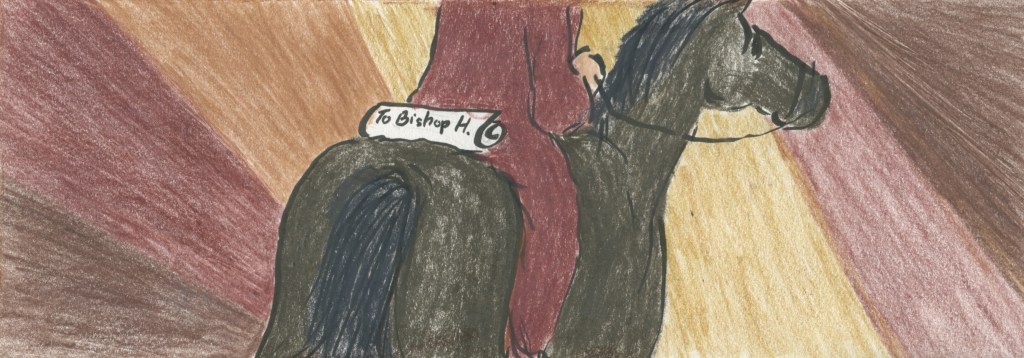
So today I ride away on the borrowed horse with the message of God’s love, also a chastising of the sins of monks. I know Alcuin searched the ancient church fathers for these answers. It follows the assumption that bad things happen because of the wrathful and punitive god, who loves abusively. That is a god that can be manipulated by human behavior.
[Footnote1] https://web.archive.org/web/20170506102223/https://classesv2.yale.edu/access/content/user/haw6/Vikings/higbald.html Retrieved 12-5-24 Source: Alcuin of York, Letter to Higbald, trans. by S. Allott, Alcuin of York (York, 1974). Reprinted in Paul Edward Dutton, Carolingian Civilization: A Reader (Ontario, 1993). Scanned and proofread by Eric C. Knibbs, 2006.
This text is part of Viking Sources in Translation. Unless otherwise indicated the specific electronic form of the document is copyright. Permission is granted for electronic copying, distribution in print form for educational purposes and personal use. If you do reduplicate the document, indicate the source. No permission is granted for commercial use.© 2006 Anders Winroth
[Footnote 2] Ibid.
(Continues tomorrow)
 Lazarus Ink