
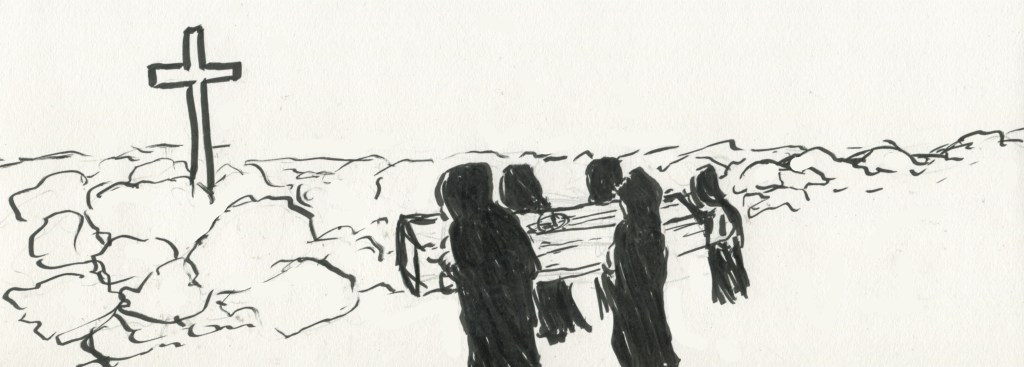
Historical Setting: 793 C.E. Lindisfarne
The patrons and politicians, monks and pilgrims all expect to hear the scholar proclaim God’s side in the issue of the burial of a sinner among the monks. Alcuin’s letter does address sins as personal displays of wealth and drunkenness, but he doesn’t really speak to that one big issue some believe was God’s purpose in dispatching Vikings. There was an expectation for hearing Alcuin’s authoritative blame for a holy curse on Lindisfarne. But it seems, Alcuin listens to a God who is all loving and takes no side in political disputes. And now a curse is not a curse without the authoritative pronouncement of it – the “aha, I told you so.” [Footnote]
The scholar doesn’t curse the whole of this place, he concludes, continuing only with individual responsibility.
“Encourage each other, saying, ‘Let us return to the Lord our God, for he is very forgiving and never deserts those who hope in him.’
And you, holy father, leader of God’s people, shepherd of a holy flock, physician of souls, light set on a candle-stick, be a model of all goodness to all who can see you, a herald of salvation to all who hear you. May your community be of exemplary character, to bring others to life, not to damnation. Let your dinners be sober, not drunken. Let your clothes befit your station. Do not copy the men of the world in vanity, for vain dress and useless adornment are a reproach to you before men and a sin before God. It is better to dress your immortal soul in good ways than to deck with fine clothes the body that soon rots in dust. Clothe and feed Christ in the poor, that so doing you may reign with Christ. Redemption is a man’s true riches. If we loved gold we should send it to heaven to be kept there for us. We have what we love: let us love the eternal which will not perish. Let us love the true, not the transitory, riches. Let us win praise with God, not man. Let us do as the saints whom we praise. Let us follow in their footsteps on earth, to be worthy to share their glory in heaven. May divine goodness keep you from all adversity and bring you, dear brothers, to the glory of the heavenly kingdom with your fathers. When our lord King Charles returns from defeating his enemies, by God’s mercy, …
Fare well, beloved in Christ, and be ever strengthened in well-doing.” [Footnote]
[footnote—source] Source: Alcuin of York, Letter to Higbald, trans. by S. Allott, Alcuin of York (York, 1974). Reprinted in Paul Edward Dutton, Carolingian Civilization: A Reader (Ontario, 1993). Scanned and proofread by Eric C. Knibbs, 2006.
This text is part of Viking Sources in Translation. Unless otherwise indicated the specific electronic form of the document is copyright. Permission is granted for electronic copying, distribution in print form for educational purposes and personal use. If you do reduplicate the document, indicate the source. No permission is granted for commercial use.
© 2006 Anders Winroth
[Ibid.]
(Continues tomorrow)
 Lazarus Ink
This is quiet and brave. Refusing to name a curse, Alcuin keeps faith with a God who heals rather than weaponises judgment, and returns blame to the only ground we can till: the self. The guidance is plain – sobriety, humility, charity – and it’s harder than spectacle. In an age hungry for pronouncements, choosing pastoral repair over political theatre feels like the truer courage. Holiness here is not thunder but steady light: tending the poor, trimming vanity, and walking back to mercy, together.
LikeLike
Well said. Thank you.
LikeLiked by 1 person