
Historical Setting: Monkwearmouth-Jarrow, 793 C.E.
Monkwearmouth-Jarrow is a double monastery with both monks and nuns under one abbot, living in separate communities but sharing in some things. It makes common use of books and inks and abbess, and sometimes church. St. Paul is on the River Tyne, and St. Peter, Monkwearmouth, on the Wear. It’s a good long walk from one to the other, crossing the river near the mouth on the sand at low tide. This pattern of a double-monastery was also known by the Irish missionary I remember from an earlier time. He is now called “Saint” Columbanus granted sainthood when he finally yielded the Celtic to the Benedictine Rule. I think God always knew him as a saint.
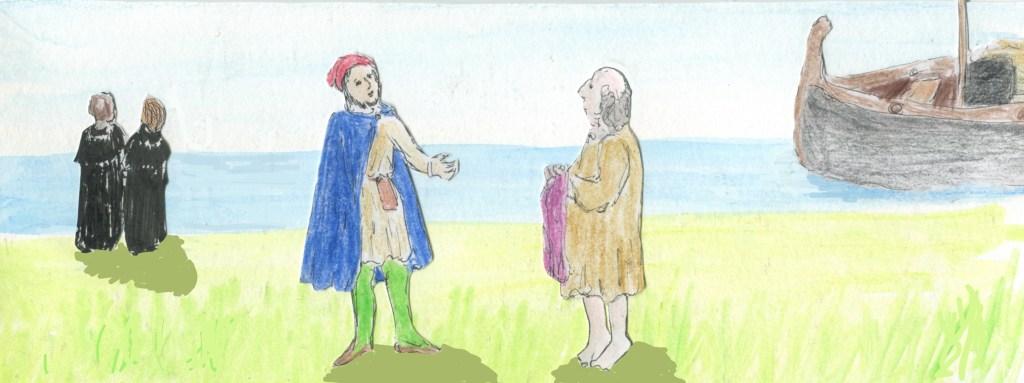
A young man who is a novice here at Jarrow is trading his commoner’s clothing for the black robe.
He says “I’m so glad the merchant finally came with robes and I won’t have to appear prideful walking among the monks in these common clothes.”
Apparently, these long, black, skillfully sewn, robes of finely spun wool are “less prideful” than the loosely home-spun wool of a farmer’s tunic and rag bands for leggings.
All day the merchant Cloothar makes trades, starting with only the black robes which I recognize as the booty rejected by the raiders of Lindisfarne. He trades with novices for common clothing and he always trades up, for better and better items.
By the end of the day my own trade of the borrowed black robe provides me with a very “prideful” wardrobe: a linen tunic, leggings, a sash and shoes sewn in the new way, pointed at the toe, a brightly dyed hat, a traveler’s bag, and a fine wool cloak in a costly shade of blue.
Cloothar uses a coin for a room at an inn which he shares with me, in payment for helping with the rowing and the market. The innkeeper allows me the use of a vat of lye-water to launder my “new” garments. I spread everything out on the bushes to dry, but, as Cloothar warned, I’ll be wearing them damp all day tomorrow.
Dressed as I am now, I could be mistaken for a young scholar, a rising son of a newly wealthy commoner – prideful indeed.
In times of plague and wars, raids and thefts, material goods survive the first owners, and the heaps of these leftovers of lives become commodity. The humility of a monk’s robe fetches the highest price because having too much good stuff makes an odd paradox of wealth.
(Continues tomorrow)
 Lazarus Ink