
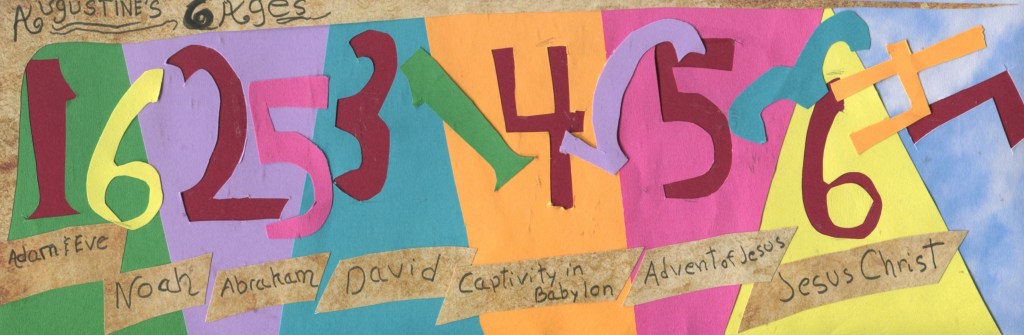
Historical Setting: Jarrow, 793 C.E.
I stand before the book stand that holds Bede’s ecclesiastical history, considering eschatology or thoughts of end times as a circle. History tries to be linear with a beginning and an end, a head and a tail, as a line, with only an untapped option to circle for eternity, biting its own tail.
Notions of end times are, by the mortal nature of living beings, always just guesses. Whether creative guessing or hypothetical calculation with the guesswork in the premise, the imaginary begs for validation in reality. Prophets of end times can never say, “see I was right after-all” because if end times are an end, there is no after-all. There is no need for fact, only for followers of the prognosticators. [Footnote 1]
This becomes significant for Bede and his writings because he had to answer to a critic, Plegwin, accusing him of the heresy of putting Christ in the end times, and not in the linear now, in the argued calculation for “the sixth age” (which is the now). To Bede, historian who looks to papal decree for the facts of calculating epochs of history, his critic’s accusation of the heresy of getting Christ in the wrong epoch must have been devastating. That’s what happened. He answered the accusation of heresy with a letter. [Footnote 2]
Heresy, or unfounded here-say, would be a horrific charge for anyone who names every opinion as either righteous or flawed depending on its source. If a pope said it, it is infallible. If it was spoken by a monk with an Irish haircut, it can’t be trusted. How then, does Bede hear God speaking? And how is he a trusted authority on God’s truth?
The old man who once sat with Bede at his death comes back now to further guide my understanding of his mentor. I thought Wilbert’s intentions were to instruct me on the proper reading of the Venerable Bede, but actually, he wants someone to be an interested visitor who will listen to his own reminiscences of his saint. Maybe he doesn’t even mean to pester me by defending the writings.
Wilbert says, “Bede’s teacher was Abbot Ceolfrith. This first abbot at the founding of Jarrow was Bede’s guardian and teacher from childhood, on through this crisis over an accusation of heresy. In Bede’s commentary on I Samuel he references the departure of Ceolfrith, considering his own first childhood teachers.”
[Footnote 1:] https://en.wikipedia.org/wiki/Six_Ages_of_the_World
Retrieved: 5-8-25
[Footnote2:] https://blogs.bl.uk/digitisedmanuscripts/2018/05/the-real-venerable-bede.html “The accuser claimed that in Bede’s Chronica Minora, he denied that Christ had lived in the sixth age of the word, as was commonly believed. Instead, Bede argued that Christ had lived in the seventh age. In the letter to Plegwin, Bede wrote: ‘If I had denied that Christ had come, how could I be a priest in Christ’s Church?’ (translated by F. Wallis, Bede: The Reckoning of Time, p. 405).”
Retrieved 2-20-25
(Continues Tuesday, November 18)
 Lazarus Ink
Julie, it is no coincidence that you, like me, have reached an age that we are thinking about “end times.” I realized suddenly this year that I have done pretty much all I will ever do of much importance except take care of my physically disabled husband and his needs. I am glad you are still sharing your wonderful and thought-provoking ideas about Lazarus’s possible lives with all of us.
LikeLiked by 1 person
Thanks Sandy, older and wiser you will always be. And as a caregiver you are a saint, in my opinion. But considering end times, the promise is we will never know. And in the bliss of not knowing, I still keep right on writing, and now seek a publisher for my novel, and I imagine music still keeps right on coming to you anew, with all your many gifts and wonders.
LikeLike