
Historical Setting: Jarrow, 793 C.E.
The King’s man, Ousbert, is also a lay visitor at Jarrow in the aftermath of the raid on Lindisfarne. Our purposes here are very different. I’m just looking for a history, but he’s looking for the vulnerabilities of coastal monasteries to make his recommendations to the king going forward. It’s a very different perspective, seeing a community as a long heritage of saints, or observing it as a future target for greedy marauders. Weren’t both views shaken by Viking attacks?
At Lindisfarne the Viking raid was blamed on lots of things, but none of the blame seemed to land on the Vikings. One side was groping for the weaknesses in the Irish heritage of that community. Those who wanted to rankle the wrong in the Irish way couldn’t really blame the scheduling of Easter or a different tonsure, but they did find one little distinction between the Irish and the Roman that laid the blame for destruction squarely on the Celtic root. That was the first Church building not made of Roman stone, but it was made of oak and thatch. The Romish fix was apparently covering it with sheets of lead. Footnote But raiders were still able to sack the treasures from it before it was burned to the ground. The newer Romanesque stone construction, still stood, but the raid turned the lead a molten ooze over the bed of ashes.
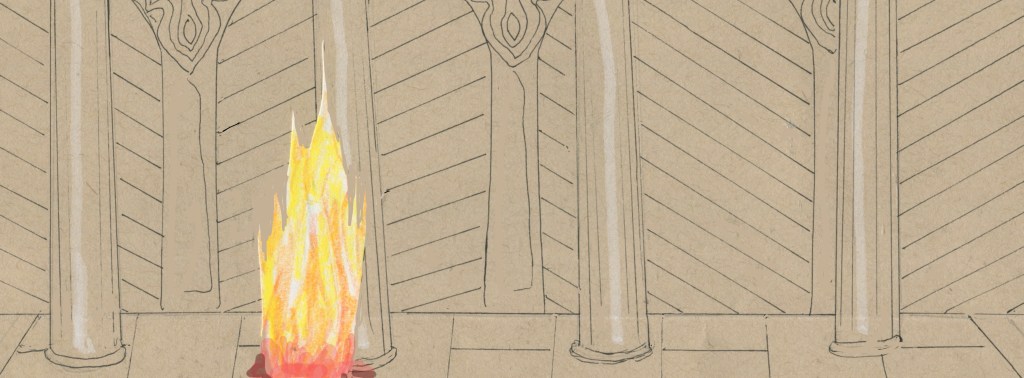
Jarrow already has stone buildings, but here in the forests, unlike in Rome, there is an inherent appreciation for wood. So, despite the Roman exteriors, these interiors — the pillars and arches and rafters are tooled by local artisans in the warm, wooden ways of the Angles and the Saxons. And it should be considered that wood burns the same whether it is Irish, or English or Roman. The same wood that echoes our conversation just now and makes a simple monk’s choir into magnificent music, is flammable.
I mention this nature of wood to Ousbert but he ignores my concern. He has no wish to take this worry to the king, since the use of interior woods isn’t just in monasteries. It is in the castles as well.
It is terrifying to imagine that Vikings could raid anything coastal and the notion that Vikings could raid establishments even beyond the holy places, is something no one wants to consider. In fact, until there was that written letter to Alcuin no one even acknowledged those coastal raids already happening.
Footnote: https://en.wikipedia.org/wiki/Anglo-Saxon_architecture retrieved June 4, 2025.
(Continues Tuesday, December 16)
 Lazarus Ink
From what I have read, there was a great deal of sympathy extended by Christendom to those who were victimized by the Vikings in Ireland and elsewhere. I would be interested to know the source of your information that the Irish were “blamed” for their plight.
LikeLiked by 1 person
Of course the Irish and the English and all the coastal people rightly blame the Vikings for the Viking Raids. But this series of posts is talking about the scholar Alcuin’s letter to the bishop of Lindisfarne (Lindisfarne was first established in the Celtic order) which is the first documented attack of Vikings on coastal Britain. It becomes a matter of “blaming the victim” which is a way of empowering the victim to prevent attacks because, Alcuin pronounces the sins of Lindisfarne as the cause.
LikeLiked by 1 person
Sadly, Christians are not above errors such as this. We are all human, and all fallible. You show great discernment in recognizing the error, even if Alcuin did not.
Christ, Himself, said that sometimes a tower just falls (Luke 13: 4-5). Suffering is not necessarily a sign of sinfulness. Witness Job. It is though a reminder of the need for all of us to repent.
LikeLiked by 1 person