
Historical Setting: Jarrow, 793 C.E.
Librarian Wilbert and probably others too, found the night’s noise from the special “guests” annoying.
“This is a sacred season. It is the Christ’s birth, and there those fellows are bearing down on us with all that Pagan noise. They might as well be Vikings for all the disruption.”
He has no real idea of the tragedy of Vikings taking actual lives of people for no better cause than personal greed. These watchmen are assigned to keep guard on the vulnerable. They dress as monks to “fit in” here, but armed as they are with swords under their robes the silhouettes they cast would make them seem very hefty monks.
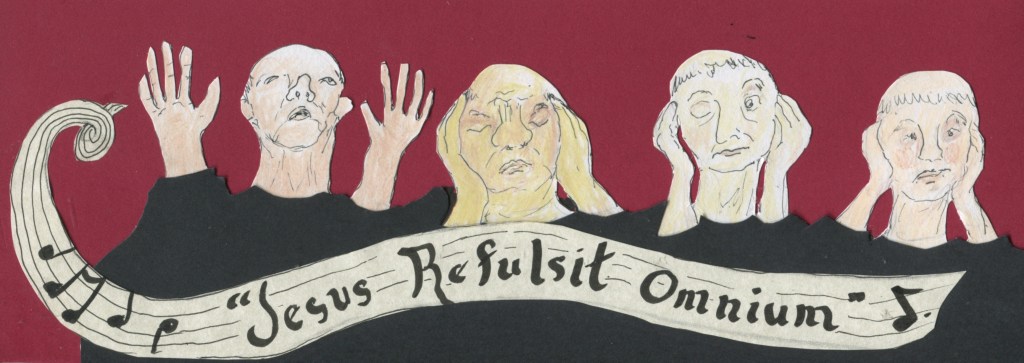
“Brother Wilbert, I have to say, I rather enjoyed the irony in their choice of song, all the while they are keeping constant vigil for foreign invaders they are singing Latin songs of Jesus welcoming all nations.”
“They are uneducated Angli. They have no idea of the Church Latin they were singing.”
“It is seasonal.”
“The season sings of the Holy Mother and the infant.”
Now he lifts his old bones from the stool at the welcome table, and waddles his way to the Bede materials to find the place where the historian wrote of this.
“The Angli [English] begin the year on 25th December when we celebrate the birth of the Lord; and that very night which we hold so sacred, they called in their tongue ‘Modranecht’. That is ‘mother’s night’.” [Footnote 1]
It was Pope Gregory I who took on the gospel call to spread Christianity to all the corners of the earth. He sent Augustine and his band of missionaries to this place to Christianize the heathens. And the missionary did his work giving gospel names to the gods and goddesses who were already here, rather than capturing people to Christianity by violence. We call Gregory “great” now, and it seems, the Roman Christian way of greatness is the imperialistic part of Christianity because it is said that in the spreading of Christianity, greatness is achieved. [Footnote 2]
After this day with my mind cluttered with the bookish history of a joyful season, I’m leaving for vespers. And here is Wilbert still at his station.
“Brother Wilbert, I have a better notion now for the drinking song I will teach my neighbors.”
“As though they need any new songs.”
“I happen to know some very fine carols of Francia that have as many verses from the gospel, as Luke has verses in the Shepherd’s story.”
[Footnote 1] https://www.whychristmas.com/customs/uk-christmas-history#early
Retrived 3-30-25
[Footnote 2] St Augustine of Canterbury was the person who probably started the widespread celebration of Christmas in large parts of England. The first recorded date of Christmas in England was when Augustine baptised 10,000 Saxons in Kent on Christmas day 597. (There was some earlier Christianity in England before the fall of the Roman Empire, but there’s no records of the birth of Jesus being celebrated. After the Romans left, other Celtic parts of Britain knew about Christianity but again there aren’t many documents about if or how they celebrated the birth of Jesus.)
(Continues Tuesday, December 23)
 Lazarus Ink