
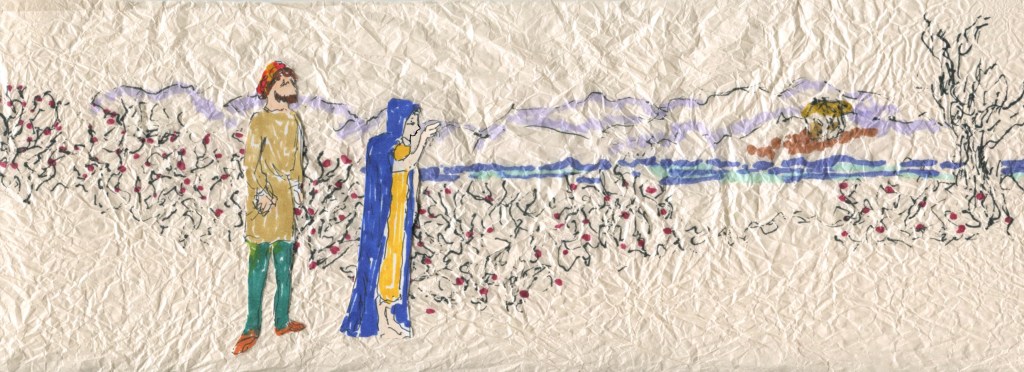
Historical Setting: Monkwearmouth, 794 C.E.
The relentless intensity of grief that owns this mother’s spirit allows a breath for my mundane questions about the circumstances of her life. I am trying to understand her options.
She says, “Everything is made of words. In a castle even the words are rich. For the castle man “stinky garbage” is “discarded” or “dismissed. But when the Mister took the baby from me, he said I was “dismissed.”
She knows lots of words for garbage and for death, and she even knows the euphemisms.
She says, “The castle word is ‘deceased. But the baby is still the same dead.”
Grief takes this moment for humor — dark and messy — momentary, oddly displaced laughter is couched in grim. Then in this meandering silence the emptiness continues. I grope for reprieve, a change of subject.
“Where is this castle?”
“It’s on the other side of the river up high from the pauper’s woods.”
“I’m staying on the other side, at the Monastery and I’ve taken walks from there in the evenings. I’ve seen lots of woodlands, and on the hill behind to the woods is only a little village. I thought only a few houses are there.”
“Come, I’ll show you.”
We walk along the river looking across at the same river bank I’ve often walked. She points to a little stand of trees she calls the “paupers’ woods,” she chooses to creep along behind the sparse foliage on this side, to stay hidden from the paupers she knows, but I see no one over there. Then on the rise near the clearing is a small cluster of houses I called a village.
“See there, overseeing the village is the castle. The Mister might see me here.”
We are much too far away for anyone to distinguish individuals over here. Yet, this girl insists we stay hidden as though anyone over there would see her. She whispers imagining they could hear us all the way over here.
“That is his horse, tied there by the castle, so I know he is there.”
Now I see, her word for a house with a roof is “castle.” And very likely, seeing the lay of the village, the cruel man who owns a horse and rules from the castle and speaks in inflated words is probably only the village ealdorman — the one assigned the authority to collect the fees and dominate the lives of these poor in the name of the king.
(Continues Tuesday, January 20, 2026)
 Lazarus Ink