
Historical Setting: Jarrow, 794 C.E.
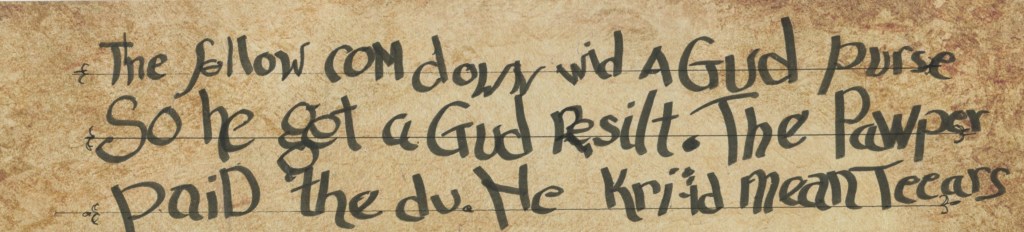
I make my way through the scribbles of an untrained, barely literate scribe, in order to read these cases and judgements brought before the Jarrow ealdorman. The log book is page after page of squabbles over sparse material things. Who owns the fishnet woven with stolen string? Is it the poacher or the land owner who is entitled to the rabbit?
The judgement made by this king’s appointee is always won by whoever gives this ealdorman a coin, or a fish, or the skin of the rabbit in question. Therefore, the judgment always goes against the poor and his descriptive words for the poor and needy are also a euphemistic degradation. He has names for those who can’t pay for his favorable judgement: “paupers,” “urchins” and “leeches.” The use of judgmental euphemism made this house a “castle,” and it tells how he continually brought suffering down on the poorest of these people.
Ousbert says, “Did you notice the lock on the door to the bed chamber?”
“‘Tis odd to lock a bed chamber. He must have had nightmares of angry villagers coming to get their revenge in the night.”
“But the lock is on the outside of the chamber — it is where he kept the girl who birthed the infant. The box where he apparently kept the infant was a simple crate — with no blanket or toy. We found it pushed under the bed.”
“Did he have a good excuse for all this?”
“When confronted he had nothing to say. He just stood there in the chains I ordered for him, and watched us gather up the evidence. I have plenty of evidence to hand to the lawyers to support the girl’s story.”
“Did he seem embarrassed or ashamed of the things you found?”
“He had no remorse, only blame. He said, ‘the kept girl stole the life of his legacy. The baby died soon after he dismissed her because she had ‘put a curse on it.’ He wanted the King to put her in chains. Even though she wasn’t there to speak for herself it was obvious it all happened as she had told you, and that the baby died because he had no idea of how to care for an infant.”
I answer, “It was one terrible thing to hear her story, and another, to know that was how it was.”
(Continues Tuesday, March 10, 2026)
 Lazarus Ink