
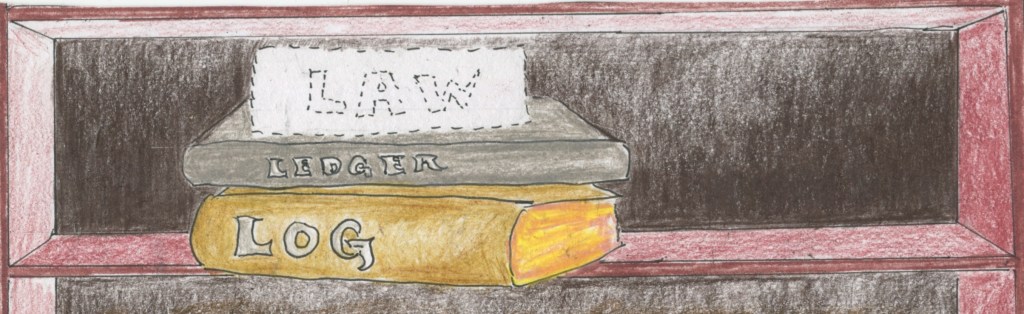
Historical Setting: Jarrow, 794 C.E.
Ousbert wonders why a temporary ealdorman, whose task is to settle minor disputes and send everyone’s taxes on to the king, should want to find a dusty old book of laws?
He asks, “Why a book, when we have a God appointed king?”
“How will I know what is considered fair? Take the case in the log book where two villagers were seeking a fair settlement over using the King’s road for a livestock path– how can I know the king’s mind on that without any record of the King’s law?”
“The king’s righteousness derives from his divine power to access God’s righteousness.”
“I would think it should be God’s rule first, then the King’s interpretation of it. But even that seems random and fickle when it is this earthbound human, who I am, trying to discern righteousness.”
“And you think that if the king wrote a book, and if every ealdorman over-seeing every little forest and village had a monk’s copy of this book, that would make a difference to how you fill the ealdorman’s place here?”
“I was thinking a book of King’s laws would be usual here. I was reading in Bede’s The Eccleasiastical History of the English People that already two hundred years ago, king, Æthelberht, who ruled over Kent, at the cusp of English Christianity, wrote down a Code of Laws so in his new holy rule he would follow the Roman way. [Footnote] I guess I assumed that every king thereafter would provide a written law for the subjects to know and follow.”
I can see this request is nonsensical and exasperating to my friend.
“And you think a two-hundred-year-old notion is useful in these new times?”
“I guess I was expecting something I knew of history to be a grounding for these times, so that when one thing is useful we could build from that and we would always be bettering ourselves, from one generation to the next.”
This soldier argues, “We better ourselves across generations because Kings are chosen by God, they are winners in wars, so they are always stronger and bolder than the last, so kings are always better than before.”
That is exactly as I had feared. Here in this raw nature, humankind believes human advancement can be made through warfare. But if people don’t use books or runes, or works of art, inspired, to carry forward the advances made from one generation to the next, the goodness of old isn’t a foundation for betterment in the new. We simply relive old hates through wars.
[Footnote] Bede, The Eccleasiastical History of the Englis People, New York: Oxford Classics, pp 78
(Continues tomorrow)
 Lazarus Ink