
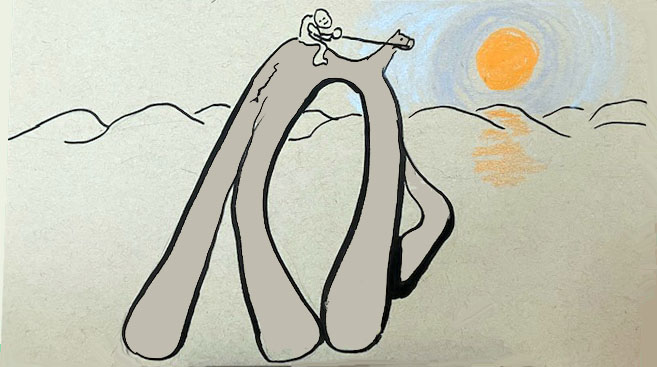
Historical setting: 602 C.E. A cottage in the Vosges
I’ve learned from Greg how the Bishop of Metz has, in a way, honored my request that my son be allowed to choose pacifism. Though Greg would be a soldier, his mission could be the Jesus peace. I would’ve said the “Christian” peace, since Jesus is known only as the humanity, my friend, while the all-encompassing Trinity personage, I would call Christ, seems to have been forged into a new metal by the warring culture that we are. The plowshares are hammered into the swords as armies are named “Christian.”
Ana suggests the boys just stay with us here, because “your Papa can teach you the Greek language of the Christians in the east. He knew the spoken languages of the Persians living in the regions where Jews and Christians fled after the Temple in Jerusalem was raided and smoldered by the Roman soldiers.”
Greg objects, “No Momma, Gaillard doesn’t know about Papa.”
Gaillard stares at me with a curiosity tinged in awe.
I can explain myself. “I used to know an old Roman soldier, we often talked of the history of faraway places.”
Ana gets the hint to speak no more of my strange circumstance. “Oh, yes” She agrees, “Old Nic was a soldier before he joined the brothers at Legugè.”
“I do remember things of languages in far places. And the monasteries keep links between the Greek and the Roman vernacular so that the churches in the east and the churches in the west can keep the same doctrine. [Footnote] Surely your uncle who is the teacher at Luxeuil, or maybe the Bishop of Metz would also know of this. Your uncle may even have the scribe’s copies of these language guides the church officials use to bind the east to the west. I have some knowledge, but wouldn’t it be better to learn, first, what is already known and used by the churches?”
“But Papa, what use would it be for us to learn the varieties of languages if we have no one to speak them with. I think we need to actually go to the places in the east. We will use the fast horses from the stables of the Waldalenus. The dux says he will send us when Gaillard is fully literate in our own vernacular.”
Gaillard adds, “…and when Greg reaches his full stature because we may need to ride on camels and they say camels are quite large.”
[Footnote] Herrin, Judith, Byzantium: The surprising life of a medieval empire. (2007) Penguin, Random House UK. pp 22-23.
(Continues tomorrow)
 Lazarus Ink