
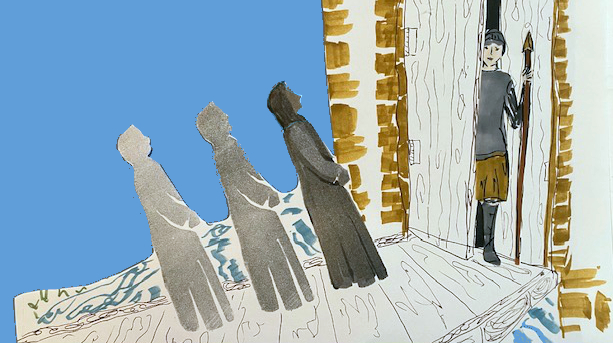
Historical Setting, 610 C.E. Besançon Fortress
We’re starting the plan to go into the dungeon to set free Father Columbanus and other prisoners. We assume the soldiers at the north gate expect a “Brother Ezra” to arrive as the Father called for at his capture.
In time, this story of rescue may be attributed to a legend with a saint’s name.[Footnote] Maybe that’s how tradition gives history students fewer names to remember. Of course, God knows all people and notices each sparrow and every other little breathing bit of creation. So none of these details of fact are lost to God.
Plodding on alone toward the fortress, I’m pondering. Maybe rote legend is why so many kings had the same baptism story, and why only apostles write gospels. Except maybe not so much the gospel writer of Luke, who also wrote Acts and was said to be a follower of Paul who did claim apostleship though he wasn’t a disciple. And that accounts for my own thoughts of Jesus becoming skewed by popular opinion in Luke’s tales. I still blame Luke for starting the rumor that my sister was a prostitute. But I digress.
So maybe Matthew, Mark and John are really just names that were attributed to the works honoring those apostles. They were named after named apostles, in the same way Ana and I named Gabriel after the angel and Gregory after some Gregory. I know John was named for John the Baptist. And a mysterious secret I have no proof of is that the ‘beloved disciple’ who claimed the authorship of John was an enamored teenager and follower of John the Baptist.*
Now, here I am approaching those foreboding walls of Besançon. This fortress is in the center of an oxbow on the river Daub. The hills rise into the mountains to the east and I’m walking the path toward the wrinkle in the river that serves as a moat on three sides of the fortress. Over on the south-east, the land-side, is a slope of pasture land where we plan to deliver the Father to the wagon we brought for the escape.
“Are you Brother Ezra, follower of Father Columbanus?”
The guards glance passed me for the army I don’t have, and now seem pleased to see only me, alone, and not those thousand armed and vengeful men. But maybe they assume there is only one Brother Ezra.
I answer, “I’ve come to pray with your prisoner, Father Columbanus.”
[Footnote] Jonas, the best-known hagiographer of Father Columbanus, wrote nearly a century after Columbanus lived, and Jonas tells this story of the prison break at Besançon. (Munro, Dana, ed., Translations and Reprints from…Life of St. Columban Sections 34 with ref. to 16) Jonas names the helper in the escape as the “little boy, Domocalis” who also served Columbanus in his wilderness quietudes. This blogger of fiction uses different characters for this rescue, and replaced that child named with Brother Servant in most other places in this blog, because our modern perspective takes issue with a priest using a child as a personal servant. Maybe we are better people in these times, or maybe we simply hide different sins?
*It’s only a theory, picked up and used in this fiction. At this time it doesn’t reflect credible scholarship, but maybe someday more definitive information will be available about some of the parts of John.
(Continues tomorrow)
 Lazarus Ink