
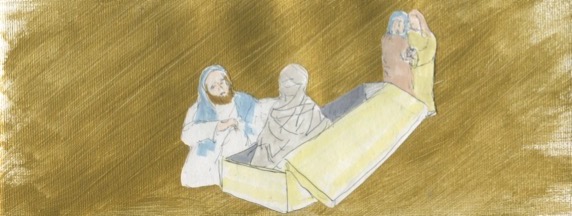
Historical Setting, 626 C.E. The farm in the Vosges
I ask Brandell, “Why would you think I would be angry with you?”
“The Church authority said my little silly rhyme is against the Doctrine of the Church because it speaks favorably of Jews. And right now, there is a King’s ban on Jews. [Footnote] But also, he said that you would be angry that the song encourages the Lazarus rumor. He said you didn’t want that rumor circulating about the friend of Jesus, Lazarus, who is said to be living among us in Gaul.”
I ask, “The Church said it is I who don’t want the Lazarus story known?”
“He said you accidentally got caught up in the rumor, and you really want to be known as Ezra, as they call you at Luxeuil. So my little song was encouraging common people to continue to spread those rumors about a Lazarus living in Gaul.”
“Well, I’ve never tried to stop the story from spreading. I know with so many political things affecting the rules of the Church, now the people who speak for the Church don’t have easy answers. But I didn’t think they intended to stop people from knowing truths.”
Apparently, Brandell’s song was criticized, not only because it mentions the Jewish root of Christianity, which is now against Christian they say, but because, to some of the local Church brothers it seems to imply an acceptance of my own strange circumstance life and life again, and particularly that I was a friend to Jesus. I realize it’s hard for a monastery to know what to do with me, but to use it as a wedge between my son and I, is just wrong.
We are home again now.
“Papa, he said that the Church authorities are grateful you don’t support the idea that you are that Lazarus. He said were there really a Lazarus come back into this life, he would never, ever, be a common farmer. He would be a saint and he would spend all his time making miracles happen.”
Ana laughs, and I have to laugh. Surely Brandell sees the humor in that too. But he isn’t even smiling.
Where’s his sense of humor? We depend on him to have that cleaver clarity that tells a truth and at the same time sets us all laughing. Now here he is, his harp silent, sitting at the uneaten supper left on the table, hardly touching anything.
Ana tells him, “At least have some soup.”
[Footnote] “Dagobert decreed, about 629, that the Jews who were not converted to Christianity by a certain date should either leave his dominions or be put to death. Many changed their faith at that time, while large numbers were slain by the sword,” says the Jewish historian (“‘Emeḳ ha-Bakah,” p. 8).” https://www.jewishencyclopedia.com/articles/4848-dagobert, retrieved 10-8-2023, this article by Richard Gottheil and Meyer Kavserling continues to debate the reason for this decree.
(Continues tomorrow)
 Lazarus Ink