
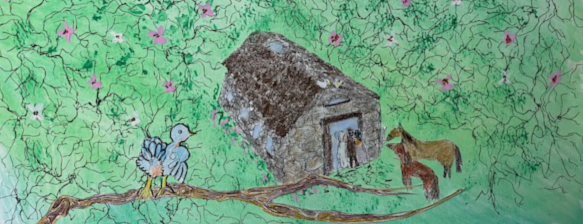
Historical Setting, 629 C.E. Vosges Mts.
I’ve shared my concern about Layla with her sister Hannah, who is a medical practitioner.
Hannah offers, “Papa, this is what I will do. I’ll take the donkey cart and the medical kit and go there to those new barely patches around the walls of aristocracy where the serfs farm. And just like any worthy practitioner of medicine I will call on a woman who is with child. I will listen to her belly for the thump of life and I will brew her a tea for the morning sickness. Of course, my visit can’t be seen as a spying mission on her husband. But if I should notice anything amiss, I will remind her that her own family is always a safe haven.”
“Thank you, Hannah. That’s all we can do now.”
So, with the marriage of our youngest our greatest worry, our second youngest, the poet and artist, is quite the opposite. He’s just returned from a perilous journey to help rescue a Jewish tribe from persecution and now he is here with a new talent and a wonderful partner, Gaia.
Gaia and Brandell are, right now, making plans with Mater Doe at the secular church to speak their marriage vows to one another up there. Having a Mater for a Pater doesn’t worry Gaia at all. This deaf priest and she enjoy talking long and loud of their common homeland. Brandell is hoping Mater Doe will give permission to cut a wider clearing in the wood behind the church to make room for lots of people dancing and feasting.
I suggested some other options for gathering, the pilgrim’s portico at Luxeuil, or the village green of Metz, but the wood behind the little secular church is not exclusive for anyone. And they are inviting the vintners, both Christian and Jewish together.
Maybe it’s a sign we are in more settled times when the bigger feast for all the neighbors is for the wedding, and not a vigil for the dead. Another hope for peace is that the Merovingian line has yielded a king with power over the lesser nobility and land owners, promising some uniformity of rule. Though King Dagobert, who now rules all these Frankish lands, still only listens to the Christian nobility, always aching for battle. We may yet be begging for a different constant. Whenever a land is ruled by self-centered wealth, as rich as it may seem, it is never peaceful and the poor suffer first.
(Continues Tuesday, April 9)

