
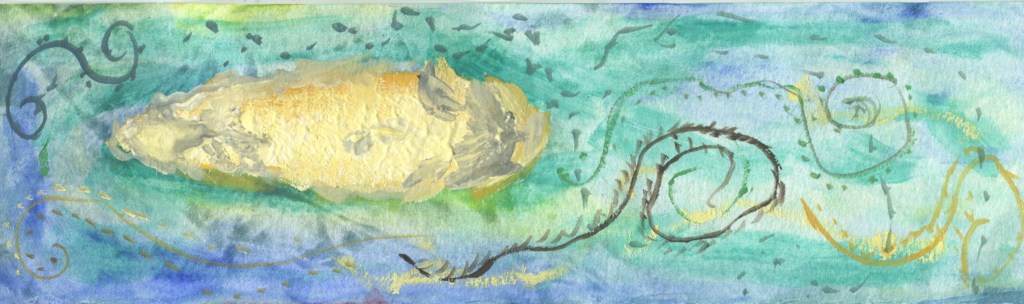
Historical Setting, 629 C.E. Creek House in the Vosges Mts.
We were talking about the nature of life and that the one thing that defines life is the constancy of change. Growing, coming and going, keeping and letting go, these are all things of change. Life is never stagnant. In fact, the opposite of life is stagnant.
So, Ana sends me off to take the grandchildren to the creek to dig for clay. That’s what set me thinking about the nature of stagnant things. I came along with them to guide them away from the stagnant pool that was trapped to stillness at the water’s edge. We saw the white belly of a dead fish in the muck and I told the children to stay away from “that stagnant water.”
“What is stagnant?” asks five-year-old, Sam.
“It means water that doesn’t flow so it isn’t moving, or living, or changing.”
“And it stinks” says the oldest, Ann.
Now that sets me to wonder, is the stink the death part of the stillness, or the life part?
I told little Sam to stay away from that stinking water and now he has a stick in his hand and he is dipping the stick into the slimy muck of it. My adult nature is scolding, while seeing from a child’s perspective the clump of algae just under the surface is green and living. Poking it with a stick exposes life within the stillness.
Try as I might to distinguish the stagnation from the flow, stench from fragrance, death from life, it is always that living edge of death that is the most fearsome. Psalm 23 takes us to this edge, “Lead me by still waters,”
So, the children and I dig for the cold and smooth, sticky clay. Everyone gets a turn to dig.
When we return to the cottage with dirty children and our pail of clay they want to start immediately making treasures to stay forever on Ana’s shelf of precious things. But Ana says they must wait for another day, because the good clay has to settle out in stillness.
“No! It will be dead, then” argues Sam.
Ana looks at me wondering what this the child knows of death.
“We were talking about the water that doesn’t move being stagnant, and we considered the death of a fish.”
“Oh.”
(Continues tomorrow)
 Lazarus Ink