
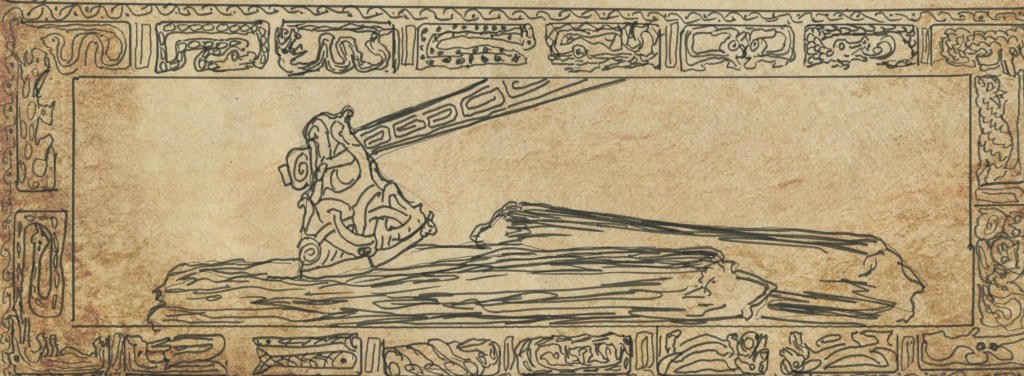
Historical Setting: 789 C.E. Jutland
The mystery that pricks my imagination just now is the work of the smiðr. I watch him work for a few minutes here, thinking of purpose for his art and I see how this is so much like the work of Celtic monks illuminating the sacred Christian texts.
And here, these carvings of snakes and dragons slither over every civilized thing in this house, the carved bench, the walking stick, the fire poker, everything, like fang marks left in the hide of the wolves’ prey, this decoration lays claim to every possession. Maybe these ribbons of monsters own all of humanity in this untamed land. They say “All things decorated here!”
Or maybe the purpose of the art is not just to make the human claim, but maybe it is to please a pantheon of otherwise oblivious gods? Or maybe it is a game, a competition among smiðrs for the finest carving — the deepest cuts and the most flawless curves. Maybe it is done for all of these reasons.
I’ve felt this intense focus on repetitious detail before. As a monk in a more ancient time, I, myself, sat in silence with so many others like me, capturing the daylight on our stands in a scriptorium, in order to copy manuscripts precisely. We intended our work to pass the abbot’s human inspection, yet our spoken purpose was that we were working to glorify God. Didn’t we all say that even when we cared most that we glorify ourselves in the abbot’s assessment, or maybe glorify our own standard of perfection.
But there is one deep and hidden reason for such intense work that I know well also and surely the smiðr is aware. It is never spoken. But art serves that moment of deepest devotion when the redundant task busies our hands or feet or voices so Spirit finds us in timelessness. This is the traveler on the labyrinth. It is the repetition of the prayer words in the rabbi’s ritual. It is the stopping of time where Spirit finds spirit, and only a oneness with God exists.
Of course, this pagan smiðr, whose gods have names and powers, probably doesn’t expect to discover a holy oneness with Spirit, or does he?
Maybe we all experience the mystical moment in the same way, and only our names for God and Spirit and Holy differ. It is even possible to live outside of the one Spirit of Creator love, while only some prideful taboo or numbness keeps us from acknowledging it.
(Continues tomorrow)
 Lazarus Ink
“But art serves that moment of deepest devotion when the redundant task busies our hands or feet or voices so Spirit finds us in timelessness. ” yea!!! ❤️🙌🏻🙌🏻
LikeLiked by 1 person
Thanks K.L. who share Spirit so generously in song and photos — inspiration
LikeLiked by 1 person
Aww, you’re welcome, my friend. I appreciate you so much!! ❤️
LikeLiked by 1 person