
Historical Setting: 793 C.E. Skåne
I was asking a history question. “What was the tragedy that made these Norsemen brutal?” The answer the seiðr offers is to take me to a rocky shore with a ruin of a house and tell me I don’t know human nature.
“In the far north, where the winters are dark and the summers are still frozen-over, the only people are the ones who have always been.
“But in this place, further to the south in this land, people came dreaming of rich farms and overflowing gardens. The ones who were always seeking bigger farms were the first to be unsatisfied with parceled lands in Gaul. So, they came here and found all these rocks and bad soil and they tried to make farms of it because here the fields could be as large as they could imagine. But eventually, their wide imaginations slimmed to fit reality. Each farm grazed a few cows. The pasture lands were frozen away in the winters. So, dreams of endless fields and flocks were never really fulfilled. One small farm could sustain the few cows for milking, but with the multiplications of generations came a fear of too many people. How would they divide the land small enough to make every grandchild a farmer? So, what do you suppose happened?”
“The second and third generations of the farmers found other means?”
“No, of course not. That’s not what people do. Because everyone does what they know – farmers spawn farmers – well actually, that spawning of farmers is blamed on the wives of farmers. You know how the song goes, ‘The farmer takes a wife, the wife takes a child, the wife takes a child,’ the wife takes more children,’ on and on until ‘the cheese stands alone.’” [Footnote]
“That’s a silly children’s game. It isn’t how people actually live their lives, dwindling away to nothing but the cheese.”
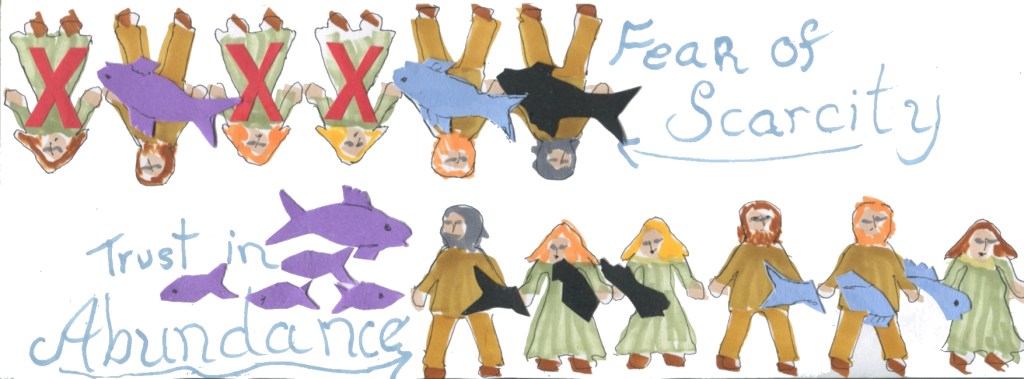
“Even if it isn’t true, if people believe it is a fallacy, it is acted on as true. And the mindset of these patriarchs was this fallacy that too many people could cause a famine in a frail world — the fear of scarcity.”
“No wonder, after all my deaths and earthly years too, I had no imagination for such a disaster. It is completely the opposite of the Christian generosity and love for neighbor and the Jesus teaching of abundance when food is shared. Jesus showed it as a sign in the feeding of the multitudes [John 6:1-14]
[Footnote] https://en.wikipedia.org/wiki/The_Farmer_in_the_Dell traditional courting game with many European versions, first find of it written was German in the 19th century. Guessing it has ancient roots.
(Continues tomorrow)
 Lazarus Ink