
Historical Setting: Jarrow, 793 C.E.
Today I’m still owned by God, but that’s my secret. I’m dressed as a student, not a monk. I find Jarrow’s renowned library has a magnificent collection of books. It is well-known among the monastic communities and that reputation enables this monastery to borrow more and more books to be copied and added. A collection that began a century or more ago with one abbot’s books increased many times over with this sharing among the monasteries and the industrious work of the monks copying the borrowed volumes. This is also home to an author of history and hagiography, Bede, who lived his life as a monk here in St. Paul’s. I was told of him in Lindisfarne, and that’s why I came.
The librarian sits at the entryway with the log book for visitors. He asks that everyone who uses the library put, not only their name, but also a brief statement of purpose. Maybe putting down a purpose gives this librarian a way to be helpful in guiding the visitors to the books they’ve come to find. Or, it is simply a literacy test, to catch commoners and novices who would pretend to use the library when they can’t read or write. He watches carefully when I sign in.
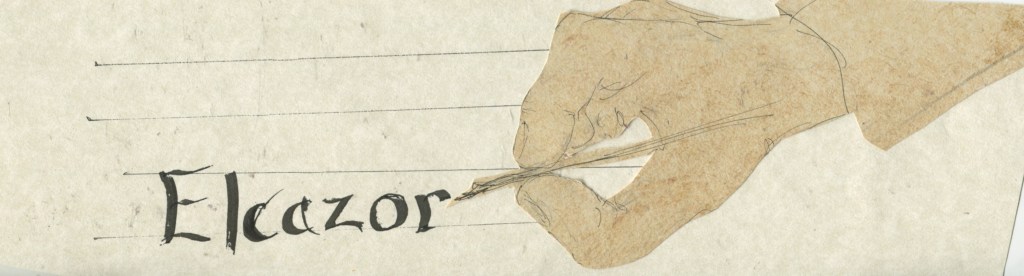
It has been a long while since I’ve held a quill and inked anything on parchment so I take care that my penmanship is exactly as was required at Ligugé and Luxeuil. “My purpose is to read the works of Bede.” And my name? I choose not to use the Roman version of Lazarus with all that weight of a biblical sign for a monastery to ponder. Instead, I write the Hebrew version, Eleazor, which seems a better fit for my new secular appearance as a young scholar.
The librarian, Wilbert, is hovering over every letter as I write. He looks closer and closer at my letters with a scowl that wrinkles between his brows and gathers at the top of his nose and draws his nostrils outward. Clearly my letters are more beautiful than the person signing in above me. So why does this call for such scrutiny?
“Eleazor?” he asks. “Is that a Frankish name?”
“No, it is old Hebrew.”
“So, you are Jewish, yet educated at Luxeuil? Who would have thought?”
“Why would you think of Luxeuil?”
“You make your “e’s” “a’s” with two strokes of the pen in the Merovingian style.”
“Yes, I am from Francia.”
(Continues Tuesday, October 21)
 Lazarus Ink
Wilbert’s narrowed gaze at your “e’s” and “a’s” – lovely detail. We carry our formation in the smallest gestures, don’t we? Penmanship as tell, ink as traitor. Even when we costume ourselves as strangers, the hand remembers what the story tries to hide. Curious what Bede will make of you.
LikeLiked by 1 person
Thank you.
LikeLiked by 1 person