
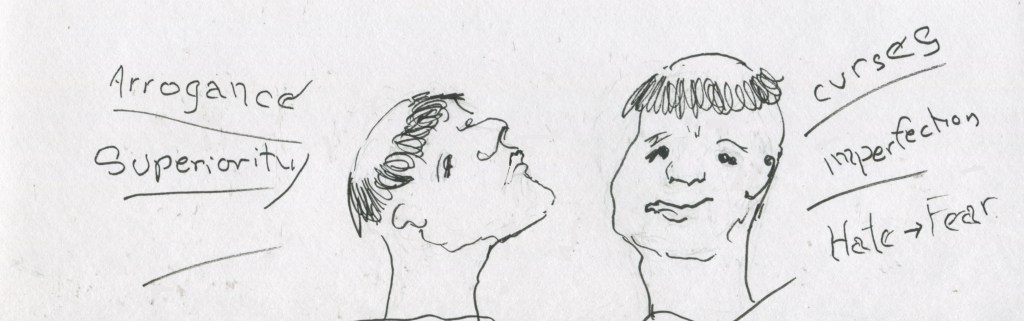
Historical Setting: Jarrow, 793 C.E.
Both styles of monks, the Irish and the Roman, are beloved by God. And maybe God answers the argument when a monk from the Roman Rule happens to lose his hair without even shaving it, but only in the front, giving this Roman Christian the Irish tonsure. And the Irish monk goes bald in the top, back of his head, so any hair he may have seems to be a crown. Our Creator judges with humor.
This little joke told by nature in the ways men loose hair is an earthly metaphor for a heavenly truth. It is possible for a thoughtful, prayerful person to learn empathy for another they might deem as enemy, or more lightly, unlikable. This intentional thought pattern can offer an honest window on fearless love.
Here, I am visiting a monastery staying in cell for travelers, in a less than hallowed hall of this community. Just outside this door I hear two novices dredging up old secular hates.
“Arrogance! That’s what it takes to copy off my tablet then lay it before Brother Cowen and claim it was your own thought, Brother!”
“Who’s to say it wasn’t my thought also? Obviously, my work was superior, with each letter perfect and nothing overwritten or scraped off as was yours. I handed our teacher a far better display of writing.”
“May your demon friends curse your whole deceitful tribe!”
As a stranger here, I don’t know what to make of these people. There may be a deep animosity already between them. Apparently, one novice had reason to call the other “arrogant and deceitful.” And the other eluded to the first fellow’s imperfections — poor lettering and strikeovers. Only God can intrude with the missing love here. And maybe one day these two novices will be brothers together and will find that love.
But there are ways to find human understanding that releases the hurt, prayerfully, relentlessly begging for the power of love. One way I find for understanding is an intentional technique for widening narrow words of hate. The hate words between the novices, “arrogant” and “deceitful,” are narrow and negative apparently drawn from a history of tribal hatred. But by searching for synonyms for these rigid hate words, little glimpses of understanding can emerge. “Arrogance” is a neediness and “deceitful” longs for forgiveness. There can be a wedge of understanding instead of rehearsed, on-going hatred. Actually, even this word “hate” widens into the word “fear” and “perfect love casts out fear.” [I John 4:18]
(Continues Tuesday, November 25)
 Lazarus Ink