
Historical Setting: Monkwearmouth, 794 C.E.
The Christmas story leaves Rachel grieving for her child.
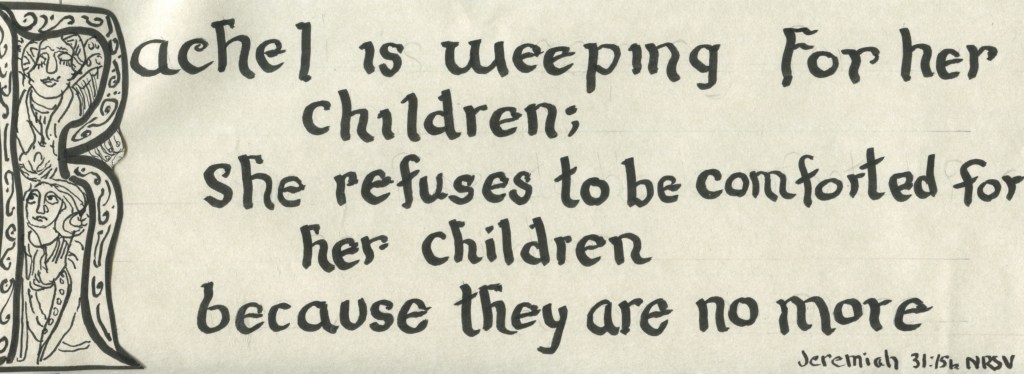
There are lots of bits of the Christmas story. When the nuns read the whole of it from the gospel of Matthew, told and told again by the followers of Jesus escaping Romans in Judah it calls for pondering, not just celebrating. The early Christians sought safer places. In the Matthew allegory the angel visits Joseph in a dream, while in Luke the angel comes to Mary. Joseph is the name of the biblical dream-keeper, so of course it was a dream. In Matthew, Mary and Joseph escape, back across the Reed Sea into Egypt with the baby, while Rome works through their puppet King, Herod, to issue infanticide on Judah. Matthew keeps a finger on the pulse of the Hebrew bible and remembers Jeremiah 31, and allegorically names the weeping mother Rachel, after the mother of Jacob (Israel).
We know who Mary is. She is the happy ending to the Christmas story. But happy endings all depend on where the story teller takes a breath and sits back and smiles and says, “and that was the story of…” to make the story seem complete.
So, we sit here by the river, a stranger just visiting Jarrow for its library and this young woman who escaped a brutal household, then escaped the sea, then escaped the chains, forged for demons…
Is there a place where she is safe, Dear God?
I ask, “Where did you live before Mister took you to the castle, ?”
“I lived in the pauper’s wood.”
“Is your family there?”
“They says my ma gifted me to the olders when I was a babe, then she went on her way. In the paupers’ woods people come and go but the olders are forever there. When Mister come down, he traded with them — me, for a King’s letter of permission.”
I can’t leave this child and yet she seems to have no place. She surely can’t return to this powerful man, “Mister” who traded a “King’s letter” for her, then sent her away after she birthed his baby and nursed it for a year. And it seems there is no place for her in the paupers’ wood where they traded her for a letter of permission. Permission for what I wonder. And that is all I know of this place.
I ask again, “Can you show me where these places are?”
(Continues tomorrow)
 Lazarus Ink