
Historical Setting: Jarrow, 794 C.E.
At the ealdorman’s house, Ousbert left the desk and the chair, the empty shelves and the sleeping mat which I have washed in lye soap and refilled with fresh straw. And in the first room are also some benches lining the outer wall. I thought the benches were for people waiting to make their required payments — but then, why would they come here and sit and wait to do that?
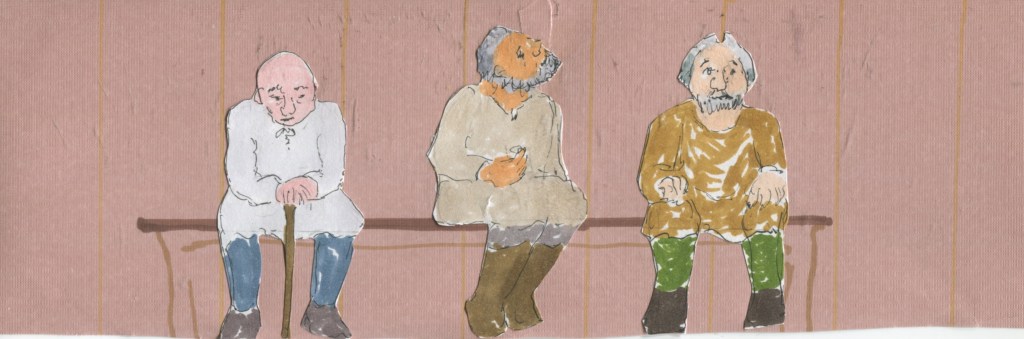
Now I find the benches are a gathering place each morning for the town elders. It was the baker yesterday with his bread bribe. Today some old men come in and sit and talk chewing long stems of green grasses. They tell their old stories to this new ealdorman, complaining over the power structures, and they fill me in on all the history and happenings in a whole different way than Bede told it, but with the same variety of bias. Here history comes as gossip.
The real work of this ealdorman’s post is supposed to be collecting the tithe for the king, while the Church manages collecting the tithe for the Church. It is all called a tithe, from the old land divisions naming the worth of these lands in terms of “hides.” [Footnotes]
How do I, a stranger to this land know of this? It is because these benches seat the tradition of the old men of the morning gathered and telling all there is to know of this place, truth or gossip, whatever.
Ousbert told me some things: that the ealdorman receives a third of these fees for the king; and that is how he’s paid. And I can see, that since the military and the monastery are exempt, this post thrives more on bribes for justice than on the portions of payments, since this doesn’t happen to be a wealthy corner of the earth for collecting a lot in tithes — and with the king and the church each expecting a cut, paying up the taxes is no simple inconvenience for these people.
I’m still waiting to talk with Ousbert again so that I can report to him the thuggish behavior of the soldiers he posted. Now I can also understand the tension between the abbot and the posted guards there. It is why Ousbert did not ask to have a monk temporarily assigned to this ealdorman’s post.
So, the first question these old men perching here have for me is, “Whatever happened to that other fellow’s little-un?”
Footnote: https://en.wikipedia.org/wiki/Tithing — retrieved 8-17-25
(Continues tomorrow)

