
Historical Setting: London, 794 C.E.
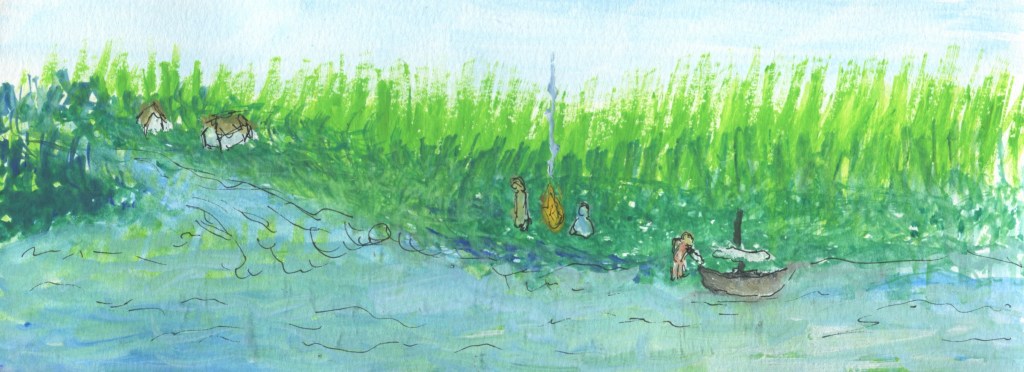
These weeks are mostly spent rowing, rarely sailing along the wooded coast of Anglia. This journey seems to yield little in new markets for Cloothar. Yet we make our stops on land wherever he catches a glimpse of fishing buoys or a whaft of smoke rising, marking the presence of people. He trades fabrics for firs and perhaps a meal of whatever was hunted that day. And if the hunt failed, we join people in sharing a pot of thinned stew. [footnote]
Cloothar is good at finding us food and shelter, but he is no brother — neither by family or monk’s vows. I would like to call him a friend, but he has trouble quantifying friendship in his way of understanding. He doesn’t expect me to be a source of comradery and he assumes that any friendly chatter must be purposed with some material ending. Yet I yammer on.
“Did you learn your merchant’s trade from your father?”
“What matter is that to you, Eleazor?”
“I was just wondering the source of your gift.”
“Knowing things of a person gives you power over them. Do you hammer me with questions because you think it will make you the captain of this ship?”
“No, of course not. I was just…”
In this silence between us now, I can only enjoy the humor of his miss-understanding, imagining myself taking over control as this so-called ship’s “captain.” That would only mean I would be privileged to tell him when to draw the oars.
Since I am longing for conversation, I find our stopping places a reprieve. I’m already comfortable with the language of the Saxons and we share stories.
One would think my prayers without ceasing would satisfy my need for conversation, but neither does the merchant offer me his own company nor does he yield the tranquility of sanctuary. When I put my complaint in a prayer I ask God for solitary time, and also, to retool Cloothar into a friend. I believe that prayer was answered, but not by changing Cloothar. Rather, God answered by changing me to accept him as he is.
After this long journey following the shoreline south, the rivers flow into the sea with the fresh water mixing with the brine, and each river entices Cloothar to follow it in search of a market. Rumors among merchants tell of a town rising from the old Roman walls of a city, now a thriving marketplace. [Footnote]
[footnote] https://www.thehistoryoflondon.co.uk/ (retrieved 9-2-25) organizes the history of the rise of settlements and urbanization in Southeastern England broadly by periods of occupancy. The late eighth century after the Roman occupancy crumbled, and before the Vikings made their lasting settlements in the mid-ninth century and on, this area was under Saxon rule.
(Continues tomorrow)

