
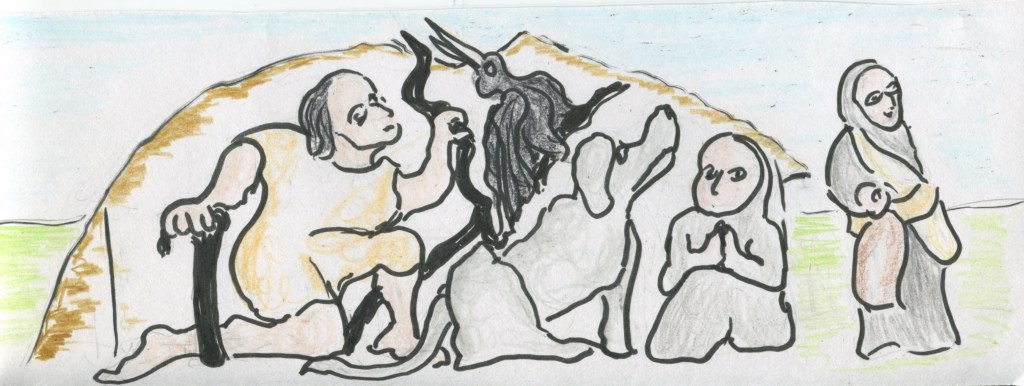
Historical Setting: The Great Skellig in an unknown time
And here we are, his little collection of life’s leftovers together only because we are each needy of healing. Trinity can take herself outside and return again. She and the hermit have their own sign language together so she can be obedient to him. She always lets him know if anything is amiss in here or out there. When the hermit is exhausted and sits down to rest on the rock at the doorway, she sits by him and slides her big wooly head under his hand, resting her head on his lap. In so many ways she gives him a warm comfort neither the shag above us clinging to the branch, nor I, can offer.
Now, every day at low tide the little fellow takes his prod and pail and goes off. He returns with an assortment of the things left between the rocks by the tide: the wriggling fish, an eel, or a sea blob. And he brings the stinking stew up here to give the shag a daily feast. He sweeps up the soiled straw beneath the bird’s perch again and all around, and heaps the straw outside. In the evenings he makes a night fire outside. Maybe the fire wards off monsters of the night, or maybe he is just marking our place in darkness. It is not far beyond our doorway that he turns the soiled straw of the day to spark and ash and with some added peat, the night fire leaves new embers for the next day’s fires.
Each morning the woman whose voice I first heard interpreting for him comes with the sacks and flasks, and Trinity alerts the little hermit so he moves the sledge from the doorway. She never enters or even bends down to look in. I’ve never seen her and she hasn’t seen me. It is all very regular and very silent. All of these daily patterns and routines are faithfully attended so as dark, and small as this space is, it always smells of clean earth and fresh straw. It is always sparse with just a mere promise of enough.
Since it was the canine that can hear my shouting nightmares and senseless sounds in my sleep she knows I have a voice and she knows my single chant is always woefully, “I can’t help you.”
Dear God, may I heal to usefulness here in this place of slow and gentle restoration.
(Continues tomorrow)

