
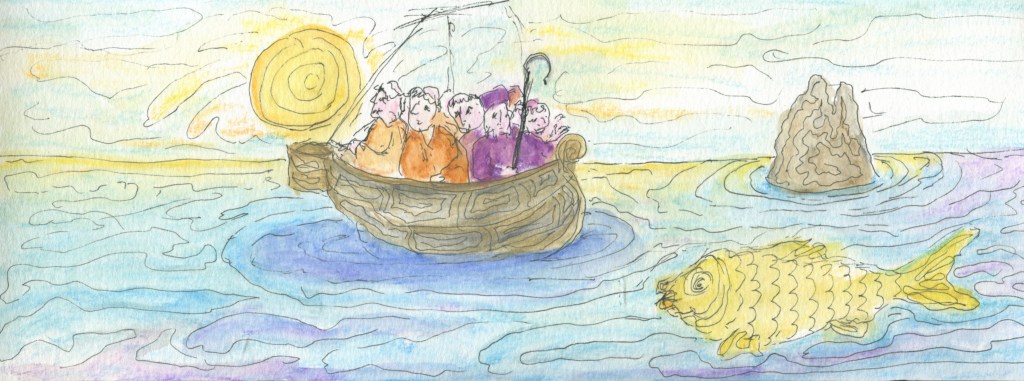
Historical Setting: The Great Skellig in an unknown time
Gardening with the Sister, I can ask my questions about the people who come here.
“Why is Brenden a saint and Brother Timothy simply a good man with a dog? Or does it matter?”
“Oh, it matters. When the stories that the monks tell are of the saint, they are filled with amazing wonders and miracles, where earthly us would see only signs.”
“Signs? Signs can be holy.”
“Signs are everyday things, like the leaves of the Swiss chard that grow back from the root when harvested. It is a sign of God’s gifts of abundance. A holy gift isn’t used up, but comes back again and again. Like goat’s milk. That is the sign in nature, but it is no miracle or wonder. It only speaks of the miracle of God’s gracious abundance. So, it is a sign.”
“So, when the Saint and the monks were sent to this great rock soaring from the sea…”
“…This Skilleg, God did not simply give them a path onto the rock. First, they struggled, they circled the wrong rock, then they circled around this for three days, prayerfully, of course, then the miracle. It is told for all the generations, exactly in this way:”
‘…and they saw a great rock of stone appear above all the water, and three days they sailed about it ere they could get into the place.
But at the last, by the purveyance of God, they found a little haven, and there went a-land everyone. And then suddenly came a fair hound, and fell down at the feet of Saint Brendan and made him good cheer in his manner.
And then he bade his brethren, ‘Be of good cheer for our Lord hath sent to us his messenger, to lead us into some good place.
And the hound brought them into a fair hall, where they found tables spread ready, set full of good food and drink. ‘ [Footnote]”
She adds, “So this is a story of a saint, because the hound led them to a miraculous feast, in a hall with tables and an abundance of food.”
“Isn’t that also how Brother Timothy makes the relentless climbs, guided by the creatures, and he also finds the most needed things — the eggs and sea plants for food, and the rain water in the clefts of rock — is this not the sign of a saint, also?”
“No. To be a saint, requires the miracle of finding the gracious feast served in a great hall with tables.”
[Footnote] Caxton, William, Modern Spelling Version The Voyage of Saint Bredan (Published by Langley Press, Copyrght 2016, Simon Webb, noted as the author.) The introduction to this hagiography is informative, and sets this publication in its historical context 1470’s, hundreds of years after the life of the saint, but even in that later time it was not in the English words we would expect to read in our century. Author, Simon Webb, made it accessible. Caxton was producing the first ever English language printed books.
(Continues tomorrow)

