
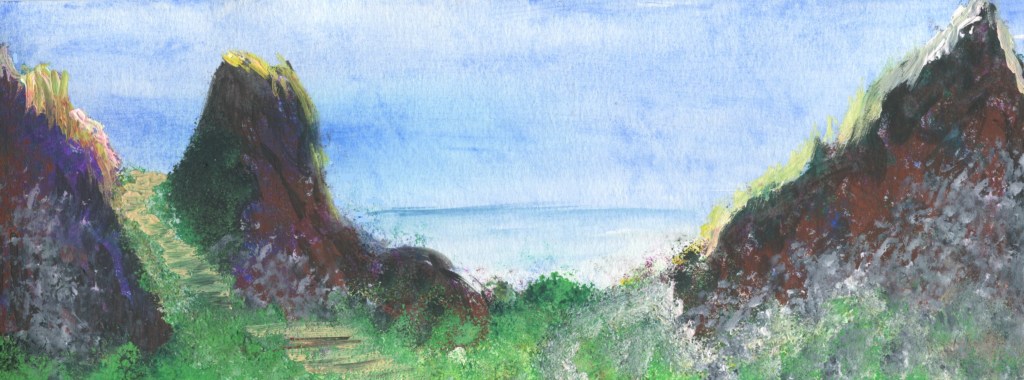
Historical Setting: The Great Skellig in an unknown time
On this new day I step outside the cell and watch for Sister Brigid to come up the rise.
I’m grateful for the walking stick. This trek, like everything in this place, requires a serious climb. Gratefully, there is a path with stair-like layers, but were it a staircase there would be more than six hundred steps. I take stops for resting all along the way.
These monk’s cells are what account for buildings on this island and they remind me of deep forest mushrooms, but without the forest. They are built of dry stacked stone. (No mortar is used.) So the secret of this strength that stands through centuries unfazed by wind and storm lies in the dialogue among each of the layers of stone, with the pull of the earth. [Footnote]
At the base the walls are in two layers, the straight interior walls as any house or hut, and a curved outer wall that continues above the straight interior, rounding like a Roman dome, with the weight of the stones laid one against the other in a unity of strength.
Where the straight walls end, the round exterior is set with cobbles, as is any stone house prepared for a thatch roof. Apparently, there once was an expectation of thatch. But here there is so little material for a nice weave of thatch, so, some have their roofs sodded with mossy grasses. And there seems to be plenty of dampness here to maintain mosses.
I think, with the slightly angled vertical “stalks” for stems and the round flora lay of the roof, the cells with sod look like huge mushrooms just up from a forest floor.
I gaze across the valley that makes a curve between the two peaks of this rock from this somewhat high place where Brother Timothy’s cell perches, across to the higher rock face of this Great Skellig where the rocks were stacked to be the monastery.
Sister Brigid calls this wide U-shaped valley “the Christ’s saddle.” In this season it is a green valley where the goats graze. Despite the abundance of birds that make a fertile garden place of this whole sea rock, the wind and the sea support the bleakness, and the garden patches require an intentional gardener. No doubt Sister Brigid has worked the soil of her garden since she was a child.
[Footnote] A most interesting aspect of historical fiction is when old history has new finds. Another internet search of Skellig Micheal provided a more detailed, and a first person observation of this setting. This blogger attempted some amendments, like learning that the actual stairs were a later creation — I only assumed some sort of path was there. https://petercox.ie/blogs/a-life-in-the-landscape/the-monks-of-skellig-michael?srsltid=AfmBOoqYm2UmxaPDLdI29VUvmuE1e0WfFs9-Pj0H41rUxSBwVxdHk5ER (retrieved 4-11-26)
(Continues Tuesday, July 28)

