
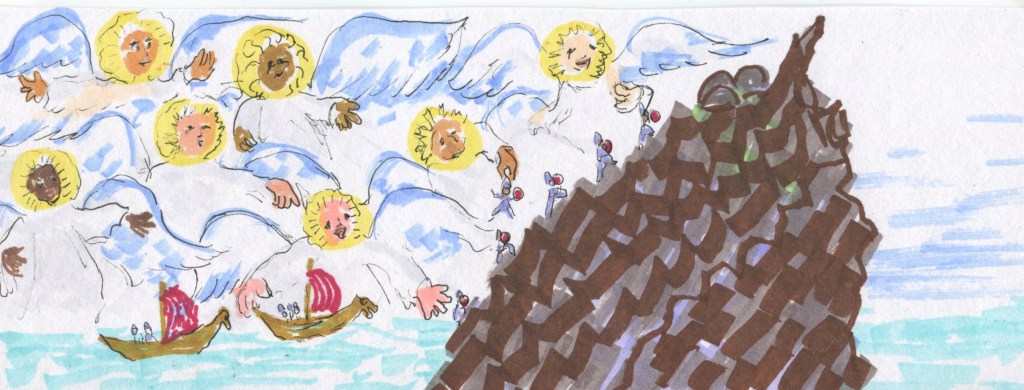
Historical Setting: The Great Skellig, 924 C.E.
The abbot and I are considering, again, the question of a saint’s power to protect a monastery from a Viking attack.
“I was a lay follower of Father Columbanus also named for a dove, and then I was on a mission to deliver a message for him to a council of bishops when I was driven through with a polearm by a bishop’s guard. [Blog post #44] It was a long healing.
“That would make you a martyr.”
“Not really. Martyrs have to be dead, like the saints have to be dead for the Church to name them saints.”
He offers his smile, and tells me more of Iona.
“I visited the abbey of Kells, before I was assigned here, and the terrible tales of Iona were well-known. They’d ‘suffered numerous attacks, starting in the year 795 and continuing in 802, 806, and 825. The massacre of the martyrs of Iona was the result of the raid of 806 AD, where fleets of Vikings stormed the abbey, pillaged it for riches, and killed the monks, who were largely without weapons, and thus defenseless. This was Iona’s first incidence of “red martyrdom”, or the bestowing of martyrdom as a result of violent death by religious persecution. ” [Footnote 1]
“Had I not been shipwrecked, I would have been there then. And now here I am instead, safe on an island that would be nearly impossible for Vikings to land and then scale the cliffs. or would they climb the world’s most intimidating staircase? They would be all out in open view of any angels looking on. And then what treasure would those attackers find? A single golden chalice?”
“You might think we’d be safe from attack, but the Great Skellig has already been famously raided, though not as recently or as often as others. It’s been said, ‘ In 823, … Skellig was plundered by the heathen and Abbot Eitgal was carried off and he died of hunger”. Again the Vikings attacked in 838, sacking this church,’ [Footnote 2] and some others on the mainland as well.”
“So, are you prepared for more attacks?”
“We stifle rumors of riches, and hopefully, the Norsemen keep the memories of the hard landings and daunting cliffsides for their generations to remember. And of course, our small number of monks are young and strong and agile, gifted in the climbs. They go places for their prayers all the time, where no other man would travel for an earthly purpose. Maybe that would make them safer.”
[Footnote 1] https://en.wikipedia.org/wiki/Martyrs_of_Iona (retrieved 1-31-26) This note references (1)“Iona”, Follow the Vikings, University of Stavanger, Norway”. Archived from the original on 23 July 2024. Retrieved 19 June 2024.and (2)
“Iona: A History of the Island”. electricscotland.com. Archived from the original on 28 October 2022. Retrieved 28 October 2022.
[Footnote 2] https://en.wikipedia.org/wiki/Skellig_Michael retrieved 1-30-26 and [28] /ref. to Gray, Martin. “Skellig Michael”. World Pilgrimage Sites. Retrieved 27 July 2021.
(Continues tomorrow)

