
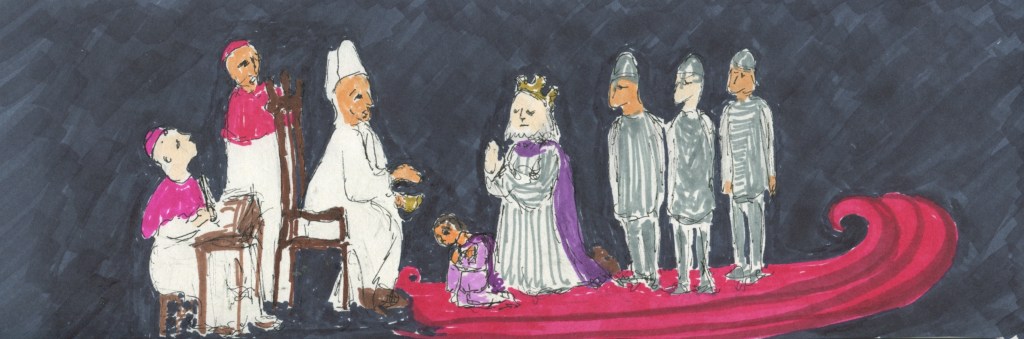
Historical Setting: The Great Skellig, 924 C.E.
Mostly in these times other people don’t see history as I do. I see it all in the light of Jesus love, even in the peaceful march to the cross by Jesus among his enemies — the Romans. So, I wonder how the murderous ways of warring kings can ever be assumed a military win and at the same time, blessed by God. All that happened was one king out brutalized the other. Nothing in a war is “God’s side” unless it is caring for the refugees, and forgiving the perceived enemy.
I ask Abbot Mactyre the loaded question.
“Did these warring kings have no thoughts of the Jesus peace, or were they not even Christian?”
The abbot knows my heart. He laughs at my bent question, as we are sitting here on a sacred rock, the Skellig, believing we are removed from these earthly woes of wars.
He says, “You realize they claimed they were Christian back in the day, nearly a century ago.”
It is refreshing in these times to find someone else who believes as I do, about war.
He continues, “But I have to wonder if Æthelwulf was left with a tormented conscience, because, after that win, he took his little five-year-old Prince Alfred on a pilgrimage to Rome.” [Footnote]
“And did he return then, knowing the Jesus peace?”
“I don’t think so. Rome is still Rome. On his return this widowed king of West Essex met with Charles the Bald of Francia.” [Footnote]
“Was he the successor to Charlemagne?”
“Some generations after. Æthelwulf returned from Wessex with his own child bride, Judith, the daughter of Charles the Bald. This Queen came with the political power of the universe, at least the power of Francia, to the little parceled lands of Enga land. She was twelve years old then.”
“Really?”
“Younger than some of Æthelwulf’s sons. You do realize you have miss-placed more than a century of changes.”
“I remember Gaul when it was only healing after the Romans bruised it so badly. So, what all happened in this century when I was awash?”
“Well, Æthelwulf returned with Queen Judith to continue the reign over Wessex. He had assigned Æthelbald to serve as King when he was gone. But on his return, Æthelbald was unwilling to relinquish the throne back to his father.
“It sounds so Merovingian of Æthelbald.”
[Footnote] Alfred the Great: Asser’s Life of King Alfred with other contemporary sources, Translated … by Simon Kenes and Michael Lapidge, 1983, The Penguin Press, Middlesex, England. Blogger’s note: the Asser source and the Anglo-Saxon Chronicals are contemporary to very late in Alfred’s reign, and for the most part tell the same story. Asser, more developed and flavored with his opinions or maybe reflecting popular opinions of these kings and queens. Asser malign’s Aethelbald for not relinquishing the throne here. Another minor difference is that Asser looks upon the pilgrimage to Rome as two separate journeys while the Anglo-Saxon Chronicales sees it as leaving when Alfred is 5, and returned three years later. (This blogger of a fictional story chooses the long stay in Rome version.)
(Continues tomorrow)

