
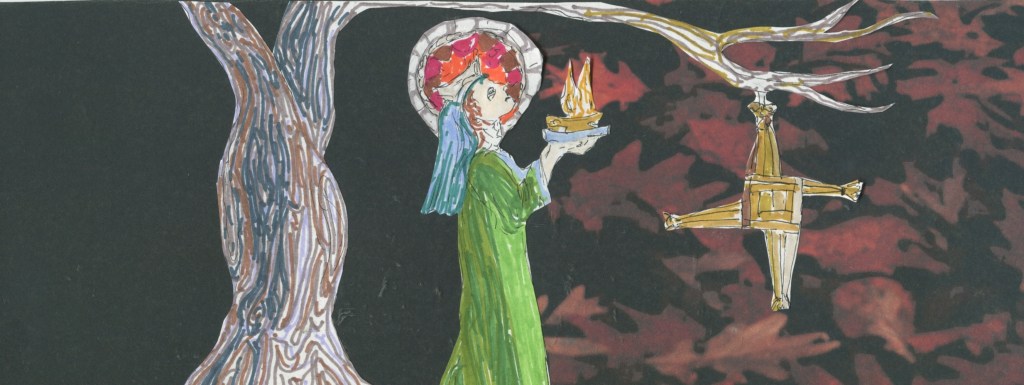
Historical Setting: The Great Skellig, 924 C.E.
The moon is setting; it is nearly the hour of matins. This night is long and dark, and Brother Lugh is not the least bit ready to doze off. I’ve caught a few winks, but really, this is many hours of lost sleep now. The best I can do is just pretend I’m asleep and not even try to sound interested. Now his monologue turns to what is really on his mind — Sister Brigid.
“So, Brother Laz, you can understand how a Christian can have a Pagan name. So, Sister Brigid is also named for a Pagan god.”
I turn to face the wall, in hopes I won’t get any glimpse of his love glow and mistakenly think the sun is rising. Turning, not snoring, demands the answer of a listener.
I mumble, “Brigid said she was named for a Christian Saint.”
“Yes! That’s what I am saying! There is a thin place between Pagan and Christian, and Sister Brigid is that place, as surely as the Skellig is the thin place between earth and heaven. The wonders of the Pagan goddess were poetry and healing and as an artisan in forging metal.[Footnote1] Three things in one, like the Christian Trinity. And isn’t that also like the Christian St. Brigid?”
The abbot rings the bell to wake us for prayer. Already awake, it is a short few steps to church. Brother Lugh and his passions pour out strangely and as early as we are, and our voices aren’t tuned to chants. He finds his chance to speak to the abbot with this particular concern. He asked not for special prayers, or for more details on that after-life promise of a mansion with many rooms. We all know he grieves. He’s a very tight bowstring. No, he wants the abbot to recite for us the vitae of St. Brigid, and in his plea, he mentions the importance of this because she is, after all, right up next to St. Patrick as a patron saint of Éire.
Abbot Mactyre says, “So Brother Lugh, at least you show up at this early hour before you go off milking goats. And now you are begging for a particular homely. I take it you find the subjects of my usual talks unfulfilling — applying the teachings of the gospels to our lives here. So, you would rather I devote our study to a saint made of a young woman who exasperated her father.”
“She fed the hungry.”
[Footnote1] https://en.wikipedia.org/wiki/Brigid (retrieved 3-13-26)
(Continues tomorrow)

