
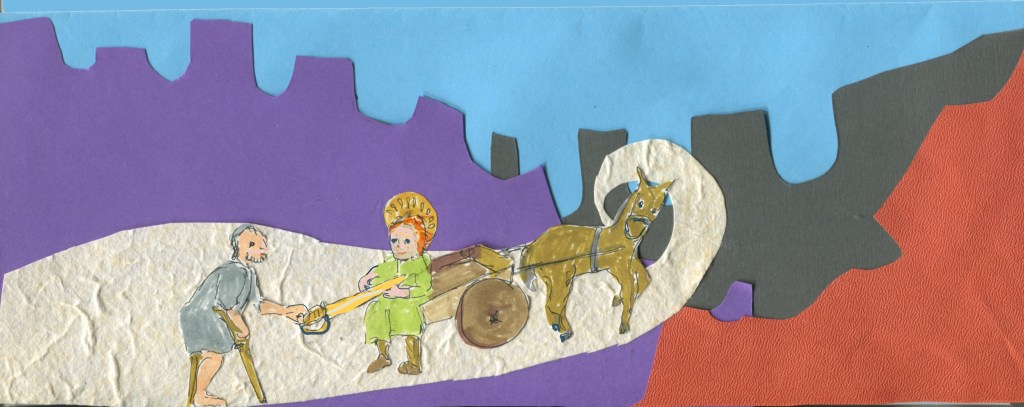
Historical Setting: The Great Skellig, 924 C.E.
Brother Lugh promised me that the stories I don’t know of Saint Brigid are not boring, and I need to know this. It is about taking from the rich and giving to the poor. That is a basic tenet of Christian folk lore in these times.
He says, “Brigid’s father, Dubthach, was dealing with a hard to manage child. She let thieves run off with his pigs. She fed his bacon to a stray hound. She gave his cattle to the poor. Any possessions she found were handed out to the less fortunate. This enraged Dubthach and he finally decided to sell her into bondage. He put her in his chariot and brought her to the King of Leinster. Brigid was ordered to wait outside while Dubthach went into the King’s home to make his offer. The king was surprised by the proposition.
— ‘Wherefore sellest thou thine own daughter?’ he asked.
— ‘Not hard to say’ responded Dubthach. ‘She is selling my wealth and bestowing it on wretched worthless men!’ — [Footnote]
“So, did the king side with the father?”
“Well, Dubthach was an influential man. Some say he was a ‘good man’ but, of course, goodness is for God to assess. The king was willing to purchase Brigid himself, but when her father went to get her from the chariot he found she had given her father’s sword to a leper. And of course, the king had no use for such a troublesome girl either.”
“It must have been hard to decide if a saint could also be a thief. Or maybe in these times when women don’t own property, a girl child stealing from her father isn’t really stealing.”
“I suppose. The world is full of stories of wealthy-born saints who give their own inherited riches to the poor and then commit their lives to God; but for a woman, whose wealth is her father’s or her husband’s, this feature of saintly behavior might involve thievery, I suppose.”
“So, what did her father finally do?”
“He sold her to a druid. Some say it was the Pagan influence that made her love an oak tree and keep a perpetual flame at Kildare. The monastery she founded was named “Kildare” the name for the oak tree. But personally, I think she was a new birth of the goddess Brigid. Do you think it is possible for God to let a Pagan goddess become a Christian?”
[Footnote] Justin R. McCarthy provides this quotation and the story retold here in his book Saint Brigid: the Celts & the Early Irish Church citing the source as the Book of Lismor, Passage 1308.
(Continues Tomorrow)

