#72.7, Tuesday, Sept. 16, 2025

Historical Setting: 793 C.E. Lindisfarne

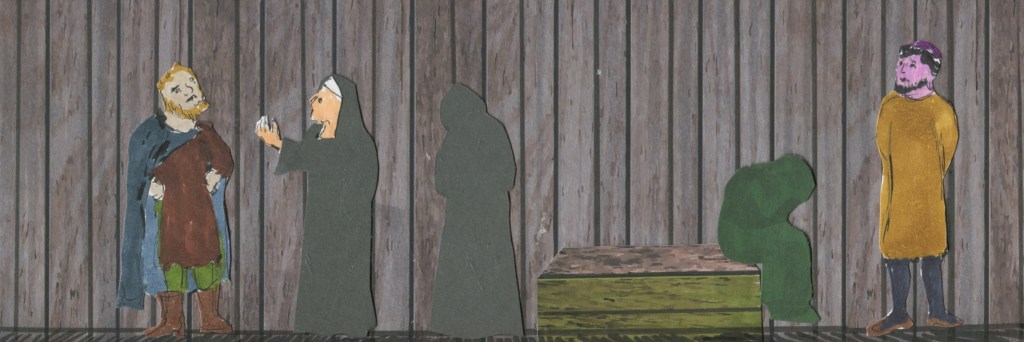
     The bishop continues reading. In chapter ten of Matthew, the followers of Jesus are commissioned to go out like “sheep among wolves.”  At this reading, these men listening are in the clothing that speak this metaphor accidentally too well. The monks wear the wools and these king’s men, pretending solemnity, keep their royal weasel hidden as the linings of their cloaks. The patrons and the pilgrims to the shrine smother golden chains in collars of wolf. Jesus was, of course using animals as metaphor, but here they are material. This message is current all these nearly a thousand years hence, and standing for the gospels continues to be tedious.

     The wealthy and the powerful here are standing in the front rows of the benches because they came for the customary acknowledgements of their gifting.  But then they are all beset with this reading from the Gospel. They didn’t come prepared for this. 

         The monks in the back of the room read from Luke more often than from Matthew. They expected instruction to love, even one’s enemies, and to live every day in the upside-down world, where the blessings are bestowed on the poor and suffering, but not as the world deposits blessings, mostly for the rich and powerful.

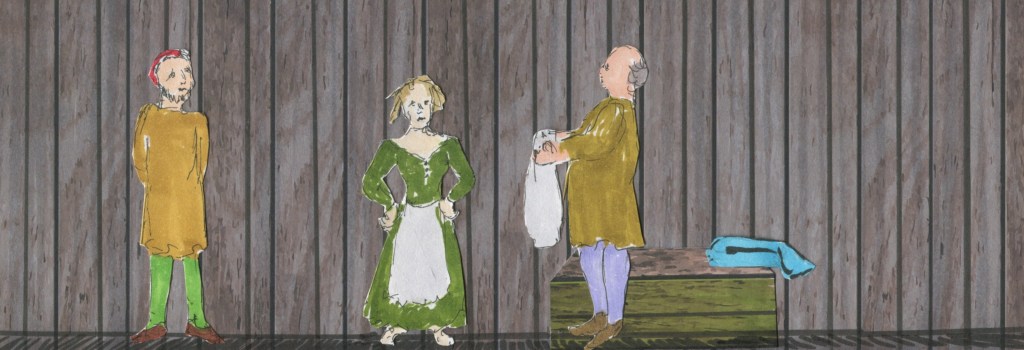
Usually, if the holy words drone on it is possible to find some beautiful distraction to gaze upon like fine brocades and golden boxes. Before the raid, the hum of somber reading could allow one to dismiss the words with wandering eyes, dancing among the golden reliquaries – slithering the dazzling pinnacles and jewels – castles for the eyes. But the relic boxes are gone now; in their places are simply barren boards.  Even the sconces, once dripping tears of beeswax into puddles that counted the hours of the drone, are gone from the walls. The only treasure left is this one book not smelted by famous goldsmiths, but inked by a solemn monk.

         The boards are stripped clean of the beautiful silks and satins with the intricate patterns and layers of colors. Once it was, that a wandering eye could follow a labyrinth of birds and snakes woven in amazing patterns of beaks grabbing tails and tails twisted in perfectly symmetrical knots.  But the fabrics were raided. Now, the big-eyed monsters that play on the edges of things are only to be found in the pages of the book from which the bishop reads. And the bishop has the artwork pages turned down, so even he sees only words. Nothing is to do now but to stand and listen.

(Continues tomorrow)


#72.6, Thursday, Sept. 11, 2025

Historical Setting: 793 C.E. Lindisfarne
 

The bishop orders, “Stand for the Gospel!”

When the worshippers are the community of monks, he never issues this order because the benches are stacked away and everyone is already standing, as are the monks today, standing in the back of the room. It is the dignitaries and guests for whom the benches were strewn. Maybe the benches were set out here to space the king’s men into tidy rows to thus stifle the chit chat among them. There is an assumption the reading of the gospel is only for the holy. Regardless, everyone is required to stand.

There are several hours before the ebbing tide allows the visitors to return on the land bridge. So Higbald has the entire four gospels laid out before him with only the first page turned over. He begins with the genealogy which sources an ancient hero king, David, among saints. Does anyone notice that some of these named patriarchs in Matthew are really matriarchs, and some even foreigners? Or are they all foreigners here for this audience of Anglia?

The king’s entourage is standing when the bishop reads the birth story, a night silenced by an omen of doom – when the local king orders the slaughter of the innocents. Matthew turns the ancient words of history back onto its later generations in this foreboding arrival of a Messiah, up from Africa, because the readers of the heavenly signs – those foreigners from another land – warned of the doom.

All these words from Matthew, are familiar phrases, but the meaning changes with the burials and the carvings of the stones, and the stripped away linens baring the wood of this altar.

As the Bishop reads on into Chapter 5, some, like me, always grasping for the love thread, imagine Luke’s telling of gospel is more consistent in telling of God’s grace. But here, as the bishop reads aloud deeper into  Matthew, Jesus’s words seem pitted as human behavior ripening for the judgement from God. Hell is present and Heaven is a Kingdom offered as a rewarding experience.

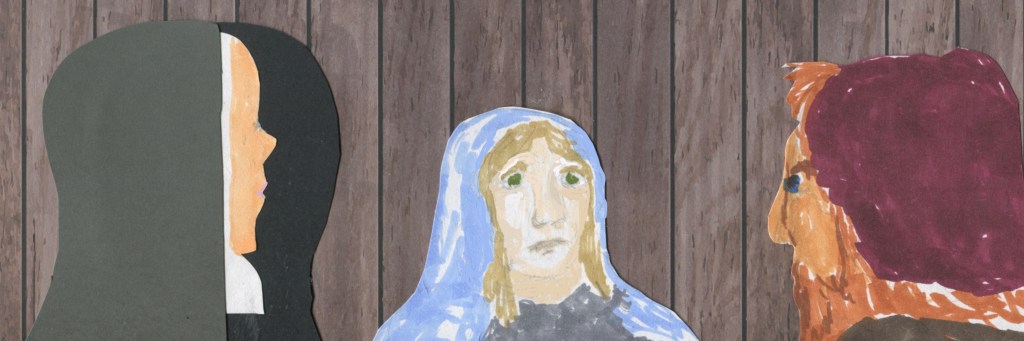
One guard, on shaking knees, sinks back onto the bench for a moment, until the glaring focus of the bishop makes this disrespect conspicuous. So those beside him raise him to his feet. The fasting monk, fainting in the back gets less notice.

I deliver a cup of water to the monk, and another to the book stand for the bishop. The failing guard is dismissed.

(Continues Tuesday, Sept. 16)

#72.5, Wednesday, Sept. 10, 2025

Historical Setting: 793 C.E. Lindisfarne

Visiting dignitaries becomes a procession of mourners as each visitor must ponder his own mortality and the fragility of life. Some here count the years until the charted end of the world – Doomsday – scheduled at the end of this millennium.  There is the personal hope that this tragedy was only about the sin of the monastery, and not really about God’s Day of judgement. But truth be known, only the brashest of lies can argue these deaths are blamed on the burial of one sinning novitiate. The blatant liars of the political realm hope the bishop will take the blame for this because some believe the Viking attack was due to the late abbot’s decision to bury that sinful novice as though he were a rightful monk.

The bishop brings the letter from the acclaimed scholar Alcuin, which I already know lays the blame on everyone. Seeing the use of this letter Alcuin’s groping for sin and blame makes sense. These survivors need a reason.

Benches are arranged for seating because, apparently, the bishop plans to fill the hours until the next low tide for crossing back to the mainland, with his sermon. Higbald rises to speak behind the naked table, striped, as it has been, of liturgical cloths. He calls for all to stand for the reading of the gospel as he lays opened Lindisfarne’s true treasure, with the outer covers spread face down on the bare wood. Turning to the carpet page before Matthew, created here by the hand of a beloved monk, perhaps inking the images at this very table.

The bishop is silenced for this moment with the awe of the book. We’ve all seen these facing pages. We know this art, and we have felt the awe ourselves. We stand in holy silence knowing of the images he sees, the cross made of six connecting partial circles, with the one a perfect circle at the center, all amid a sea of vipers in their intricate patterns of coils and tail grabs.

Opposite that page is the beginning. The first letter, one form with three heads and each head is starring at us. [Footnote]

Having spent my hours while the squash soup simmers, waiting at this altar, mesmerized by this work of art, I am indeed an iconodule. I am grateful for the artist who, in the true image of Creator, illustrated amazement with creation for our human eyes to see.

[Footnote]Eleanor Jackson, author of The Lindisfarne Gospels: Art, History and Inspiration, The British Library Guide, provided a beautiful description, of “each incipit page… surrounded by a frame which seems not to contain the letters so much as retreat from them, allowing them to burst out of the top and escape through a gap in the lower right. With their apparent ability to metamorphose, expand, contract, progress and interact, the letters seem to be living beings, reminiscent of the interlaced and contorted creatures that are so prominent in the decoration.” p.59.

(Continues tomorrow)

#72.4, Tuesday, Sept. 9, 2025

Historical Setting: 793 C.E. Lindisfarne

Low tide opens the way for the great procession on the land bridge. The bishop’s guards set the walking pace, followed by the bishop and the people of his own household who come here often, I am told. The next to come are the wealthy patrons whose gifts support this monastery: representatives of the local king and others of worldly power and wealth.

  Small rowboats, the currachs are rowed alongside the land bridge.  These are usually kept on this shore but they had been used at the time of the attack to carry some away from the danger. I’m told the monk who keeps the kitchen is with those in the boats.  Brother Ealdwin tells me he will know if the salt was hidden somewhere or if it was stolen. It will be missed in the soup I’ve set to simmer.

Everyone goes first to the Shrine of St. Cuthbert to pay homage. The repository for gifts is still intact. These dignitaries processing become, for this moment, humble pilgrims as they are blessed by the bishop receiving requests for special prayers.

But all the pomp yields to the intended purpose, as the procession moves to visit the cemetery. The brothers who have been hard at work carving forever stones to mark the new graves guide the visitors, not to the area of the old graves with that controversial burial of the unforgivable, but to the new place we’ve made where the winter squash had only recently escaped the garden wall.

Here are the new stones, the sandstone memorials to the named dead. But also, here are the stones carved for the welcome of Doomsday, scheduled soon in one hundred and a few years. Where other tombstones would have bas-relief showing the great works of the deceased or blessings of heaven in winged creatures – doves and angels – here is the story of an army with their weapons flinging above them as they march up into the ravage. And on the other side of that stone is the sacred explanation of the end times.  Here is a cross, symmetrically, and balancing on each side a reaching hand, while the lights of heaven are foreboding from above. It is a stone that attributes the deaths to the first sign of the fulfillment of the Doomsday prediction feared to arrive in fullness in its time.

(Continues tomorrow)

#72.3, Thursday, Sept. 4, 2025

Historical Setting: 793 C.E. Lindisfarne

     The returning surviving monks continue their spiritual practice here. Some see Lindisfarne as the vanguard for the great turning of the millennium.  There is the notion that this island was chosen to experience the Doomsday judgement first, expected in 999 C.E. The world has only a little more than a century to prepare.

      The monks are fasting and carving forever stones to mark this spot in time, so I’m gathering up squash from the withering vines to serve a hearty meal to guests.

     When the end of the world seems emanate, some of us carve stones, so that God and the angels, or maybe the next age of giants or sea creatures visiting here, will know what happened. Meanwhile, I am here, a borrowed monk, picking winter squashes off the vines we removed to make a new place for graves. I can make a spicy squash soup, a hearty meal for the visitors we expect here anytime now before the end of the world.

     What is the sacred message in this?  What is the value of being the first ever “last place on earth?” A shrine of an incorrupt body of a saint would seem the right place for the final judgment to start.

     Dear God, I know you as the constancy of love, the never ending, always living, beauty of all Creation and the love, the listening to each heart beating. You have gifted us humankinds, said to be in your image, with imagination, yet we are unsettled and overwhelmed by awe of eternal, and so we seek the edges of what we can know as beginnings and endings. Guide me, as you always have, through these end times. Please bless the soup of daily life. Thank you for the hard-shelled squash that keeps so well for winter anyway. Amen.

     Now when the land bridge rises in the tide, and the procession of visitors arrives, we will be ready. The bare spaces on walls where the sconces were torn away and stolen will be scrubbed of candle soot, and the bleak barren tables and rails where lost linens once marked each liturgical season will be polished clean of old dust.  Why is it the dust always returns and marks the shape of the missing?  Unused space is constantly being blanketed in the pale shroud. I wonder, do the angels continually dust the heavenly house of many rooms promised to be waiting for us? Or is heaven already laden in the grey shroud of dust. I will never know.

(Continues Tuesday, Sept. 9)


#72.2, Wednesday, Sept. 3, 2025

Historical Setting: 793 C.E. Lindisfarne

     Depending on the king or the earthly power, whether patriots or rebels, Lindisfarne is known either for its sin or its mercy all over one issue. And now the bishop is bringing an entourage to hear the reading of Alcuin’s letter to be read as the king’s men come to tour the damage and the material losses here.

     This community is supported by the shrine of St. Cuthbert, which is reached by the wealthy patrons and pilgrims who walk the land bridge at low tide.  Like the shrine of St. Martin, in Tours, Lindisfarne is a monastery supported by the gifts of pilgrims. Here, the incorrupt sanctified remains of St. Cuthbert are enshrined. In the last century this holy man was a lone mystic building his hermitage on the island of Farne, until he was called back here to be a bishop.  He accepted the call, but soon went back to his solitary life. [Footnote 1]

     The unusual “miracle” that led to his veneration as a saint was discovered when his body was being exhumed and prepared for moving him to this shrine.  The miracle or amazing oddity was that his body did not have the stiffness of death or the decay of his flesh despite a passage of time after his burial. [Footnote 2]

     If I were one to take part in the cult of saints, I would surely choose to have Cuthbert as my patron.  It would explain a lot about my own oddity of deaths, and for me, life and life again.  Of course, I was assigned this by my friend, who only wanted an earthly sign for the spiritual truth of everyone’s resurrection.  And I can only assume Cuthbert’s resurrection was purely spiritual, even though his body is still in-tact.

     Like a sometimes land bridge from the island shrine to earthly mainland, the invisible mystical bond between heaven and earth is set aside and sealed in a vault as “sacred” and untouchable by human simplicity. The constant demand for physical evidence to explain mystical reality to all of us of earth seems to demand a physical miracle. Maybe the spiritual reality that hears common prayers is not an oddity at all, to be relegated to saints. Maybe it is simply the everyday love of God, a Spiritual embrace for anyone to know — no saint is required.

     There are many paths to Lindisfarne – by land or water, or on the wings of angels.

[Footnote 1] https://sourcebooks.fordham.edu/basis/bede-cuthbert.asp (retrieved 1-3-2025)

[Footnote 2] Ibid.noted here as described in the hagiography by Bede

(Continues tomorrow)

#72.1, Tuesday, Sept. 2, 2025

Historical Setting: 793 C.E. Lindisfarne

     I arrive back at Lindisfarne to find Brother Ealdwin and several of the others still chipping images into sandstone to make markers for the graves of the monks who were slaughtered in the raid. They don’t allow my intrusion to stop their work. Even though the work they are doing is timeless there really is no hurry to make grave markers. The dead will be dead forever — maybe.

     My message to them is that Bishop Higbald, along with an entourage of other prominent supporters of the monastery, will be crossing the land bridge at low tide the day after tomorrow. These could even include the king’s envoy.

     The monks continue working in silence, barely flinching with the annoyance of my disruption. Is a visit from this local king’s representatives not regarded as important here? Or do they not need to prepare?  Things in the priory are still in a brash state of dishevelment. And what food have we here for guests?

     “Perhaps, while you are doing this important work of preparing the graves for all the world to understand this tragedy, I could be useful in making preparations for guests.”

     “Let the king’s men fast with us.” One answers.

     “In two days, those who fast would be fainting. We should have some food here. The peas left in that one bag are nearly gone.”

     The daily chores yield milk and eggs. The cow grazes on fresh growing grasses and the chickens still find wild seeds and perhaps a leftover crust. But other food will be needed.

     The garden is ready for harvest. I know because we removed vines of squash plants to make room for the new graves. We had to create a new area for these burials to set them apart from the old cemetery, due to that concern over the sinful novice who was buried here after he had taken part in the regicide then in his remorse committed suicide.  In the opinion of the king’s men, Lindisfarne became corrupted in sin. It may have been a political error to bury his body here, but only God knows if it was actually a sin. As for me, friend of Jesus and perhaps the abbot, now deceased, and for Bishop Higbald as well, forgiveness and grace — unconditional love—are more holy than retribution and punishment. So, the gracious burial of a sinner may not be sin, rather an act of grace. Of course, grace isn’t the way of politics.

(Continues tomorrow)

#71.12, Thursday, August 28, 2025

Historical Setting: 793 C.E. Lindisfarne
 

         Returning across the North Sea, I have passage on a merchant ship, an old-styled galley, not as fast and fit as the ships of the marauding Norsemen but crosses the waters then hugs the coast all the way back to Lindisfarne.

         Arriving on the island, I find the bishop is currently at his quarters on the mainland. Brother Ealdwin isn’t alone here though. The few monks who had left with the bishop have returned and are keeping the hours and grieving together over the great losses here.

When it is high tide this monastery is like any other, a place of daily work and prayer, smothered in the tranquility as a thin place for listening to God.  But when the tide recedes, pathways open to all that is of earth: pilgrims and blessing seekers bringing golden gifts and earthly woes come and go on the land path. The thin space between the mystical realms isolates into a clearer distinction between earth and heaven.

         Seeking the bishop to deliver his message from Alcuin, I await the low tide to cross over to the mainland.

         Bishop Higbald has a fine home befitting any earthly nobleman, as do all the bishops I have encountered in Gaul. His guards are not monks, but military guards who guide me to his library where I wait with the message from his friend, Alcuin.

         “Ah, Brother Eleazer, was it?”

         “Close enough. I have been with your friend, Alcuin, the king’s teacher, who is grieving with you over the sad news from Lindisfarne. He took a few days of thoughtful prayer and study, apart from his teaching duties, to prepare this answer.”

         The bishop chooses to read it privately so I’m excused to wait outside. He emerges from his study with the message for me to take back to the monks and pilgrims at Lindisfarne announcing a public reading of Alcuin’s letter following the third low tide. That will be the day after tomorrow in the morning.

         At this time of the rising tide now, I am ferried back to the island by the rower with the bishop’s skiff.

         Here on the sandy beach in the wash of the tides, are several of the monks, including Brother Ealdwin.  They are doing the task Ealdwin began, of carving sandstone grave markers for the monks we buried. The motifs are eschatological – the coming of the Christ – the resurrection of all saints.  It looks to be a long 9th century before us, always in awe and maybe in fear of the millennium.

(Continues Tuesday, September 2)

#71.11, Wednesday, August 27, 2025

Historical Setting: 793 C.E. Past lives on the Loire

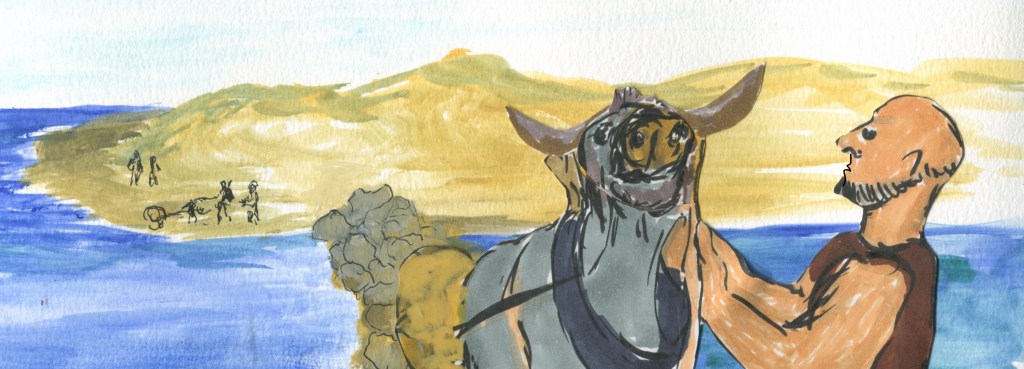
This horse was borrowed for a fee from the public stable on this edge of the sea. He goes wherever I lead him, while an owned horse only seems to know his way back to his own stall. If there is a fire, the horse who knows his stall will go back in even if it is his own hay that is burning. 

And here, Christianity is an owned horse that only knows its own stall.  In a crisis it goes back to the old barn even when it’s burning to make things the same as they were before. What is discovered in tragedy? Is it sin or grace?

Riding toward the sea, along the Loire from Marmoutier Abbey, I pass the Christian-basilica at Tours tucked among the ancient Roman stones. The old paganism of the Romans flavors all this burning hay of Christianity, so the bishop asks the teacher to find the sins so that the Christians may offer due penance and make amends with some kind of angry god crafted from the very ancient, sometimes pagan, root of a wrathful faith. 

In danger Christianity returns to the old ways that built this barn from paganism. If only Christianity had a petty little god that could be appeased with gifts and ritual — good people could more easily manage a god like that. It would only require good behavior not the deep love for even an enemy.

I come now to the place on the Loire where I raised a family – taken back from paganism after the Justinian plague. All these centuries later the foundation stones of Eve’s house are still in place.  This was Eve’s little cottage, with critters on one side of the central wall and people on the other. In this family Christianity was snatched back from paganism.

When the horse who is owned, Christianity, comes back to the burning barn of paganism he might not even notice that the depths of the foundation are a different kind of god – God, invisible, unspeakable, gracious, forgiving, with us, longing for love. This God who is God, whom monks whisper too in secret, and who answers back with voice and touch, is not just an ancient human totem appeased with gifts and rituals and superstitious sorrows.

Here is where my grandchildren once played. They noticed the rainbow and chased after dragonflies. Ezra’s vineyard was here where the vines grow wild into the trees now.

Thank you, God, for the meadows where the horses graze together.  Amen. 

(Continues tomorrow)


#71.10, Tuesday, August 26, 2025

Historical Setting: 793 C.E. Past lives on the Loire

         I know the teacher toiled over what to say to the bishop, distressed and grieving. I fear Alcuin failed to curb the tone of didactic instruction. Or maybe it isn’t a failure to subdue the instructor’s voice, but an intention to offer reprimand. That could be considered a fine quality in teaching in these post-Greek times without dialogue.  Here, the instruction was for “correction,” maybe away from “gentleness,” he encourages them to “fight bravely.” And so much for the Jesus pacifism.

Then by addressing the material losses, lecturing the grieving churchmen over their victimization by stranger Pagans, Alcuin is giving them a means or a demand to change themselves, thus to control these circumstances going forward – blaming the victim kinds of instructions –similar to demanding a woman to wear unattractive clothing so not to appeal to the lusts of rapists. 

“Do not glory in the vanity of dress; … Let your dinners be sober, not drunken. Let your clothes befit your station. Do not copy the men of the world in vanity for vain dress and useless adornment are a reproach to you before men and a sin before God. It is better to dress your immortal soul in good ways than to deck with fine clothes the body that soon rots in dust.” [Footnote 1]

This is the teacher’s response to what I had witnessed of the tragedy? I had seen the fine silks and dyed linens stolen from the naked martyrs of Lindisfarne — the clothing was heaped on the beach to be hauled off by Vikings for trade in distant markets.

The scholar continued, “Redemption is a man’s true riches. If we loved gold, we should send it to heaven to be kept there for us. We have what we love: let us love the eternal which will not perish. Let us love the true, not the transitory, riches. Let us win praise with God, not man. Let us do as the saints whom we praise. Let us follow in their footsteps on earth, to be worthy to share their glory in heaven.” [Footnote 2]

So today I ride away on the borrowed horse with the message of God’s love, also a chastising of the sins of monks.  I know Alcuin searched the ancient church fathers for these answers. It follows the assumption that bad things happen because of the wrathful and punitive god, who loves abusively. That is a god that can be manipulated by human behavior. 


[Footnote1] https://web.archive.org/web/20170506102223/https://classesv2.yale.edu/access/content/user/haw6/Vikings/higbald.html   Retrieved 12-5-24 Source: Alcuin of York, Letter to Higbald, trans. by S. Allott, Alcuin of York (York, 1974). Reprinted in Paul Edward Dutton, Carolingian Civilization: A Reader (Ontario, 1993). Scanned and proofread by Eric C. Knibbs, 2006.

This text is part of Viking Sources in Translation. Unless otherwise indicated the specific electronic form of the document is copyright. Permission is granted for electronic copying, distribution in print form for educational purposes and personal use. If you do reduplicate the document, indicate the source. No permission is granted for commercial use.© 2006 Anders Winroth

[Footnote 2] Ibid.

(Continues tomorrow)