#69.6, Thursday, June 12, 2025

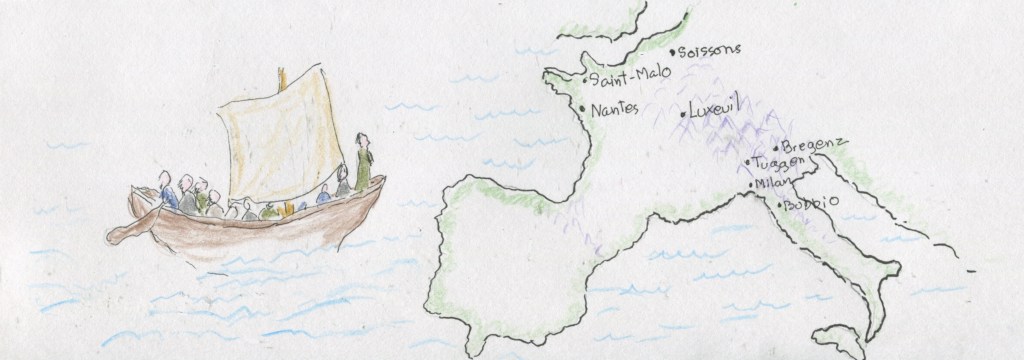
Historical Setting: 793 C.E. Lindisfarne Monastery

         Some of the marauders are returning to the boats with blood on their swords and laden with the booty they’ve stolen. No one from the monastery is chasing them.

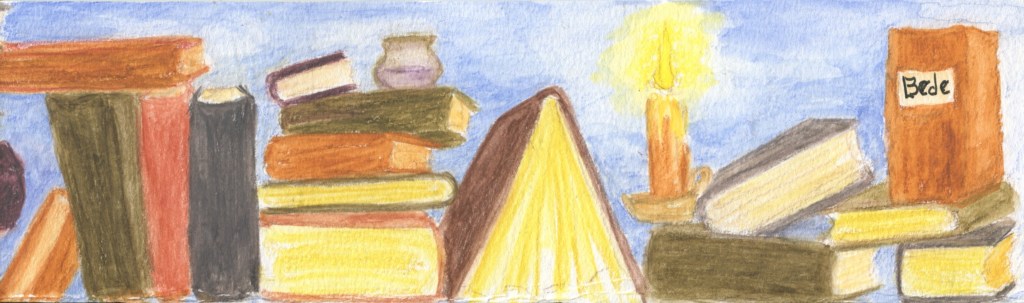
         Gunnar knows my Christian nature and he chooses me to help in opening what might be Christianity’s greatest treasure, since it was placed as the centerpiece of the elevated table in the main oratorio. But it is no chest of jewels as they hoped for when they carried the heavy thing off. It is a beautiful book in a jeweled binding.

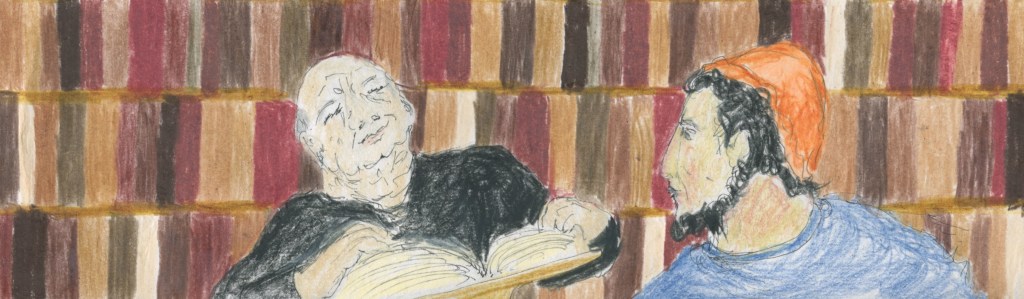
         The marauders and slaves crowd around as I open it before us all on the sands of the beach. I open from the back of the book, at the end of the fourth gospel, where Jesus is on the beach amid the boats pulled onto the shore, asking Peter, “do you love me?” [John 21:15] Opening from the back, I turned first to these pages in John hoping to catch sight of the dialogue on the beach. This gospel was copied into the language of the Romans so I find myself translating the words into the Norse language I barely know. There seems an annoyed sense of disillusionment among these Vikings in finding no jewels inside, but here, instead, these written pages.

         And it surely makes no sense to these marauders that the human-God shape-changer who is the subject of these gospels would end, not with a proclamation of victory, but with a begging for an affirmation of love. Instead of orders for retribution, Jesus orders the feeding of his lambs.

         I flip the pages from back to front, pondering the details of the artwork. From end to beginning, it is ever more brilliant — full pages of color and miniscule decoration – beasts and birds, spirals and leaves, all good things of nature, monsters, dogs and cats, inked in the style these Norsemen recognize as their own. 

         This is an odd wealth for these who would steal riches of gold and silver. It is the human response to nature with art and imagination they already know well.

         Turn back, again, each page nearly to the front, and here it is in Matthew 1:18, right at the first shape change story, the Incarnation, [Footnote] when the holy became a human infant, now with the murdering horde looking down on this page in awe. All spread out on the page like a great living form, are the Greek letters, “Chi Rho.”

[Footnote] Eleanor Jackson adds text to the picture book The Lindisfarne Gospels, Art, History and inspiration, The British Library guide, “With their apparent ability to metamorphose, expand, contract, progress and interact, the letters seem to be living beings, reminiscent of the interlaced and contorted creatures that are so prominent to the decoration.” (p,59)

(Continues Tuesday, June 17)

#69.5, Wednesday, June 11, 2025

Historical Setting: 793 C.E. Lindisfarne Island

         The slaves wait with the boats while the monastery at Lindisfarne is being raided. We talk among ourselves about our own Christian ways. I find these men who once called themselves Christian, in these times, have no idea of the Jesus peace.

         How does God answer the prayers of people when twelve slaves on a beach are praying different prayers and each one of us trusts God to be just, though we have vastly different notions of justice? 

         Dear God, how have our human ways taken us so far from the constancy of love for neighbor? I know the slogan from the teachings “Love your neighbor as yourself.”  It should be simple, except maybe for that “self” part. It is the human way to come before you despising the self, claiming sin as our spiritual nature. Dear God stay near us.

         From this beach we can see nothing of the raid. We heard the battle cries as they went ashore, but nothing now. 

         Now, one raider, Gunnar, comes dragging a bag of loot. He comes right to me, with a wide, flat jeweled case. Others are coming now. Everyone gathers around to see this thing. He believes it is a chest of sorts or a drawer that contains the most treasured jewels because it was found in the most special place on the high altar. It has a beautiful case with what looks like locks and hinges though has no real lock or place for a key. Gunnar suggests I will be able to open it because I know “Christian magic.”

         It is wide, but not very deep as a chest of jewels. It’s very heavy, and yes, it is beautifully set with gold and silver and precious stones.  It’s clear why they would think it is a chest to display gems, because they have never seen a book before.

         “It has no lock because it isn’t meant to be locked.” I simply unhook the clasps, and it is the most beautiful rendition of gospels I have ever laid eyes on.

         “It’s nothing!” someone shouts.

         “Let’s just keep the jewel case, and cast these innards into the sea.”

         I know that is what they would do. Others are returning from the raid with their swords bloodied and armloads of silks and satins — brocades cut into liturgical garb — golden crosses on heavy chains –and here are simple weaves of wool — the robes of monks. There has been a terrible devastation.

(Continues tomorrow)

#69.4, Tuesday, June 10, 2025

Historical Setting: 793 C.E. Lindisfarne Island
 

The red shirts have the longships pulled onto the sand facing the sea waiting for the signal. We talk among ourselves.

         “I was once a Christian.”

         “I am still a Christian.” I answer.

         “How can you be a Christian when we belong to the pagans and have no priest?”

         “I guess Christian is who I am and not what is done to me by the Church.”

         “That’s what the poor blokes in Christian robes say as they are getting bloodied by the swords of our pagan masters! This is not the time to hold fast to old ways, my friend.”

         “It is who I am. And didn’t each of us just make the sign of the cross as we watched the raiders running through the grasses toward the monastery?”

         “Aye, my friend, but our prayers were silent then. We could have been blessing our masters on their ways.”

         “And you think God doesn’t hear your silent prayers?”

         “Even if the masters don’t know it, this raid was clearly the work of the Triune God of Christ.”

         “A Viking raid the work of God? How is that possible?” I argue.

         “It’s clear when you read the signs.  First the signs of doom filled the heavens, then, the longships were carried briskly and directly to this exact island they set out to find. [Footnote] The Christian God brought this down on the monks and it is the Norsemen’s duty to God to carry out this raid.”

         “No,” I know that can’t be, “I’ve known the God who is and worshipped by Jews and Christians throughout all of my years, and God doesn’t manipulate violence.  God doesn’t punish people with pagan warriors. I know God well and God is love.”

         “Haven’t you heard the ancient stories man? People, even whole tribes and nations are always at the mercy of God’s mighty justice!”  

         What can I say?  Here we are, twelve men on a sandy shore in a respite of worldly violence.  Jesus served the fish that morning and begged Peter to affirm his love. Peter said you know I love you. And Jesus didn’t say, then punish my sinful sheep. He could have said, “Bring your swords and slaughter my lambs and eat well, you deserve it.” But Jesus said, “Feed my lambs.” [John 21] If I would say this aloud, it would make no sense to these men whose Christian vision is clouded with narrow notions of justice that simply means paying back hurt for hurt.

[Footnote] That early navagation tool would have allowed Vikings to approach an island from the sea, without having to follow the land. It was the Norse Bearing-Dial (based on sun shadows) Ibid, the drawing of this is on page 193 of Gwyn Jones’s A History of the Vikings Rev. Ed. (Oxford University Press, 1984)

(Continues tomorrow)

#69.3, Thursday, June 5, 2025

Historical Setting: 793 C.E. The far shore of the North Sea

         Several days and nights of sailing and rowing – now swells of stubborn waves on a calming sea are breaking ahead of us and were it not nighttime, we might see the dark line on the far horizon is the foreshadowing of land.

         “Drop the sails and secure the beam. Man the oars. Silence.”

          Among the Norsemen, anticipation is building like a lidded pot on a blazing hearth, ready to boil over with the howls and cries of battle – but silence is ordered as we move swiftly and quietly, closer, ever closer to the shore.  If a wandering monk were saying his matin prayers by the sea this morning he might notice shadows — shadows between the cresting waves — like logs floated onto shore from a distant storm-fallen forest. We are so many here, but even looking from one longship to the next, we are no more than deep darkness between the breaking waves. The shore waves are hitting us broadside now.

         The first ship with the officers and slave masters has a wooden navigating wheel to capture sun shadows and so maintain our direction for navigation. [Footnote] Now, with the sighting of land confirmed we see the leaders of this fleet have, indeed, navigated well. We are clearly approaching a large island populated with the hovels of monks around a central building  high on the land overlooking the sea. This is one of the Christian monasteries said to be on the islands off East Anglia.  Closer now, we draw in the oars and drift with the shore-bound breakers. The warriors, still shirtless for rowing, gird themselves in chain-mail and weapons and pluck their shields from the hooks on the gunwales.

         The thralls are given the signal and I find the water cold and nearly waist deep, though we are very close to the shore. We walk the boat onto the rocks in the wash of the waves. As the last boat is ashore, the raiders are screaming their terrors and running toward the little mounds where humble monks are probably just rising for their morning watch.

         We thralls, holding the lines for the boats, now are making the sign of the cross with our shared Christian prayers, not for the Norsemen but for their victims so brutally awakened this morning. Probably all of us who are slaves were captured from Christian lands. And now we wait here on the edge of the sea.

[Footnote] Vikings used a predecessor to more modern navigational tools, a Norse Bearing-Dial  A drawing of this is on page 193 of Gwyn Jones’s A History of the Vikings Rev. Ed. (Oxford University Press, 1984)

(Continues Tuesday, June 10)

#69.2, Wednesday, June 4, 2025

Historical Setting: 793 C.E. The North Sea

         A stiffer wind and we are reefing the sail to give the wind less of us to chew on. With the speed of these ships, we can cut across the waves like well-honed blades skinning the vellum from the meat. It seems we are moving very fast, even with a lesser sheet.  In all my days I’ve really never traveled this fast by any means, unless I was falling off a mountain. Yet without the landmarks of shore this speed really means nothing.  How long will we be at sea?  Days? Weeks? No one is asking.

         What sets every sailor on edge just now, are the storm clouds billowing low in the southern skies. And with the favorable wind comes rain, sheets of rain, like a fleet of ghost sails, moving faster than our now drenched craft across the surface of the water. It rains for all the rest of the hours of the day. Nightfall comes early with no farewell sun beams in the West; we light lanterns, as best we can in the deluge, to mark our presence for the others of our fleet. We see some of the other ships have lanterns also. Right now, managing the lines and the luffing sail with these random gusts of storm is the best we can do. No one sleeps tonight.

         By the time the storm subsides, we are sitting low in the water, or perhaps the sea is sitting higher around us and it is the task of the thrall to bail. We are scooping out the water as fast as we can, and now, even those who aren’t enslaved by men, understand the master of us all is the circumstance, and all are helping us bail out the rain water.

Tarps were spread a little late, and maybe not to shelter our sleeping rather to air the wet weaves of their fabrics.

Those of us who worked through the night weren’t beset with the shivers as were the men who finally had turns to sleep. Everyone is cold and wet and sleep deprived by dawn. The clinging fog even shivers the light of day. There is no warm blanket or dry shirt and the wind is stilled to a whisper.

We see the leaders of the fleet have already called for oars, and our boat is not far behind receiving that order. So, the first crew, slaves included, are at the oars. I’d rather row than try to sleep.

         Longing for sun…

(Continues tomorrow)


#69.1, Tuesday, June 3, 2025

Historical Setting: 793 C.E. The North Sea

         Sailing east across the North Sea toward the Northumbrian islands where Christians huddle with their riches, each wind gust comes stronger and more southerly than the last. With the lifting of the clouds comes the rougher sea. Ever larger waves are racking us broadside. Everyone is seasick though we’ve hardly started on this journey.

         We look across the waves. Some ships of our fleet are on top of the crests, while others are hidden in the gullies between, all of us bobbing up and down as we are at the mercy of this random roiling sea.

         Advice to the novice sailors — don’t focus on the other ships of this fleet moving as they are with the waves — waves — ever moving, rising up at our broadside, large enough to hide the next ship, then buoy it back into view. It is hard not to become mesmerized by each longship bobbing up and down and the rhythm of the waves lifting and dipping then taking us, always unprepared, for the next. I try to keep a steady focus and not dwell on the churning water as I have often sailed and I know of this sea sickness. But, like most everyone else here, the churning of the ocean has found a home in the middle of me, and I too, am retching over the side.  If I could just sit here a moment… The North Sea is well fed on morning oats this day. Tomorrow I’ll be the experienced sailor who watches the horizon and knows each day at sea will be different from the last. For better or worse, it will be different.

         I’m assigned the second oar, port-side at the bow. Now, with each dive and pitch, the winds seem stronger and a full span of the sail is more than we can manage. Soaked and salted by the sea spray, I’m called now to help with the lines.

         When we catch some glimpses of other ships, some are already reefing their sails. The ship nearest us has dropped the beam, draping the extra fabric of the sheet and tying it down, all the while fighting to keep the lowered, draped sail from gulping the sea. It is the bow slave there who climbs out on the beam to loosen the tangle of the lines for the hoisting back of the sail. May our reefing go more smoothly. [footnote]

[footnote] In these times the internet gives a blogger like me the opportunity to see videos of Viking longship replicas and a reconstruction of a warship ruin actually sailing. My source for this blog, a Youtube video (BBC TimeWatch, 2008) showing a voyage of “the Sea Stallion” a larger and later ship than would have been in the fleet in this story, but the North Sea is the same. To me, the calm voice of the BBC narrator seems incongruous with the hazards. A note in memorial to my brother Jack, who also loved sailing wooden boats, and my own experience going along on Long Island Sound when the wind shift surprised us, he took control with the same calm demeanor as a BBC narrator.

(Continues tomorrow)


#68.13, Thursday, May 29, 2025

Historical Setting: 793 C.E. Mooring at The North Sea

         It was an uneasy sleep never knowing when the wind would turn. It will take a rare easterly to set us on our way and this may just be that day. The orders for thralls are for two slaves in each ship.

         The lifting of the fog hints at a favorable wind. Enough rain fell that slaves are ordered to scoop and bail the rain water that accumulated under the floorboards. I hope this particular boat I’ve been assigned has a tight hull so bailing will only be rainwater.

         With the fog rising, every man is at the oars and we move swiftly and silently out of the fjord and onto the sea. Even the sea, at the mouth of the inlet seems smooth. Swells move under the surface rhythmically breaking behind us as shore waves. That’s how it is with an east wind. The top of the water seems nearly smooth but each gust from the east ruffles the surface backwards as though the winds were petting a cat from the tail to head.

         We row when the coxswain says “row.” Then when sailing at sea one of the thralls assigned the task will climb into the rigging. I assume that assignment was not made based on climbing skills, it is more about who to risk. No Viking slave-master wants a fellow Norseman dropping into the sea by accident.

         Rumor has it that Lindisfarne and Jarrow are monasteries on islands off a western land and these rich islands aren’t guarded by soldiers. They will be easy targets for Viking raids. It is said that Christians have all varieties of gold and jewels, unguarded, perceived by the likes of Emil, with his collection of chism, simply as Christian generosity.

         These men sharpened their swords. I hope the Christians across the sea saw the warnings in the skies and have found safe hiding places for themselves and their treasures. With all of God’s power to create a universe of stars and omen and persistently wrap the earth in love, listening to every creature of earth whisper prayers, then to forgive and set us all in patterns and seasons guiding us through the rigors of natural events — why would this God not be warning the Christians of impending doom?

         The voice of the rowing orders knife through the early morning drear calling for sails to be set to capture this strangely backwards wind. 

         With sails, we move briskly against the swells until the new wind from the south hints the change.          

(Continues Tuesday, June 3)

#68.12, Wednesday, May 28, 2025

Historical Setting: 793 C.E. Mooring at The North Sea

         The instructions are repeated, “Always, quick and quiet, invisible under the shroud of dark,” The orders devolve into our instructor’s own longing for the journey, “As silently as an evening lap of sea water tongues the tender thigh of shore, your oars will caress the waters — ever so tenderly as all the ships in unison will move together and touch the sands of landing like shadows of the tide itself, until each keel finds its rest.”

         We are dismissed into the night, “Quick and quiet and invisible in the silence of night.”

         I stare into the clouds on this strange darkness watching these signs and omens — so many lights and wonders dancing among the clouds — sending strange winds and bolts of lightning down onto the waters. The winds set currents and backwash. Such whirlpools in the tide-wash would befoul our ships if we should land on another shore in these times. May these signs also warn the gentle Christians in their monasteries across the sea that dangers for them are looming. [footnote]

         Thank you, God, for these uneasy warnings. What else is there? Amen.

         As I ponder the notion that Thor notices each man, I also consider the notions of God that I keep in my Christian heart alongside the memories of my own dearest friend from forever. The frail human imagination, echoes of Creator, longs to manage a human-figured god who will, like any pagan god, take sides in a battle. Christians pray for it all the time. The battle flags of Christian kings bear the emblem of cross or the Chi Rho as though they are lucky charms used to manage the Christian God amid the warriors of other gods. All of us who are children of Abraham in these times say we only acknowledge one God, the God who is God, among the many human notions of gods. And yet, in times of battle and pillage God’s “side” is hardly discernible in the heavens from “Thor’s side.”

         The clouds finally let loose of the rains overnight and it pours down on our tarps, soaking even the sand beneath us, so we are all awake early, shivering and damp.  In the foggy morning there is no way to dry our clothing and find respite from the soggy cold. The fires are out and the gathered wood is wet. The oats are soaked and softened for the morning meal, so oats won’t be served hot today.

[footnote] The record of this history was written by the Christians who were the target of these Viking attacks. Historic records in this era are rare, yet the one often quoted description of this event is found as 793 in The Anglo-Saxon Chronicles here translated and collated by Anne Savage (New York: Crescent Books, 1995) “In this year fierce, foreboding omens came over the land of Northumbria, and wretchedly terrified the people. There were excessive whirlwinds, lightning storms, and fiery dragons were seen flying in the sky…”

(Continues tomorrow)


#68.11, Tuesday, May 27, 2025

Historical Setting: 793 C.E. Mooring at The North Sea
 

         We are given the slave orders for the journey. But really the only thing slaves need to know is obedience.

“Slaves are assigned two to a longship, one with the bow rowers, and the other at the stern taking orders from the coxswain.”

         The instructor gives a review of coxswain orders, so that any stray stroke of an oar will not be the doing of a slave. We are given a demonstration of a line and the knots, with the emphasis for us to touch nothing unless ordered. Then he gives explicit instruction on the reefing, or hauling up and shortening the sheet. I’ve sailed before. I know of this. It is done when the wind could overpower the ship, so here the slave’s part would be climbing onto the beam at the time the wind is the worst.

         He continues the lecture, “As we approach the island, there is to be no talking or singing.  Any human sound while on a quiet sea may echo on and on through the eons, and if Thor, romping among the cloud billows, should get wind of a voice from a longship, the clouds will part and a bolt will strike with the full force of the gods, and immediately the ship will become consumed in the funeral pyre for all of its men.”

         So, these people still believe their Pagan gods are alive and well and acting in the human world. Or is this just a threat to keep thralls in line?

         As he spoke, a flash of lightening leapt along a celestial pathway, to affirm to believers, these gods are listening. Even among Christian slaves, no voice of slave would disturb the thunder. If lightning struck a boat, the error would have to by a Viking, not a slave.

         He continues, “We will sail the sea if there is any hint of an easterly wind, even from the northeast or southeast, then at the given signal, as the journey nears the shore, every craft will drop its sail and all will man the oars. Then in the darkness, with orders silent, only given by gesture, each slave from each longship will slip over the gunwales and into the shallow wash of the sea. The slaves from each boat will steady the craft as the men disembark with their weapons and shields; then you will wait there for each hero’s return, and act on orders for our expedient departure. Always quick and quiet under the shroud of dark…”

(Continues tomorrow)

#68.10, Thursday, May 22, 2025

Historical Setting: 793 C.E. The North Sea

         Gunnar didn’t call me “thrall,” he called me “red shirt.” I am slave to a particular master who identifies his own with the red shirt. My shirt is hardly a brilliant shade of red even though I’m new, because the shirt, like an owned man, is the property of the slave trader and this one was once worn by someone else.

Those, not slaves, in undyed or raw colors have shields at their oar-ports and weapons at their sides. They are called to practice for the fight, while we who are unarmed and owned are regimented to receive slave’s orders.

Apparently, my faded shirt has a reputation for attempting escape. I’m told to stand in the center of the circle so our instructor can remind the gathered thralls of what happened once when a human piece of property decided to own himself. After a long swim toward shore the poor fellow was met with Norsemen swords; they gave him the option to swim back to the boat where he belonged or to die quickly by the sword. He chose to swim. His grave was the sea and all they could salvage was his shirt, which is now my shirt. Now I know this used shirt is filled with courage and a longing for freedom. I shall wear it with honor.

Here I am named Heitman the name I was given by Auld Bjorn. I was the bringer of wood and peat for the fires. It seems in this circle we are all named for purpose, not family or origin. We bear fruit or our personal history isn’t much treasured here.  Here are Smith and Oarman, Binder and Mender.

         At this gathering I learn the red-shirted slaves are all owned by this one wealthy far traveler. In the free men’s circle a merchant speaks about values in gold and jewels so they will know what treasures bring the most at market to guide the raid. Every treasure has a value that is known. Sometimes it is in beer or grain or fleeces when it is traded. But the value is known all around.

         The master of slaves addressing the red shirts assures us,

         “The bounty always goes to the masters, of course. Slaves don’t keep any treasures they may gather.”

Now this trader’s cohort steps in the center to speak to slaves clarifying threats and orders.

(Continues Tuesday, May 27)