#66.5, Wednesday, March 12, 2025

Historical Setting: 793 C.E. Skåne

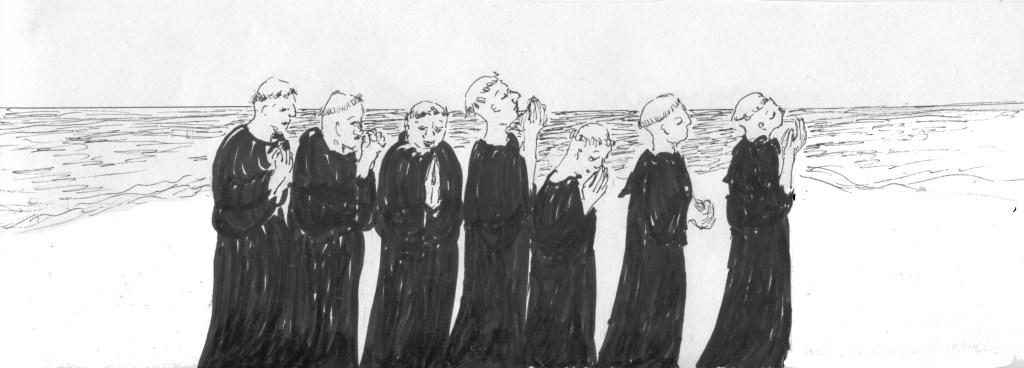
         I was asking a history question. “What was the tragedy that made these Norsemen brutal?” The answer the seiðr offers is to take me to a rocky shore with a ruin of a house and tell me I don’t know human nature.

         “In the far north, where the winters are dark and the summers are still frozen-over, the only people are the ones who have always been.

         “But in this place, further to the south in this land, people came dreaming of rich farms and overflowing gardens. The ones who were always seeking bigger farms were the first to be unsatisfied with parceled lands in Gaul. So, they came here and found all these rocks and bad soil and they tried to make farms of it because here the fields could be as large as they could imagine. But eventually, their wide imaginations slimmed to fit reality. Each farm grazed a few cows. The pasture lands were frozen away in the winters. So, dreams of endless fields and flocks were never really fulfilled. One small farm could sustain the few cows for milking, but with the multiplications of generations came a fear of too many people. How would they divide the land small enough to make every grandchild a farmer? So, what do you suppose happened?”

         “The second and third generations of the farmers found other means?”

         “No, of course not. That’s not what people do. Because everyone does what they know – farmers spawn farmers – well actually, that spawning of farmers is blamed on the wives of farmers.  You know how the song goes, ‘The farmer takes a wife, the wife takes a child, the wife takes a child,’ the wife takes more children,’ on and on until ‘the cheese stands alone.’” [Footnote]

         “That’s a silly children’s game. It isn’t how people actually live their lives, dwindling away to nothing but the cheese.”

         “Even if it isn’t true, if people believe it is a fallacy, it is acted on as true. And the mindset of these patriarchs was this fallacy that too many people could cause a famine in a frail world — the fear of scarcity.”

         “No wonder, after all my deaths and earthly years too, I had no imagination for such a disaster. It is completely the opposite of the Christian generosity and love for neighbor and the Jesus teaching of abundance when food is shared. Jesus showed it as a sign in the feeding of the multitudes [John 6:1-14] 

[Footnote] https://en.wikipedia.org/wiki/The_Farmer_in_the_Dell traditional courting game with many European versions, first find of it written was German in the 19th century. Guessing it has ancient roots.

(Continues tomorrow)

#66.4, Tuesday, March 11, 2025

Historical Setting: 793 C.E. Skåne
 

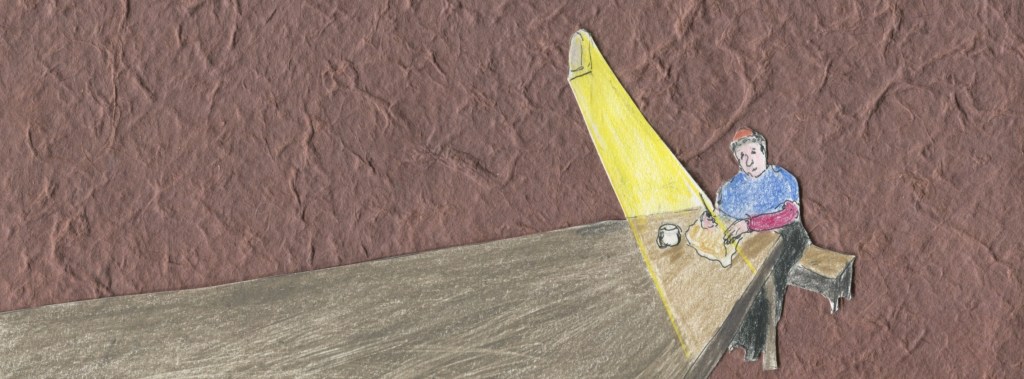
         Sleep last night wasn’t a peaceful conclusion for day. It was only gifted me by fatigue. The fire and ruin of walls may have provided a bit of warmth and shelter from the wind, but snow fell lightly inside these walls, as though we had no shelter at all. I expect we will move toward more civilization today, but for now, I tend the fire.

         The seiðr is spending these morning hours in deep contemplation. She seems not the least bit concerned about food or roof or any of the earth things we should probably think about.

         I’ve been collecting snow and melting it in an iron pot left with this hearthstone where I keep the fire going.

         “You should have some water here before we move on.”

         Saying nothing, she pours the water from the pot into her empty wineskin, and sloshes it around before drinking it. Apparently, she prefers the flavor of old wineskin to the flavor of the old cooking pot. I drink the water, rusty, as it is.

         Finally, I ask her, “Should we prepare to continue our journey, soon?”

         “Our journey to where?

         “I don’t know this land. Where are we going?”

         “You know all this perfectly well. Does it not answer the question you had that brought us here?”

         All along this way I’ve been asking about the people here. What was the tragedy that befell this land and made it a whole world of men and only a few women so that raiding communities on other lands, slaughtering its men and capturing the women becomes the way of life. When I asked for answers possibly buried in the writings of their history, Marian, the slave child led me to this seiðr. And the seiðr showed me no stories of tragedy, only the etched stones telling of gods and heroes. So, what is the root of all this cruelty and suffering?  Why is brutality a way of life here? Grief hangs heavy on this land, yet it seems no one knows of the reason for sorrow. Their gods are loveless. The wives are slaves. Children are a rarity. And seeing one ruin of a cottage by the sea doesn’t explain all this pain to me.

         The seiðr asks how I see this.

         “What I see are walls left of something that may have been a cottage – a home – maybe for a family once. Was this your home?”

         “How is it you can live all those years and still be so ignorant of human nature?”

(Continues tomorrow)

#66.3, Thursday, March 6, 2025

Historical Setting: 793 C.E. Skåne

         The stiff West wind would bring the fragrances of spring thaw to my lost homeland in Gaul, but here it only ushers in more winter days as it fills the sails and scurries our ship across the sea. Sun is low behind us over the waters; and ahead of us, foreboding rocks and cliffs are washed by the sea. But the ship makes its way into an inlet, into a tranquil bay laid among rocky islands and across a sea. Frosty rocks and winter weeds of seashore surround an outcropping of land. Far ahead of us is a bay where other ships are moored. The oarsmen are rowing this part. The dinghy, or a “fearing,” takes us two passengers onto the empty part of the shore stretched out ahead of the harbor.

         The seiðr is silent, studying the shoreline ever more intensely, with her eyes glinting with the steel-color of the eastern sky and her teeth clenched sculpting a jawline of stone. I understand this place where she‘s brought me is her own homeland. But there seems to be no homecoming here — no joyful reunion.

         She finds us a night shelter not far back from the shore. It is a ruin of a cottage, white washed walls of mudbrick, standing naked in a thorny thicket. The thatch of roof, and shutters are long-gone.  There is nothing here that is really a house but the four corners and the crumbling walls. She considers a gapping open space on the sea side to be a door, though there is no sign of anything that could ever be hinged for closure – no wood – no sill – to bar – no knocker – yet she says we must leave our shoes outside the “door.” So, we do. If the cottage had a roof we would see the blackened smoke hole center at the peak, because there is a hearthstone here, and it is indeed blackened from once having a fire.

Maybe it is good we took off our shoes. Clearly this is a home.

         Her jaw is quivering now and she turns to hide her human tears. I offer to gather some kindling and some wood and make us a fire.

         In the bleakness of the winter rocks, I find an abundance of kindling and wood, as though the earth had been preparing for life to return, waiting centuries, maybe, for me to come, gathering up the dry tender again.

(Continues Tuesday, March 11)

#66.2, Wednesday, March 5, 2025

Historical Setting: 793 C.E. Jutland

         Maybe it was after a snooze, or another day and night altogether when I awoke to hear the seiðr bargaining with the sailors to give us passage for the journey to sail across the sea. And so, we are sailing now. We two passengers are just riding along when the sail is all that is needed and even the oarsmen seem to have little to do. Only the tiller needs a man, and that is because we are human, and we think we know better than the wind how to choose a direction for our wanderings.

         The seiðr speaks softly, under the sounds of sea and wind creaking the mast and rope lines of this little boat. She tells me something of this journey.

         “I’ve not been back to my homeland since I was carried off so many years ago.”

         “You were carried from your home as a young woman — all alone?”

         “I was an infant. But of course, even Jesus was rejected in his own land.”

         “You know that of the Christian story?” [Mark 6:1-13]

         “I know that is true for seers, prophets, truthtellers, maybe even time-traveling rune signs.  People fear knowledge from a distant source that just comes to one who is common among them. Older generations only want the children to know what they, themselves, have to teach. If there is a mystery to be found from another source it is perceived as fearsome.”

         I understand what she’s saying. My thoughts are unspoken.  The invisible God with no name has so many ways to speak through Creation to all humankinds and maybe even to critters too and once in a while someone listens. Then the voice of God becomes known. It is human nature to grab the tiller of that wind driven craft and create a religion, or a cult of ritual, or a system of obedience, to allow some to be included and some to be excluded. It becomes smaller than the mystery, smaller than the universe, smaller than the flames of the gathering fire, until it is small enough to be all in human control.

         What can I say to her?

         “How is it that you know the Christian stories?”

“I don’t know all the Christian stories. And if I ever came upon a great binding of bible, which I’ve heard tell of, I wouldn’t even know how to read it.”

“How is it you know the Christian stories?”

         “They are all around us always being told.”

(Continues tomorrow)


#66.1, Tuesday, March 4, 2025

Historical Setting: 793 C.E. Jutland

          “Don’t you have to be back soon?  It seems we’ve already come a long way and you must have obligations.”

She takes a long swallow from the skin of wine strung across her shoulder, and answers, “no.”

         This village seiðr has brought me to a land that would end here at the sea, but she tells me she can’t answer my questions about the love loss here until I understand the sorrow that has come to all these places; and for that, we need to travel on.

 “The sailors will come soon and take us across to the other lands.”     

         I don’t see sailors or these “other lands.” Looking across the water it seems open sea all the way to the horizon. I wonder if her trust in sailors showing up is a seer’s mystical vision or if she knows something earthly. 

         She answers my unspoken question.

“It is the west wind that carries these ships back to their home ports. It takes oarsmen to bring them over to this shore, against this wind. So, if the ships from the lands to the east are here, it’s only because there are oarsmen who brought them over rowing against the prevailing winds and very soon, they will sail back on a more reliable wind.”

         Of course. Ships sailing on westerlies is nothing mystical.  And engravings on rocks are barely mythical. I think it is this magical presence of her that gives mystery to the hero stories, as well prophecies of ships which empowers everything she says with omniscience. She even has power over time, so that the now, where we are, is always wrapped in a rune that she can call forth into a story of once upon a time. That same timeless now is this waiting time for the inevitable to unfold and make her prediction of a ship true. Her magical powers then, are wrought in the waiting, the silence, the spreading of time beyond its boundaries.  The magic here is simply created out of patience.

         So it isn’t really magic. It is dependable and normal, like catching a west wind. In Christian, the waiting in silence is the stillness where prayers are unstrung and heard. The timelessness is God’s own answering space.

         Dear God, thank you for offering the brilliance of cold sunshine on the seas and shores of this land. But why are the people of this wondrous place so deeply grieving and raging? Please guide me to see through the hurt to the love. Amen.

(Continues tomorrow)

#65.12, Thursday, February 27, 2025

Historical Setting: 793 C.E. Jutland

          I still have questions. Why are these people, already empowered by the magnificent nature of being human — already rich with power — setting their hearts on taking the riches of others? There must have been a disaster that skewed the human values. Love, in all its varieties seems taboo. Here is a world of men and where women are few. The few women who aren’t slaves are powerful oddities. Maybe this void of women is filled by capturing thrall. It seems a people always striving become lost from the simple peace of goodness. 

         I ask, “Why are women so few here and mostly they are women captured in raids?”

         “If I attempt to answer you in your own language, I know what you will ask me next. And before I tell you about myself you have an obligation to explain who you are. How is it that you are a young man with an ancient memory?”

         Over and over again, I’ve clearly failed to explain my oddity of life and life again to a pagan seer who really has no interest in a gospel story and surely not a Christian sermon on resurrection. So, what can I say?

         “Once I was a Jewish kid living with my family near Jerusalem. I was best friends with an artisan, a builder, a smiðr. He was a teacher with a radically simple message about an intangible spiritual life — living in a world apparently made only of earthly works – tables, benches, walls, ships. So, in his teaching he used metaphors of tangible things to help people understand the invisible goodness.  He built the fishing boats and set them on the seas to gather food for the hungry and bring comfort for the sorrowing – it was the opposite of Viking raids.

         “He used things of earth as signs – using the visible to explain the invisible.  He was looking for a physical sign to explain the notion that even death has no power to destroy this invisible nature of love. And it happened that he came back to my family when they were mourning my death. And then he called me back into life and I became a physical metaphor for a spiritual truth.  I was bestowed with the same healing every living being has, but in the extreme – healing — even from death. So, here I am a forever sign of life.”

         “So, you are telling me Jesus carved a rune and you are that rune?”

         “Indeed. And now you will tell me who you are.”

(Continues Tuesday, March 4)

#65.11, Wednesday, February 26, 2025

Historical Setting: 793 C.E. Jutland

         The seiðr has chosen to teach me things of this new world where I find myself now. We’ve walked miles along a shore, and now we are in a larger village where rune stones are placed as monuments to heroes. But learning the names of Norsemen who died as heroes for a king, doesn’t make me yearn for this life. It doesn’t even appease my curiosity. Apparently, writing is not really a thing here. Carving art and story into stone or metal or wood for keeps becomes the sacred scrolls of these people.

         She asks me, guessing at my long life, “So why do you keep asking about writing? Touchstones with names give credence to our stories. So why do Christians need the full gospels all laid out in letters?”

         “You make it sound as though written stories are simply a failure of memory. But in Christianity, gospels and writings about saints (hagiography) tell the stories over and over again with one foot on earth and the other in heaven. The written word seems empowered to speak beyond the tangible earth. Even with a good memory, I can only tell the stories of Christians from a mortal, earthly point of view.”

         “Thank you, I’m glad to know you don’t mean to speak for Christian heaven.”

         “Well actually the unseen things of Spirit are the very things that all of us who are skin and bones, and all of the touches and senses of the physical creation, speak for. The Creator makes all of earth its rune stone.”

         “If that were so, then Creation would speak of courage and honor and power. And that is not so. The powers of nature may seem great, but they fail us, so people have to fight through adversity.”

         “Well, maybe in nature, the virtues of heroism aren’t limited to people. Where is there any fledgling bird on the edge of a nest that isn’t also showing courage and honor? Is not flying, its power? And what of the wolf cubs exploring the hunt. And surely, a sapling oak just up from the acorn, breaking through the earth is heroic.”

         “That’s nothing like human heroism, risking one’s life for honor’s sake. – winning a battle.”

         Dear God, I fear maybe honor and courage have become euphemisms for brutal force — gaining the win at any cost. Now I’ve awakened in this strange world made of the same familiar stuff of old kings, driving these people to become senseless, brutal monsters of themselves. What could have led them to this?

(Continues tomorrow)

#65.10, Tuesday, February 25, 2025

Historical Setting: 793 C.E. Jutland

         Apparently, in this strange new world where I find myself, the only known virtue is power and that can only be kept in check by something that can be chipped into monuments – honor. 

         For me, I’m always learning new ways and now that I’m in a new world and new time I’m groping for any connection with the past as a link to this new reality. I always try to connect the new with the known. But this kind of perception requires stretching my imagination around old things and that doesn’t please the seiðr who is only interested in showing me the differences between what I once knew and what I have yet to learn. And she just keeps noticing the “Christian” in my thinking not even because of the Jesus things – the love laws — but in my erroneous conclusions about a god she wants to show me. “Christian” is my notion that goodness is a feature of a creator god. Now I fear there is no imagination at all for a loving God in this new, warring world.  I was apparently wrong in grasping for a metaphorical Rome, where, in another time, I had already witnessed the Jesus love message getting crucified then skewed into war chants by Rome.

         We walk back toward the sea now and follow a road that seems well-traveled. A gentle climb onto a ridge over-looks the sea. Here in this prominent place is a brightly painted runestone.  The artist or the scribe laid the runes between two lines that look like the tracks of a sled meandering a twisty path to suit the contours of the stone itself. In my imagination the runes are the footprints of the beast towing the sled.

         The fingers of the seiðr touch each carved line as tenderly as a mother’s hand touches the lips of a child, speaking secrets.

         She reads it to me. “First, we know who honored him and had this stone made. Here, they were two of his fellow warriors. He fought to the death to save these companions who honored the king, so he died a hero, and his companions assume he is now honored in the great hall of Valhǫll, (Valhalla). That is the great reward and comfort for all hero warriors.”

         “You won’t find me making Christian connections to that.”

         She must know something of Christianity, as practiced in a Roman world, to think that was a sarcastic remark, but I really didn’t mean it so.

(Continues tomorrow)


#65.9, Thursday, February 20, 2025

Historical Setting: 793 C.E. Jutland

            The seiðr tells me that the story on this stone tells of the death of the god Odin.

         “It’s well-known. It is marked on this stone as a picture of an often-shared story, so you don’t even need to know the runes to know this story.”

         The whole face of this rock is one picture. I imagine, were this made by monks it would be a full page of art that separates gospel from gospel, all made to share a common symbol and maybe to show off the skill of the artist. As with the illuminated gospel page, it is a story for the illiterate.

         I see the seiðr brings me to see this first as one illustrated here. It has a certain simple beauty: a frail little fellow with a bird on his head and a monstrous fanged creature gnawing at his foot, maybe even devouring him.

         “This is the creator god, Odin. He is shown many ways, but I know it is Odin because he has a raven. Footnote 1 He is considered the god of gods.” She explains.

         “So, this creator god is all goodness, and yet being devoured here?”

         “Of course not. Why would you think that? There is no goodness or badness among the gods.  They are gods.”

         “If he is the creator is that not good?”

         “You are so deep in such the Christian thing to look only for goodness or evil.”

         “He hardly appears all-powerful here, skinny fellow being devoured by a beast.”

         “The wolf that eats Odin is Fenrir.” She explains, and she places her omniscient first finger exactly on the fang.

         “What does that mean that a wolf devours a god? Oh, wait. I think I know this story. The wolf is Rome?” [Footnote]

         “It is so Christian of you to say that. You say that just because Rome devoured the Christian god.”

         “It is an obvious symbol since it is said that the founders of Rome, Romulus and Remus were raised by wolves.”

 Of course I would assume the wolf is an ancient symbol for Rome. But personally, the actual wolves I’ve known have no taste for gods, or even any desire for the meat of a human man.”

         She ignores my reference and lectures on. “This story is clear and simple. It is told many ways in many places, and always it is an important story.  That’s why I brought you here before we look at the more complicated tales?”

         She leads me on to another stone with abundant markings.

Footnote 1: https://en.wikipedia.org/wiki/Ledberg_stone retrieved 11-23-24

Footnote 2: (https://carlos.emory.edu/htdocs/ODYSSEY/ROME/romulus.html)    Retrieved 6-15-24, a succinct telling of the foundation myth of Rome, which apparently, eluded Laz groping for a familiar symbol

(Continues Tuesday, February 25)

#65.8, Wednesday, February 19, 2025

Historical Setting: 793 C.E. Jutland
 

         The seiðr is taking me north up the shore and now we have come to a river to cross on this path flowing into the sea. I’m hoping she doesn’t intend to wade this river, as cold as it is. But, we don’t.  We walk back from the shore where a drydocked row of boats is set as a fortress wall around a village. She calls up to the guard and asks if we may enter. Had I tried to find this way alone I would have missed the protocol here. But I would have brought firewood for these people.

         The seiðr tells me to stay close behind her and to speak to no one, so no one will know I’m a stranger.

         We still haven’t had to cross the river because here is a path laid low between the river and the bank to follow along until now we come to a crossing place with a fallen log as a bridge.  Here, in this river lowland is a pagen temple made of planned wood boards. It is stacked up like a house on a house, with each little house higher and smaller, until the temple is a towering edifice reaching skyward. She leads me behind the structure where there are several of these rune stones, weighty enough to demand a circle of strong men just to put them in place. Yet each is as precisely set as the pillars of a Greek temple.

         She places her walking stick aside on the ground before she enters; I follow her, laying my tree branch aside also. We enter the circle of stones which is clearly sacred. There is no starting place or most prominent stone but the seiðr goes immediately to a stone that is familiar to her. She moves her fingers over the markings in the way I’ve seen an abbot read a precious scripture freshly copied onto velum. Maybe the abbot was touching velum, imagining stone.

         I know she isn’t reading this for the first time, but, as happens with any familiar touchstone, she is reading it through the fog of time, adding carved lines to the straight with all the memories of meaning in her own recollections of names and events. She brings to it her own voice in the years since the carving. 

         Does it clear the fog of time to have the stories of a god and a people detailed with the inks, or are lines cut into rock all that is needed to speak the forever stories?

(Continues tomorrow)