#48.12, Thurs., Sept. 28, 2023

Historical setting: 602 C.E. The Vosges Mountains

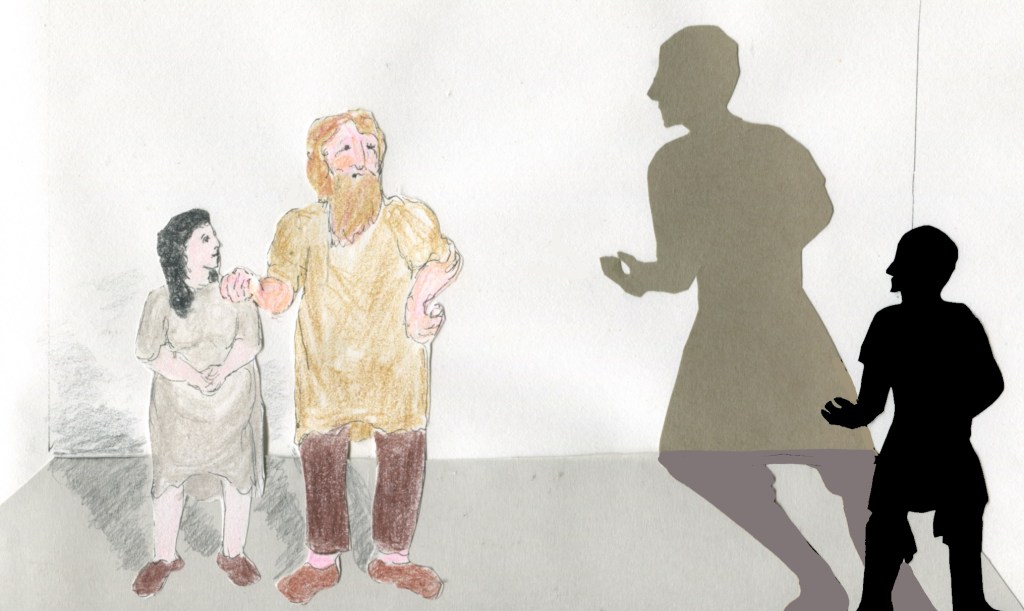
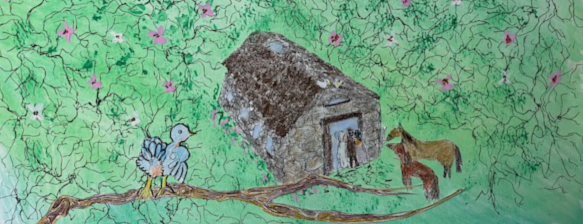
         Those who were once hunters will soon be bent into farmers who will have no safety from wars except for a landowner’s castle walls.  The legends haunting the Samhain fires of the dwindling tribes of pagans remember the ghost riders across the sky, the soldiers of Theodoric I, and the fires of the old wars with the Huns. Our own house is a heap of stones from a Roman fortress ruin. Once guard towers watched to the east from these mountains, guarding against strangers crossing the rivers. In the end the Huns just dissolved into people wrapped in winter furs gathered around the fires the same as all the tribes that are us.

         And here we are again, building higher fortress walls, sending out spies, keeping watch on the wide rivers and borders for others. We name them enemies. Wars require enemies so any others might be them. That’s the first requirement for war — someone to call enemy. If we don’t label our enemies, we could discover the strangers beyond our rivers are us. They are hungry and homeless, not because of scarcity, but because of the fear of sharing.

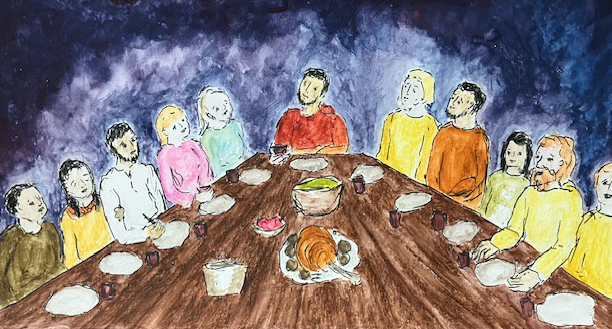
         So, what if our kings and autocrats, or even just our hunters and farmers were to savor the gospels?  What if we go with empathy, not enemy? Maybe empathy is too expensive. It leads to dispersing our winter stores and dividing our fields. Is war less expensive?

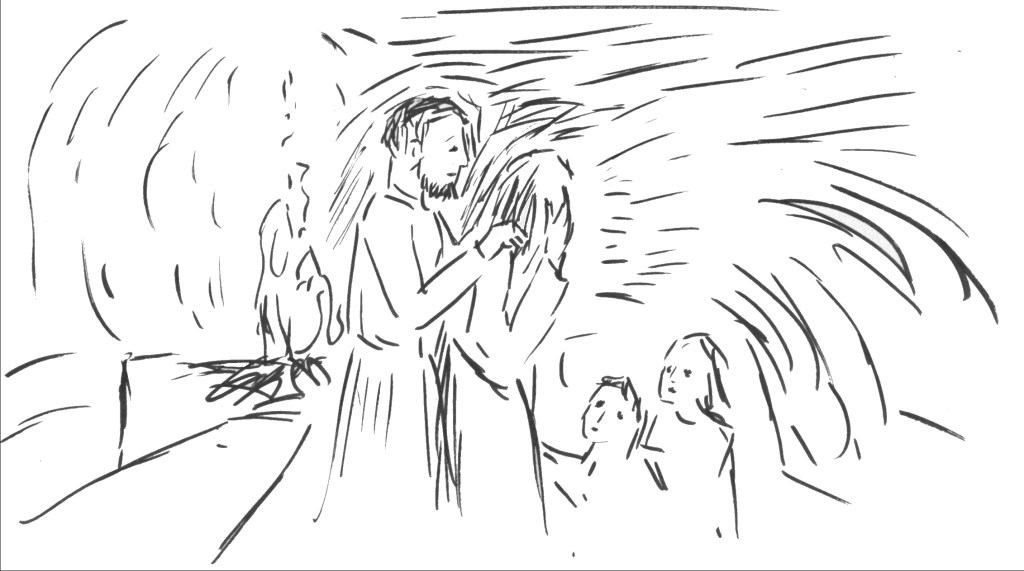
         Dear God, thank you for these great stores of plenty for the winter I, myself, alone, have set aside. May crispy autumn days keep it cool and safe from rot…

         Oh wait, God answers my prayer even as I think of it — no heart searching or revelation is even needed. I’m not deaf enough yet, or too numb to hear God shouting back, “just listen to yourself, Lazarus!  Just listen! You’ve only had one good season, and already you pray like a greedy man!”

         Well, I would plan for solid walls to keep this abundance just for my own family. It’s easy to believe this good fortune and good earth are deserved and are mine, just mine, for the hoarding and the rotting. It’s so easy to think I need bigger barns and fortresses, when maybe, really, I just need wider doorways.

         Dear God, thank you for plenty. Help me recognize that this scarcity I would fear is imaginary. Amen.

(Continues Tuesday, Oct. 3, 2023)

#48.11, Weds., Sept. 27, 2023

Historical setting: 602 C.E. The Vosges Mountains

         I was asking what Bishop Felix will do if the noble bishops of Gaul won’t negotiate.

         He explains, “I will go to the pope again and ask for an assignment to East Anglia. Oh, but I probably shouldn’t make it sound so futile when these power struggles over the hierarchy would hardly make a difference to you and the other common people of Gaul. Surely your faith won’t be forsaken by God regardless of how bishops and abbots may disagree.”

         I don’t find comfort in that. Of course, we, who are the common people of Gaul, are not forsaken by God simply because the religious hierarchy abandon us to argue among themselves. It’s probably a very good thing that this churchman, so recently elevated to his rose-tinted authority, believes his ordination is all for God’s sake. But hopefully he won’t forget that God first knew us all naked, so whatever the liturgical garb, or ermine robes and crown, or tattered tunic, God still listens to our prayers.

         Now, the guards have climbed the hill and they are already at our cottage door. There are four guards on horseback leading the fifth horse, looking for the bishop. One of the voices of these men and the clacking of armor has an indelible place in my memories of terrors. I choose not to invite them into our house or even to go out and greet them as social duty would demand. The bishop simply thanks us and is gone. I send Haberd and Brandell back from the window so they don’t see this.

         The wood-smoke wafting up from the forests at the hunter’s village speaks of a new season now upon us. New castles and fortresses require the huge straight timbers hewn from the forests. The debris of this harvest is heaped unto bon fires flaming up in the newly barren places. The naked earth is softened by burning the land into new fields soon to come under the plow.

         The aisles supporting the halls and oratorios of castles and churches can only be as high as had been these tall trees now cut into columns. Now trees are for holding roofs, not for stroking the skies. When the grand rooms are made with the long tables and great thrones for the aristocracy, then the mules will bring the stones for the outer walls, solid as ancient Rome, to hold back any intruders or armies – maybe the rumored Slavs and Avars. Everyone is planning on wars.

(Continues tomorrow)

#48.10, Tues., Sept. 26, 2023

Historical setting: 602 C.E. The Vosges Mountains

         We’re gathered at the table for our morning oats with our guest, Bishop Felix. Right in the middle of the table is a wilting bouquet of pinkish shades of chickory gathered by Haberd and Brandell. Now I see they are thinking of the color of this bishop’s robes.

         Bishop Felix has Brandell on his knee at the table, and he explains his elegant style to the child. “Monks follow the rule of poverty. But it seems bishops make their own rule. Often, they distinguish themselves in black or white or red. Of course, Father Columbanus has no rule for bishops other than what is for his monks, because there are no bishops at Luxeuil. So, as a bishop now, and yet a follower of the father I am bound by no rule for color.

         When I was made a bishop by the pope I considered the colors carefully, black for the mystery, white for the purity, red for the love — some bishops wear bright purple maybe for their own nobility. But as for me, I find Pale linen invites; it doesn’t astound or overwhelm with authority. So, in Rome I found a dyer of linens who could make this pale rose color, and it was my choice. I’m never mistaken for Frankish nobility. Were we not in a place so worried over bishop power, and had I not been to Rome where this fabric was available, I would simply choose white to remind me always to be pure. But the best thing now is that my choice is appreciated by this child who has a discerning eye for color.”

         After Father Columbanus and Bishop Felix spent the night considering the possibility of the pope intervening on behalf of the Father, I know a letter to the pope will be dispatched as soon as he returns to Luxeuil. But right now, Bishop Felix seems playfully enjoying his own place in the hierarchy having been raised to the equal of the pesky bishops. He is hoping to make peace with them one by one looking for compromises that will allow for the Celtic Rule.

         “But,” he explains, “After speaking with Father Columbanus they may be dug in and unwilling to negotiate. If the bishops succeed in ousting Father Columbanus, I plan to ask Pope Gregory to consider me for an assignment as a missionary to East Anglia.”

         “So, you would just give up on all of us here?” I ask.

(Continues tomorrow)

#48.9, Thurs., Sept. 21, 2023

Historical setting: 602 C.E. The Vosges Mountains

         Even as the sun rises these guests are sleeping soundly. This could never happen under the rule they keep at their own communities. So, to keep the quiet in the cottage, Ana and I take the four little ones outside into the sunny autumn day. Haberd and I carry some logs closer to the door, while Ana takes Layla and Brandell into the shed to search for eggs.  Hannah follows after them knowing this won’t end well with babies handling eggs. This is usually her task and she always finds every egg and none ever gets broken.

         But today only three of the six eggs make it all the way to the table. We do have a nice bouquet of wild flowers for the table and now our guests are all robed and ready for this new day also.

         Brother Servant expects the guards who accompanied Bishop Felix from Châlons will soon be at our door to escort him back to Luxeuil. The message we sent yesterday only said he would be here for a night. And a bishops’ guards have a duty to know where he is. Father Columbanus chooses not to be discovered here so he is the first of our guests to leave as he goes to continue his solitude in whatever is left of wilderness in these times. The Father takes the one bird we still have here that will return to Luxeuil, and that is why he doesn’t need to have his own bevy of armed guards following after him. Brother Servant leaves soon after the Father to return to Luxeuil.

         Bishop Felix has no urgency to leave since his own borrowed guards are expected to arrive. His mission is complete now that he’s met with Father Columbanus, and without those listening ears that would surely carry every word of the Fathers’ chat back to the noble bishops of Gaul, had the guards been privy to the all-nighter here.  We’ll make no mention of the Father’s visit when they arrive.

         Brandell thinks the bishop here dining with our family for breakfast is the most interesting guest he’s ever seen.  He touches the pale sleeve of his garment, then pulls his hand back quickly so not to be caught touching a Bishop. Bishop Felix seems to enjoy the child’s curiosity. He smiles, and takes little Brandell onto his knee.

(Continues Tuesday, Sept. 26, 2023)

#48.8, Weds., Sept. 20, 2023

Historical setting: 602 C.E. The Vosges Mountains

         The night dissolves from first dark into the timeless space between days and still these two men of God are deep in conversation. Bishop Felix tells the Father of the Pope’s priority on sending out missionaries to far places, and here Father Columbanus, is perceived as a missionary himself, traveling with his followers from a distant island to Gaul. Father Columbanus answers this comparison, not with agreement, but by reminding that his purpose here was to be like Jesus venturing into a wilderness simply to listen for the voice of God, not to proselytize to the nations.

         The Bishop argues, “But like Saint Patrick, when you came here you could see the need these people had, to know Christ.”

         “Or maybe only those who already shared our longing came to our doors. Are we changing them, or feeding them?”

         Father Felix answers, “Whatever way you say it, I told the Holy Papa that you were well-known, and beloved, here. Lots of Christians are your followers. Whether you came for solitude or crowds, the part that will impress him about your ministry is your popularity. And with the pope already critical of the bishops of Gaul for engaging in simony, the time is right to send your plea to Rome for support that your work may continue.”

         In this dark hour of matins, with Brother Servant, next to me on the bench, he drops his head back in sleep, gapping mouth, snoring loudly, and the interruption reminds the Fathers it is late. I extinguish the last candle, and stir a fresh log into the coals of the worn fire then retire to the other room with Ana and baby Layla — until very soon the rooster wakens us.

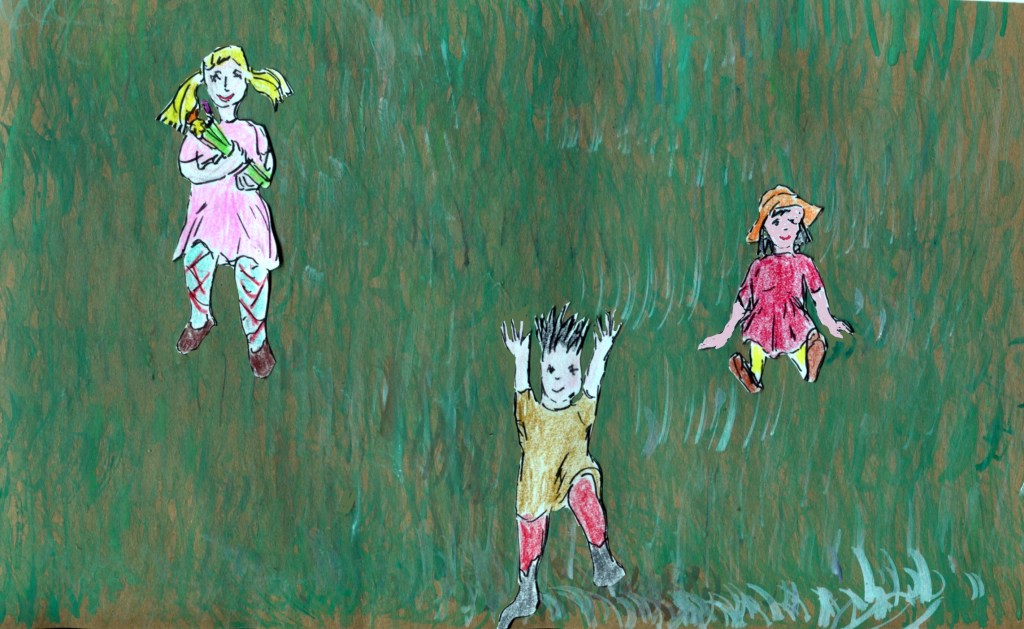
         I hear the little children rustling around in the loft above our room. Apparently, the rooster only wakes our family, so Ana and I go quietly about our chores. The children will soon be down the ladder where the holy men, are sleeping. Draped on the ladder to the loft are those liturgical robes, not to be wrinkled or abused or trodden over by children. And there are Hannah and Haberd and Brandell like prisoners atop the ladder waiting for the rungs to be cleared for their descent. But never mind that wait.  One-by-one the three children leap into my arms, trusting me to catch them, and no one yet has stepped on a robe or awakened a holy man.

(Continues tomorrow)

#48.7, Tues., Sept. 19, 2023

Historical setting: 602 C.E. The Vosges Mountains

         Several candles burned to the socket this night as Father Columbanus listens to Bishop Felix tell of his visit with the Pope.

         The father asks, “So do you suppose the Holy Father will understand my plight with these bishops of Gaul?”

         The bishop answers, “I told the Pope what I know of that injustice.  He used the word ‘simony’ accusing the bishops, then questioned me about the Celtic rule. He wanted to know how Christianity has taken hold in Ireland, which seems to be completely Christian now, yet,  he said, was “once overrun with heathens.” I told him you were born into Christianity there and you follow the creed. He asked me if I knew of the Island of East Angles where Hadrian had once taken the Roman army. I think he has his sights on all the old borders of Rome, but not as a conqueror, maybe as a builder of an empire of Christians.”

         “Ireland was never under Roman rule.” The father adds.

         Felix goes on, “But the Pope and I agreed that Patrick was of the Roman Creed. And that bolstered Pope Gregory’s explanation of the importance of missionaries going out to all these distant places and bringing Christ to the pagans.  He was proud of the success of his mission to Kent under the leadership of Bishop Augustine of Canterbury. [Footnote]

         My mind wanders to proselytizing – Missionaries going out to change people to a particular religious creed. In Acts it was Paul spreading Christianity far and wide. It was said in Mark that Jesus gathered his disciples starting at the shores of the sea.  First, he called Peter then James and John to become “fishers of people” not fish. [Mark 1:16]

         That was in Galilee, but I was in Bethany. I don’t know if Jesus was calling them to mend the nets so no one would fall through, or if he was sending them with nets spread wide to gather-in great numbers of fish/people.

         In my Jewish life growing up in Bethany this notion of converting the masses to follow a single exclusionary creed seemed Roman to me, as was also the demand to worship only Caesar. I expected God to speak for God and the human obligation is simply to listen. Jesus came as the human heart for knowing God, reminding us to savor, in our minds and souls, the old law – love God above all else and neighbor as self. And in the end, it does seem the whole world would need to know that.

Footnote: If you are looking for a fascinating all-nighter with Merovingian history, this Wikipedia article has the pope and the Gaulish kings, Brunhilda and even a wife to a Saxon pagan King of Kent, Bertha. https://en.wikipedia.org/wiki/Augustine_of_Canterbury, retrieved, 2-25-23.

(Continues tomorrow)

#48.6, Thurs., Sept. 14, 2023

Historical setting: 602 C.E. The Vosges Mountains

         Father Columbanus asked Bishop Felix the lingering question, “Does the Pope take notice of the problem with the noble bishops of Gaul?”

         “Yes indeed,” answers Bishop Felix. “He wanted to know why you, a man of great importance here, and I, one who oversees a monastery, are not bishops, and yet others are hailed as bishops who only oversee old buildings and do much less of the earthly work of Christ.  I explained that here only bishops can ordain a bishop and in Gaul bishops have Frankish titles.  He looked pained and called it ‘simony.’ Then the Pope said he sent letter after letter to the ‘great and holy Queen Brunhilda, regent for kings,’ reprimanding the practice of simony in Gaul.”

         Brother Servant and I are sitting here quietly on the side bench but with the mention of Brunhilda we bump elbows and share a smirk. The Pope is complaining to Brunhilda of bishops practicing simony? Gratefully, it is Father Columbanus who asks the question we all want answered. 

         “How is it that Pope Gregory would send his communications to Gaul through Brunhilda?”

         “I think he assumed royalty is in charge here. And there was, of course, the temporal matter of taxes owed to Rome for the use of Papal lands.”

         I whispered my concern to Brother Servant, “What of Luxeuil, and Annegray, and our farm that was also granted by King Guntram?”

         He whispered back, “I believe these are all papal lands, Brother Ezra. You pay your tithe to Luxeuil, and we send an offering gift to the Pope, and we call it the Roman tax.”

         Now both of the fathers have stopped their conversation to silence our interruption. Our humble apologies are mumbled with heads bowed.

         Father Felix continues his story, “Our Holy Papa in Rome said he’s been receiving disappointing reports about the bishops of Gaul who bestow church offices as favors to family.  Apparently, the Pope had established these communications with our kings since he’s been pope. He said he sent the queen relics – iron shavings from the key to the Kingdom of St. Peter, and a special papal garment for elevating one bishop to serve over the others – a palium.“ [Footnote]

         “And here you are” says the Father, “now a bishop? I’m not sure if that is actually Holy Justice, or simply my own humanity that is savoring revenge.”

 [Footnote] Demacopoulos, George E. Gregory the Great: ascetic, Pastor, and first man of Rome. Indiana: University of Notre Dame Press, 2015. p.142

(Continues Tuesday, Sept. 19, 2023)

#48.5, Weds., Sept. 13, 2023

Historical setting: 602 C.E. The Vosges Mountains

         A common cottage tucked away in a wilderness is a good place for two saintly Christian leaders to find a secret peace away from a listening world. Brother Servant and I are witnesses to this, but we have no scribe among us to tell it more broadly.

         Bishop Felix tells of his visit to Rome and his meeting with Pope Gregory. “When I told him of the variety of Christian communities of Gaul it sparked his interest. Some years ago, not long after this pope had been installed in Rome, he opened up channels of communication to distant lands, like Gaul, considering these far stretches of the ancient empire of Rome as his see.[Footnote]  His project is to extend the borders of the Roman church.”

         “Really,” interjects the Father, “I assumed he had so much to deal with in saving Rome from the invading hordes of Arians, the Lombards, and all the other barbarian heretics since there is no longer a Roman army. Then he also had a plague at his doorstep when he came into power.”

         “He was said to have converted the barbarians. At least they accepted the Creed. He has a purpose of the salvation of the whole world, as he has taken to heart the instructions of the Apostles.  The Pope asked me about the churches here, and particularly about the monasteries that are being established with the Celtic Rule. So of course, I told him about your work and King Guntram’s support for our work here in Gaul.”

         Father Columbanus asked, “Do you think our Papa understood that I came to this foreign land, a simple pilgrim, seeking a peaceful refuge in a wilderness? Or is his measure of good work only contingent on great numbers of people flocking to the community?”

         “He was a monk himself. He may even regret being called away from his private contemplations. So, I heard no distinction of successes, only that he is deeply concerned with reports that the bishops of Gaul display what he calls, ‘spiritual immaturity’.”

         “I told him you were doing God’s work here, and it was widely received because the people are longing for the Holy Triune on earth. And I told him that bishops in this land have great temporal power. He wanted to know why one such as I has a following, even though I was not a bishop.”

         “That was a concern of the Pope?” asks the Father.

         “Oh, very much so.” Bishop Felix answers.

         “What did you tell him?”

[Footnote] Demacopoulos, George E. Gregory the Great: ascetic, Pastor, and first man of Rome. Indiana: University of Notre Dame Press, 2015. p.141

(Continues Tomorrow)

#48.4, Tues., Sept. 12, 2023

Historical setting: 602 C.E. The Cottage in the Vosges Mountains

         As the two notable abbots sit by the hearth at this commoner’s table they are meeting here without record.[footnote] Father Columbanus tells of his retreat and speaks of the details of nature he saw just today.

         “The earth is making its last flaunting of summer days – the flowers – so many raucous, bright flowers hawking their wares of pollen. The wandering butterflies alight like long-travelers finding an inn and they savor the thirst-quenching moment and drink up the last of the summer’s beverage. Then they flutter up in little eddies two or three together over the meadow before they are on their way again.”

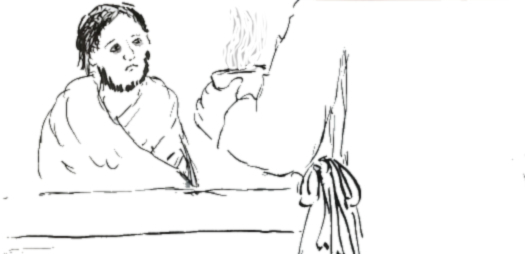
         Now I can serve up the abundant gifts of the pollens because we have bees in our shed.  I pour a spot of crusty mead into their cups and Brother Servant, the two abbots and I, toast this gift of night and quietness in private with no scribe making a record of it all.

         In whispers the Irish Father speaks the prayer. “Stay near us Dear God.”

         It is not the unctuous pulpit prayer to bring a stranger to God in from a wandering throng of pilgrims, it is simply the gracious reminder that God is always present.

         So, in the impending dark I bring another gift of the bees, a candle to center the table. Brother Servant and I sit on the bench near the door as the pale pool of light spreads onto the faces of these two saints. Anyway, I expect God knows them as saints, regardless of the opinions of the noble bishops of Gaul.

         Father Columbanus asks his protégé, “How is it you’ve met Pope Gregory?”

         “A benefactor whose name is undoubtedly known to you also…”

         “I think I know who you mean.”

          “You’ve heard her complaints yourself, no doubt. She is concerned about the rising power of the bishops based only on their earthly titles. She comes to us with a singular focus, overcoming the tugs and temptations of earthly prestige. She generously pours out a rich inheritance to buy a place for a remembrance of Jesus teaching even on earth amid the profane.”

         I hear the spirit of my sister, Mary, in their shared secret of a benefactor. Thank you, God, for this glimpse of a beloved spirit present with us, Amen.

 (Continues tomorrow)

 [footnote] Even amid all the interesting tales and hagiographies available to historians of this time, this blogger offers a meeting off the record because it is still a fictional story; only the spirit of it and the basic facts are true.

#48.3, Thurs., Sept. 7, 2023

Historical setting: 602 C.E. The cottage in the Vosges Mountains

It’s already dusk and Ana has prepared a straw tick and a linen in the main room of the house.  But now, at our door are two more guests, Brother Servant, and Father Columbanus himself, arriving here without informing any guards or other monks, or even mentioning this visit to those listening walls of Luxeuil. This meeting between the two endangered Celtic abbots of Gaul requires no scribe.

         The two abbots in our midst greet one another with kisses.

         Back when Ana and I first met Bishop Felix he was a young priest and a follower of Father Columbanus.  He was making regular pilgrimages to Annegray, and then was returning to Châlons where he reported back to King Guntram on the success of the Celtic community.

         So, when the Father sent us with a message to the “Bishop of Châlons” we soon learned the title was something of an inside joke. Father Felix wasn’t a bishop then. To be a bishop in Gaul requires the approval of the other bishops. Elevation is a matter of Frankish social class regardless of spiritual calling.  Protecting this power structure of and by the aristocracy requires the constant purging of those who could be bishop but who are not of Frankish nobility. That makes Father Columbanus a pariah to the Frankish bishops. The priest appointed by the King was suspect of being Celtic also. But the true distinction of a holy man’s allegiance seems to be tonsure.  If Irish, the front will be shaved, with full hair in the back while the Frankish tonsure is shaven as a wreath of hair. Father Felix, notably, has no hair, so he has no tonsure.  By quirk of Creation, the noble bishops of Gaul are denied their measuring tool.

         Now Ana and I prepare straw beds for three guests in the main room. The children are amazed to find that all three of these visitors already know the vesper psalms we sing in this household each evening. I suppose my children thought this music was theirs alone. Now they assume these adults are singing children’s chants.

         Haberd and Brandell, our music critics, are very impressed.  When I tucked them in Haberd whisper, “The abbots sing nearly as well as Gabe and Greg. And I think they even, nearly, know the words.”

         I answered, “nearly.”

         Dear God, help us nurture our ways of belonging to one another, full on, without too many nearlys and other incompletes. Amen.

 (Continues Tuesday, Sept. 12, 2023)