Post #31.4, Tuesday, April 12, 2022

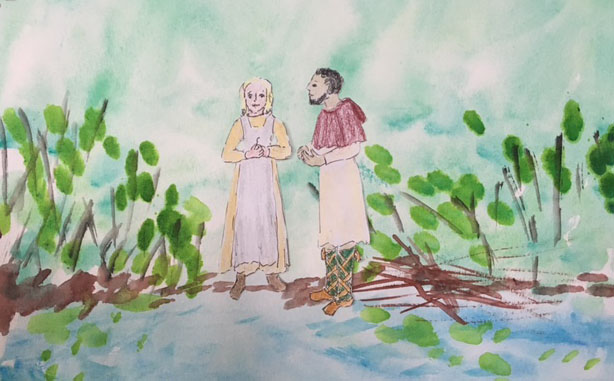
Historical setting: 589 C.E. Annegray in the Vosges

The keeper of the birds told me there is a “Rule of Ana.”

         “It is forbidden to speak any notion that this ‘Ana’ you have called by name as anything but an angel.”

         “I understand. I know this rule was made for her safety. May I be respectful.”

         “It is forbidden even to think of her as a woman.”

         “Of course.”

         I have a thought just now. I try to make a new topic of it. I ask the monk if they raise the birds here.

          “Yes. We may have more hatchlings soon.”

         Apparently I am allowed to ask about the birds.

         “Are they hard to care for?”

         “They are very much like chickens.”

         “I see no roosters.”

         “Yes you do. You just don’t know which are hens and which are cocks, they look alike to someone who doesn’t know.”

         “Of course. Do they all carry messages?”

         “What are you thinking? Whatever does this matter to you?”

         “I’m only thinking of angels now, you know, the wings and all that.”

         Try as I might, I can’t stop thinking of this idea I have. What if Brother Servant could take Ana some birds of her own to raise, and make their home at her house?  Then, she can receive messages from us, and she will have several birds that always come back to her in the same way the birds now fly away from her to come back here. She will have a community of birds and when one is carried here, it can fly a message to her from us.

         The monk reads my silence. “No more thoughts about that holy angel; fill your mind with the sacrifices of Lent, nothing more.”

         When someone says “don’t think of…” I always think of it, even if I wasn’t already thinking of it.  I can’t intentionally, not think about something. Dear God, please check on your holy angel Ana just now, while I try to forget her.

         But even when someone says the name Father Columbanus, I think of birds, because his name means these families of pigeons and doves. And when I think of birds, I think of this idea and then I think of Ana.

         I’ll speak to Brother Servant about this when he returns.  Perhaps Ana could have some fledglings.

         The keeper of the birds reads my silence once again.

         “I told you, don’t even think of her.”

(Continues tomorrow)

Post #31.3, Thurs., April 7, 2022

Historical setting: 589 C.E. In the Vosges Mountains

         Annegray is a ruin of a fortress.  Like Ana’s house it has very sturdy stone walls. But here pieces of a makeshift roof are only in the places most needed. With skins hoisted over here and striped tenting or woven waxed cloth over there it has something of the feel of a desert market place but where I would expect to see camels and displays of merchandise there are just solemn processions monks.

         I see another bird fly over like the birds in the boxes delivered by the servant monk to Ana and I wonder if she is sending a message to us here. Now I’ve seen how messages move here more quickly than even a horse could travel from wilderness places up and down the hills and back to this monastery. Maybe someone at a distance is in need.

         No matter if we value solitude or treasure companionship we are always bound to one another by need. Sometimes it’s our own need, and sometimes it’s our care for another. So the solitary wilderness times when Jesus set this example of the Lenten fast he was attended by angels Mark tells us. [Mark 1:12] Father Columbanus goes to his solitude attended by the Brother Servant. Maybe that is because of his legendary discovery of a bear in his cave, or maybe it was an awareness of responsibility for his community of monks, whatever his reason, the father takes the Brother Servant to always maintain the connection between solitude and community.

         When the fetters of responsibility for others are of our own choosing the name of that goodness is love. Neighbors, partners, obligations, enemies, companions, it doesn’t matter our assigned relationship, when belonging is empowered with empathy both beauty and grief hold us in love’s arms.

         But now I’m thinking of Ana, and maybe I’m always thinking of Ana. Were I a monk it would be a distraction from prayer and probably a sin. Maybe I am required to stay away from her because it is a worry that others don’t know me and certainly don’t trust me. But I’ve made no vow to stay here and I’m thinking Ana is all alone and isolated by the fears of … of what? And yet I stay here. As a child she welcomed opportunities to be with people, but here she is with her companions limited to the creatures of the wilderness. She must feel a terrible emptiness. And now I too am here, not there.

(Continues Tuesday, April 12)

Post #31.2, Weds., April 6, 2022

Historical setting: 589 C.E. Annegray in the Vosges

         “We’d nearly given up hope for finding Ana until I was on this journey to Annegray and I learned from this servant monk that Ana may have been captured by pirates. That’s why I sent the child’s garden tool with this man. If it was our missing Anatase she would recognize it and we would both know she was found.”

         “So you were a monk at Ligugé?”

         “Yes Father.”        

         Now I’m dismissed to the join with the other pilgrims keeping the hours while the father is going on to his solitary place for a Lenten retreat. It seems there is nothing that would stop me from just returning to Ana but that would betray the frail and hapless thread of trust the father may have in me as an obedient as monk.

         I’m assigned to a guest room for pilgrims. This place was an old Roman fortress so it has walls and boundaries, but very little accommodation with actual rooms for guests. I’ve read this Rule of Columbanus we follow here. So I know most of the hours I spend here will be in the oratorio chanting the psalms with the brothers and other pilgrims.

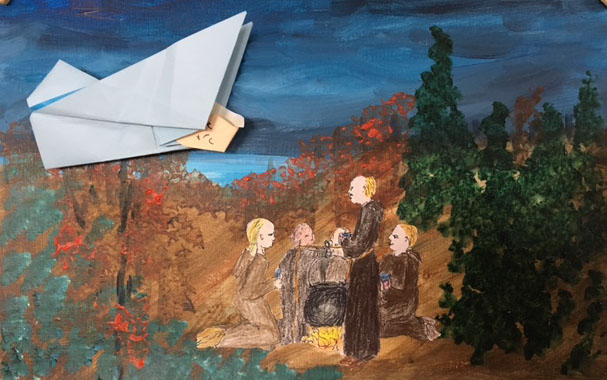
         A bird flies overhead where we have no roof.

         There is a monk tending the birds in this little room next to the oratorio.  As a bird lands on a high rail this keeper of the birds takes it in his hand and removes the message, then places it into the aviary where it is safe from predators.

         “Could I ask you about this?” I have lots of questions.

         He answers, “I’m just the assistant here. The brother who keeps these birds is away.”

         “Is that one of the birds that Ana had at her house?”

         “How would you know of Ana?”

         “I was taken there for healing when I was near death. I am of the family where she was an apprentice in healing. She was kidnapped from our family so I was glad to learn now that she’s safe. We’d been searching for her.”

         “No one but one monk and Father Columbanus are even supposed to know of her. So you should say nothing more about this. As far as we are concerned here, she is nothing more to talk about than a holy angel.”

         He calls it “The Rule of Ana.”

         “And there should be nothing to say to any holy angels that can’t be said in prayers.”

(Continues tomorrow)

Post #31.1, Tuesday, April 5, 2022

Historical setting: 589 C.E. Ana’s house in the Vosges

         This morning the servant monk arrived with a mission to take me to meet Father Columbanus. Finding the Celtic Father was originally the purpose of my quest before I learned Ana was somewhere to be found. But now, as the monk is telling me to come meet the father it seems more of a requisition than an invitation. Apparently I’m being called before him to explain my intention in staying with Ana well beyond my healing time. Before we leave he asks Ana of my fitness for a walk into the valley and up again. Of course I’m able and shouldn’t I answer for myself? I can easily go two kilometers and return by evening. But the monk suggests I may not be returning. She goes into her room with a roof and doesn’t watch us leave.

         Father Columbanus has an unobtrusive authority as I have known to be the demeanor of desert fathers of ancient times. His assurance springs from a silent root.

         After a prayer the servant monk introduces my circumstances here as one who was found with pagan hunters, injured and in need of a physician.

         “But I am not a pagan, good Father. I’m a Christian who set out to follow the pagans because they knew of this place.  I was hoping to find you as I had heard about your journey here from St. Patrick’s island.

         “Father,” Brother Servant intervenes, “when we found him he had been wounded by the pagans; they called him a thief and he sent me with a child’s garden tool saying he knew the young woman you have secured in solitude. His bent dagger was supposed to assure her. At the time I believed him to be one of the pirates who kidnapped and raped her.”

         “But that is not who I am, Father.  I am called Ezra, after the Ezra who is the patriarch of the vineyards on the Loire. I am of that family. The child Anatase was borrowed for her childhood to be apprentice and blind guide for that other Ezra’s sister, Eve. Eve was a practitioner of healing even though she was blind.

         “While Ana was yet a child I went on to Ligugè where I was a monk and scribe for some years. The monastery now has no need for its scribes so when the tragedy came to my family I returned to the Loire. Eve had been brutally slain and Anatase was missing.”

(Continues tomorrow)

Post #30.15, Thursday, March 31, 2022

Historical setting: 589 C.E. The cottage in the mountains

         “The Rule of Columbanus is a shorter document than the Rule of Benedict,” she tells me clearly intending to change the subject.

         “So these are easier rules?”

         She smiles at that silly question.

         She explains, “It takes fewer words because all that obedience and fidelity is to God and not the bishop or the abbot. There is much less detail about wayward varieties of monks and proper outward appearance.”

         I see from the copy we are given it begins right off in the place where The Rule of St. Benedict puts off until “IV. The tools for good works.” mentioning the biblical commands for love of neighbor. [Footnote1]

         This Rule of St. Columbanus begins, “…First of all we are taught to love God with our whole heart and with our whole mind and with all our strength, and our neighbor as ourselves; then {come} works.” [Footnote2]

         Ana adds, “I imagine you and the old monk Nic would have preferred this Celtic Rule.”

         “Ana, you have such a gift of memory, even for these tiny details of our opinions.”

         She explains, “It was so important to me then to know the things that linked people together, things that mattered to people… So of course I remember our reading lessons with Nic’s pages.”

         I still have my question, “Let me ask again because you seem to be evading my questions about your isolation here, giving me only theoretical answers about managing groups of monks. But your loneliness seems so important to you that it is unspeakable to anyone but God. Is that true?”

         Tears well in her eyes. “It is true that I care not to speak about my circumstance here. It’s my own fears that isolate me here forever and ever. You can’t blame it on the monks. They would only help me if they could.”

         “I’m asking this not to make any accusations but to learn if I’m actually welcome here as you allow me to believe I am; or maybe I’m an intrusion into your longing for solitude.”

         “You are welcome here.” She goes quickly into her private room said to have a roof, where she can shield from me her deep sobbing.

         “I didn’t mean to quake the dam.” I apologize as Ana returns to our worktable drying her eyes.

         She has completely regained her composure as the Servant monk arrives at her door.

[Footnote1] The Rule of St. Benedict, Translated by Carolinne White, Penguin books, p. 17.

[Footnote2] The Rule of St. Columbanus (Regula Monachorum), Translated by Terrence G. Kardong, “St. Columban: His life, rule, and legacy” p.1retrieved as a pdf  8-20-21

http://www.companyofjesus.org › Rule-of-Colum…

(Continues Tuesday, April 5)

Post #30.14, Weds., March 30, 2022

Historical setting: 589 C.E. The cottage in the mountains

         The monk explains that in Lent there are more pilgrims than ever at Annegray. He thanked Ana for the seeds and wild roots and flavorful herbs and for instructions for the kind of root cellars used in Gaul. So now, he says, food was already set aside for guests. He says they need more copies of Columbanus’s Rule so this servant brings more velum ends and ink.

         The servant monk says to me, “Surprised we all were to find Ana is such an able scribe. Even in these times of good health all around she is still useful.”

         Ana rises from the table to stir the pot. Her lips are pressed, holding back tears. I know this isolation here, serving people she never sees, is a deep hurt.

         After the servant is on his way I find I can be more useful with the daily chores washing the bowls and readying the pot. Then she sets the table with velum, ink blocks and blades and brushes.

         “Ana, how did they discover you are a literate woman?”

         “Well, you know the messenger birds only fly one way, so to ask something of me they send the servant monk here with a wax tablet. It’s a tablet like the one Brother Nic used to teach me letters.  When the servant brings news that someone is in the infirmary in need of an uncommon cure, the symptoms come scratched in the wax. Then I press the wax down and write the instructions for the remedy and send it back with the proper herbs. But now they want true writing. I’m not practiced with the inks but here they are in need of Rules for guests so I become the scribe.”

         As I watch Ana spend her hours and her days caring for a group of strangers she never sees or touches nor even does she know by name, I ask her if she finds this isolation a blessing or a curse.

         “Do you welcome your solitude?”

         “Such is the way of all goodness, light and warmth of fire, love and even life itself…” She answers, “It is both blessing and curse.”

         “How is such isolation a blessing?” I ask as we scrape the blocks of ink into powder and trim the dried and stretched calfskins.

         “The complaints old Nic had of The Rule of St. Benedict were structures to serve as practical solutions for controlling an unruly mob of boys using punitive earthly measures and threat of hell. And now you ask me if ‘community is the curse’?”

 (Continues tomorrow)

Post #30.13, Tuesday, March 29, 2022

Historical setting: 589 C.E. The cottage in the mountains

         Close to the heart in these mountains deep in its valleys, the Black Forest cradles an eternity of ancient lore. Turned as yarn on the spindles of storytellers are romantic legends of fairies and princes, commoners always reaching justice after cruelty, always turning things upside down as was Mary’s song sung again in the Gospel of Luke. [Luke 1:46-56] But with the bad news I bring, it seems for Ana what had become a dream of a happily-ever-after is just more ashes to sweep from the hearth.

         I try to understand. “So you have to stay all alone out here in the wilderness in a house with only a half a roof, on account of the possible indiscretions of young monks?”

         “You make it sound restrictive. I’m grateful for the safety of this circumstance.”

         “Really? But here you suffer the consequences for other people’s sins.”

         “Did your buddy Jesus tell you life is fair?”

         “No. Of course not.”

         “Maybe it was the old monk, or maybe it was you, yourself who taught me the Jesus answer. The only way to get perfect justice is to become the one who feeds the hungry and clothes the naked and cares for the sick and imprisoned, and never even try to find the equal measure of it all. Here I am much happier setting my sights on serving others and not worrying over my own allotment.” [Matthew 25:21-46]

         This angel of Annegray has a few things collected and ready to send on to those monks: wild seeds of forest herbs for spring gardens, roots and mushrooms to give delicacy to common porridge, and a page of writing, rolled up packed in with all these little finds of nature. She prepares whatever she can to remind monks they are the warp woven into the beautiful Creation with the weft of Holy Love.

         “So it’s not a rumor. You actually are the attending angel here in this wilderness.”

         Thank you God for this window on devils and angels.

         The servant monk comes on foot with a bag of things for Ana, and he puts the things she’s sending to Annegray into his bag. He takes the empty bird box down and replaces it with the bird he’s brought with him. He asks her something in a whisper she freely answers aloud.

         “Don’t worry about Ezra. I’m not afraid of him, even though, as you noticed, he is quickly healing and becoming quite strong and healthy. Maybe he can help me with the scribing assignment.”

(Continues tomorrow)

Post #30.12, Thursday, March 24, 2022

Historical setting: 589 C.E. The cottage in the mountains

         Ana and I are stumbling over steep cobblestones of reunion. Her dream of finding her beloved teacher alive and well, welcoming her back is dashed, and instead she gets handed a man with a wound.

         She breaks into my silence with words, “Of course you have nothing to say. I shouldn’t pour out my own sorrows on you Laz, you need to rest now.”

         At this waking earth and heaven are new again. Old patterns of woes and hurts fade to pale in the morning light. Ana still plays a child’s song and on clay flute. She puts it aside and ruffs the hearth with the bristles of her little broom. It’s a tidy room that has no roof. Rains come and go, sun makes mist of the damp, now it is all glittering new.

         At least today I have strength enough not to be a constant trouble for Ana. Thank you God. She is preparing for a visit from Father Columbanus’s servant who brings her supplies and assignments and keeps her posted on events of Annegray.  Then he returns to the monastery with, as she says, “whatever one would expect to receive from an attending angel. It’s in the Gospel of Mark that Jesus went off and fasted and prayed those forty days of forever in the wilderness, with wild beasts, tempted by Satan and ministered to by angels. [Mark 1:12]  So Father Columbanus set foot in this wilderness as a ‘desert father’ in imitation of Jesus surely expecting the wild beasts and angels and devils. I choose not to be a beast or a devil, so I simply make my effort to attend them as angelically as is humanly possible.”

         “So you made the choice not be the tempter?”

         “Apparently, the temptations that come to monks in these current wildernesses are not the kinds that afflicted Jesus. Jesus had to contend with temptations like: using his superpowers to help others rather than showing off by leaping off cliffs, or choosing between all the power and wealth in the world or love for God and neighbor. That’s what it says in Luke, you know. [Luke 4:1-15]”

         “I know.”

         “When it became obvious that even the most devout young monks could yield to the base and simple temptation of lusting after sex simply by having a woman present, I was relegated to this distant cottage and the eunuch was assigned as messenger.”

(Continues Tuesday, March 29)

Post #30.11, Weds., March 23, 2022

Historical setting: 589 C.E. The cottage in the mountains

         I’ve always imagined finding Anatase and it would be a happy reunion, abundant gratitude and endless hopes fulfilled. I’ve done nothing here but stare into the deep sky and I feel like she’s blaming me for all her hurt just because of my gender.

         “Sorry Laz, I didn’t mean all men seek to own and manage women; its just the ones I know of – I mean in these times.”

          “It’s okay Ana, I understand I’m a lot of trouble for you and I bring only bad news. I’ve come here shattering your hopes. 

         I yammer on, “For me it’s so good to see you strong and well, grown to be such a beautiful and wise woman.” I can see this was another wrong thing to say but I have no idea why. “What did I say, Ana?”

         “Beautiful and wise you say as though you caught a glimpse of sea at sunset. Wise and beautiful is my anathema!”  It’s always these conspicuous holy gifts that cost me any possibility of a good life with a trusted and loving family. Wise as a small child, my own mother feared me because I was longing for learning. She sent me away and it was only by God’s grace that Daniel borrowed me from the pagans so I could taste the virtues of family in my teacher’s service.

         “And beautiful you say, so the men I would loathe most lust after my breasts and ravage and rage to find a place to plant the phallus without the slightest nod to my nature and even to their own natures, as God’s good creation. So for that gift of beauty my teacher never even saw, she was slain and I was taken from that one loving home. These perfections I was born into seem to be my curse.”

         My answer now is a long and hungry silence of words. It is my unspoken prayer of thanksgiving for Ana and her beauty, and for the healing I’ve been granted here by her wisdom. Maybe it’s the spirit of her teacher that pangs my longing to be her trusted and loving family. Or maybe I’m excusing my own lust for her lips and her breasts by thinking of my own virtue.

         Dear God, I find here that my own sexual desires could be an earthly metaphor for holy love. But it is a complicated maze. Is that by holy design? Probably it isn’t my place to know. May I receive your own rule, as Ana already knows the rule for women just by her very nature.

 (Continues tomorrow)

Post #30.10, Tuesday, March 22, 2022

Historical setting: 589 C.E. The cottage in the mountains

         Awake again, the brother servant and Ana are having biscuits and porridge. Brother Servant says he will be going back to Annegray right away, and offers to help take me to a straw bed closer to the fire before he goes. That is a kindness.

         I wish not to cause them trouble.  Maybe I could’ve just gotten up and gone over to the bed with only a little help from Ana. But Ana is giving us so many explicit instructions all about which way I am allowed to move to protect the stitches.  For one who would drop a bowl on the hearthstone, she seems way too cautious over the possibility of jostling her needlework.

         Now I find this bed comfortable. The linen wrap intended as my grave cloth becomes a fine fresh bed sheet, and here is a feather pillow like my childhood days in my rich father’s villa; except there we had a roof and the winters weren’t as cold.

         The monk takes the empty bird cage and has gone now as Ana moves the bench near me to serve the porridge. She has questions.

         “The father’s servant monk said you’ve come with sad news about my teacher.”

         “We’ve been grieving her death, and for all this time we also found no closure, only fears and worries over your safety. It’s so good to find you again and to know you are well — a grown woman now.”

         “But who is it you’ve found?  I’m hardly the bold, ever-daring Anatase, the child ready to take on any challenge. I’ve learned deep fears and now loss. Father Columbanus said I would be a blessing to a convent but how could I ever live under such a rule?”

         “Probably all that reading you did from Brother Nic’s pages put a sour odor on the Rule of Benedict, but other communities have different rules. I think the regimes of prayers and psalms, the guidance for solitary monks learning to participate in community is for many a trustworthy structure.”

         “Maybe that’s the problem. Men crave the structure they impose on women, and women already have patterns of nature to structure their lives.”

         I fear we’re not discussing monastic rule anymore. Silence seems my best reply.

 (Continues tomorrow)