Post #27.8 Thurs., December 16, 2021

Historical setting: 588 C.E. Forest Primeval

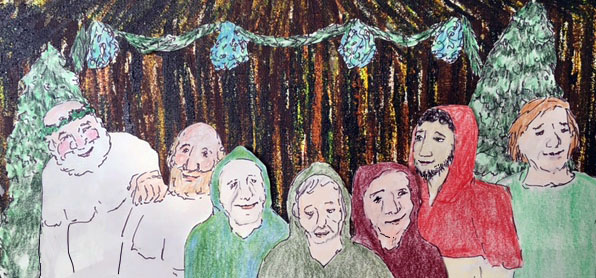
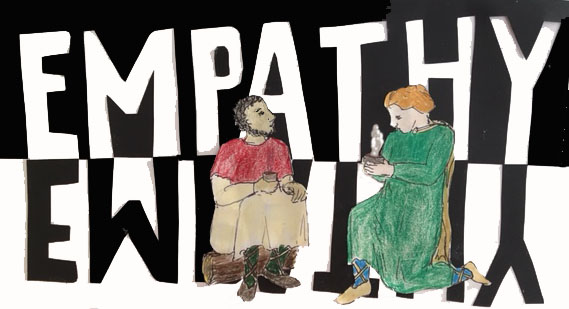
         Tall and pale, he flicks an orange lock of hair away from his eyes so I can’t ignore his glint of terror. It’s true. Empathy is a fearsome pain if it goes unfed.

         “I need to be tougher than all that.” He says.

         “Toughness Thole? Apparently empathy is a greater challenge than toughness.”

         “Empathy is a weakness.”

         “Yes, I guess empathy is the tricky kind of weakness that is well beyond toughness. To face it calls for nearly superhuman courage and strength, not to mention the full love of God. But you can’t escape it. You already have that gift.”

         “What do you mean?”

          “You just told me you have that problem with stinking sick people. If someone vomits, you vomit. If someone faints, you faint. If someone bleeds, you faint because bleeding for the bleeding is inconvenient. So maybe for you, with your seed of empathy growing as it might, you already know the agony of feeling pain with another. And empathy is only appeased by accepting the dare and acting on it. When you know of thirst, give water to the thirsty. When you know of hunger, share food. Try it. Whenever you feel a twinge of hurt for yourself take notice of another person, and recognize it as a command to do kindness.”

         He doesn’t argue. In fact he says nothing. Apparently my dogmatic easy solutions have annoyed him. I take a breath; I hope I don’t vomit just now, as that would simply prove to him there is no virtue in empathy. I have a moment to find a secluded place in the woods.

         Waking now, cold and wet in sweat, it is Thole, himself, who brews the tea. I recommend leaving it at a distance so I can get it myself.  But he is already too near. He offers me the cup with his own risk. He assures me that if he too catches this thing I will find enough leaves left to brew another pot of this tea for him.

         Thank you God for empathy, and for Thole.

         As my strength returns, I do find myself brewing a pot of this magical tea for Thole. We seem to have spent several days in this wood, always cold, sometimes smoky, in darkness and in light.

         On this morning strength has returned to Thole also, and when I wake I see he is already tending the work of putting out the flame and spreading the ashes as we strike camp here.

(Continues Tuesday, December 21, 2021)

Post #27.7, Weds., December 15, 2021

Historical setting: 588 C.E. Forest Primeval

         The druid told me Thole stayed at our so-called camp while I was in the village, and they loaned him fleeces and straw for warmth and shelter. I find him there still sleeping in something he constructed of a lean-to.

         “Good morning, my friend.  I hear you are indebted to the druid for all this finery –these fleeces and this straw.”

         “Ezra!  You’re back!  I thought surely you would be dead of plague by now.”

         “There is no plague in that village.” I go nearer him, to show him the herbs I have.  “It’s a less deadly fever and they provided us with the healing herbs for the tea in case it should come here.”

         “No.” he says moving away as though I were some vicious adder. “Don’t come here with your sickness.”

         “What sickness?  I’m well, and maybe I won’t even catch it at all. Or maybe I will, and if I go mad in the fever, you can just brew me some tea.” He seems horrified. I ask, “How is it possible you spent your childhood with Eve and yet you are so afraid of sickness?”

         “I failed her in that way. If I couldn’t even visit the sick with Auntie Eve, how can you expect me to be around sick people now? I found it disgusting and horrible, so when I had to go along I just waited outside.”

         Dear God, did you forget to plant the seed of empathy in the soul of this man, or is it buried so deep in his fear of helplessness that it isn’t nurtured to life? Please break Thole’s fear that he may be touched by simple kindness.

         Thole interrupts my silent prayer, “What now, are you calling God’s curses down on me?”

         “Not curses, only empathy.”

         “I don’t need pity.”

         “I said ‘empathy’ not pity. Empathy is when you share in feeling with another. Pity is when you are just glad the suffering of another isn’t yours. Pagan gods pity us. The one true God who is love empathizes. So I’d have to pray to a pretend god if I was mustering pity for you. Do you need to be pitied?”

         “I don’t know what I need. But if you start spewing sickness and stinking I can’t help you. That just makes me sick too.”

         “So you are saying you do have empathy. You just don’t know what to do with the holy gift.”

(Continues tomorrow)

Post #27.6, Tues., December 14, 2021

Historical setting: 588 C.E. Forest Primeval

         Druid Largin is preparing for a sacred ritual of harvesting the mistletoe. For this he will wear a white robe, and use a golden sickle.[Footnote] The sacrificial animal is a white bull, already tethered in a stock. I don’t expect any of the others of us, Jewish, Christian or other pagans among the Greeks or Romans or even the far off Magi would understand the Celtic sacred nature of the oak and its winter robe of evergreen. The druid seems to know things. Maybe he even knows there is a story of the pagan Yuletide.

         I’m sure he knows now that whatever illness I saw here was not the plague, but it was a contagion and I may soon be grateful that the druid provided some leaves of that healing tea. Possibly the druid knows what Thole has been doing all alone at mid-winter camp with no shelter.

         “So what of Thole?” I ask again.

         He muses, “I’ve loaned him some fleeces and straw for his shelter. I know it’s foolish to lend to Christians, since I loaned your people a child and now you’ve lost her and she won’t be returned.  Christians really can’t be trusted. But just the same, he had no sense for a winter’s camp, and we couldn’t just let him suffer.”

         “That was kind of you. Did he mention his purpose in coming back into this forest?”

         “He had a purpose?”

         “Such as it was. He was planning to find your village and live among your people. He felt the spirit of the woman he calls ‘Auntie Eve’ is welcomed here and he wants to be near. On the first night of Samhain he believed she was summonsed from the dead so he chose to come back here.”

         The druid surmises, “The spirits that rise up from the other world merge into a blurry oneness, so a grieving person may find a brief reminder of the one longed for but mostly it’s just the ménage of indistinguishables like the three parts of the god – Bridget. And you will have to admit, a triune god is three times as good as a solitary especially for Christians who are so prone to showing up unprepared, then loosing the things that are loaned them. If I want to find my own peace with your kind I may have to forgive the debts.”

         “That’s gracious of you, Druid Largin. And may I one day hear the story of Yuletide?”

[Footnote] So little is known of the druid ritual and tradition that what little was kept by rumor and outside observers like Pliny leaves much in need of explanation. retrieved 8-19-21, https://en.wikipedia.org/wiki/Ritual_of_oak_and_mistletoe

(Continues Tomorrow)


Post #27.5, Thurs. December 9, 2021

Historical setting: 588 C.E. Forest Primeval

         Night is already down on us, but here in the thatched house we finally have light and warmth. The tea was set outside in a steaming bowl.

         “Your sisters brought you this tea and a biscuit too; they are offering non-stop chants and incantations – they are doing everything they know for your strength to return. Druid Largin wants them to stay away so they don’t catch this sickness. But like the fellow you helped that night, you’ll be strong again soon.”

         She answers, “I have to go now and help my sisters prepare for the Yule.”

         This woman has been fighting for life alone here in the cold and the dark, and now she is worried about helping prepare for some pagan feast that comes around every year. 

         “You’ll have plenty of time when your strength returns.”

         “No, please help me get up now. I have to go to them. We have so much to do to prepare.”

         “For the Yule season? It’s still two weeks before the sun stops and turns again? Surely you have plenty of time to rest.”

         There is so little reason to worry over her so I’ve hardly stayed awake for my watch; only when I wake to add wood to the fire do I notice it is nearly dawn and the woman I am tending is well and sleeping without fever.

         At first light I hear the voices of her sisters and she awakens and gets herself up and goes out to greet them.  In this early morning light they are chattering their happy reunion, like birds in the springtime.

         Druid Largin is standing aside, grime faced, arms folded, taking in this chatter over petty concerns that seem to occupy these women amid their own threats of plague.

         “I guess getting the Yuletide properly celebrated is essential.” I surmise.

         Their priest answers, “They’ve completely lost the meaning of the story. All they do is worry over repeating meaningless tradition, the same as it was forever and ever, all over again this year.”

         “I didn’t even know there was a story of the Yuletide.”

         Maybe I am being insensitive to this other religion. I mean to change the topic, “Have you seen anything of the man Thole I was with? If he is still waiting for me at the camp I should probably return.”

         He offers, “In my opinion, that fellow Thole is a bit of a useless sort. Never-the-less you should take some of the healing tea leaves with you.”

(Continues Tuesday, December 14, 2021)

Post #27.4, Weds., December 8, 2021

Historical setting: 588 C.E. Forest Primeval

         She isn’t dead and I see she has no bubos or signs of plague. She is fevered and thirsty the same as was the count that night when she brought him tea.  I’m not sure what she says, but she seems to mumble some form of gratitude. Maybe I’m standing in for some little god, though I’ve not heard of one of those elves who would visit a bedside. Mostly I think they just play among themselves in the otherworld below the earth. But then who am I to know?

         My own prayer is simple. Thank you God, for sending me here to see this holy virgin back into life. Amen.

         She really looks nothing like the Holy Virgin, but then the true look of Mary matters not in the Christian world either. That Mary of the churches is plump and pink, crowned with jewels and really hasn’t any likeness to the plain and devout Jewish mother of Jesus who saw my friend through all the hurts and woes of his unsung childhood.

         The first thing to do is ask the women who are chanting outside to provide things. I need some fuel and a flame to make a warming fire, and a blanket. Some clean straw would be helpful and a bowl of water and a cloth, and of course some of that healing tea that rescued the count. 

         They quickly return with the things I requested but they are only willing to leave them outside the entrance still fearing plague. I know she would want her sisters near her, but the druid won’t allow anyone of the village to have contact still fearing plague.

         Now I can give her a clean mat for her bed and warmth and light with the fire. Just a few sips of cool water have brought her to full awareness now and I have yet to give her the tea. She thanks me for the cool cloth on her forehead, but suddenly realizes I’m a stranger.

         “I was one of the men who came with horses on the night of Samhain.  You were so kind to our leader that night and now he is fully healed. Surely there is no one’s justice that would allow you to suffer for your kindness.”

         “What day is this now?” She asks me.

         Why would she need to worry about the day? “Don’t worry. You haven’t slept through winter yet. It isn’t even the solstice.”

(Continues tomorrow)

Post #27.3, Tuesday, December 7, 2021

Historical setting: 588 C.E. Forest Primeval

         Druid Largin blames us for bringing them what he believes is plague and also for breaking the promise to return the child. I’ve offered to go to the woman who is ill and take her the tea that healed the Count, then I can see for myself if there is a danger of plague.

         Thole takes me aside while the druid waits, “Ezra, you can’t go near that woman. The pagans fear the plague and we should too.”

         “Thole, you know my circumstance. In my very long life after life I myself have suffered plague. I know it too well and I don’t believe it’s here. Also, if I didn’t act on the command of empathy it would burden me forevermore. For me, forevermore is a very long time. So you just keep a safe distance.”

         Thole resolves, “I’ll make a fire here and wait. If you don’t return I’ll just go back home and tell them you are dead.”

         I can see Thole isn’t really ready to commit to belonging to a whole new tribe just yet. So he just stays at the campsite; I follow Druid Largin into the forest.

         The village is of houses very similar to the houses I saw when I was shipwrecked on the Island of St. Patrick. They are round thatches, closer to the earth but also similar to the round thatches we saw at the statue works of Anton.  I know that one pagan tribe can be very different from another but we Christians just assume everyone with many gods are only one kind of thing — pagan.

         Druid Largin shows me to one house where a fire is kept outside and some of the women are chanting rhymes and spells around that fire.

           I duck into the entrance though no one else follows. This place is very cold, and nearly dark with no fire. There is a strong stench of sickness here, but again, it is not the plague stink. That elderly woman who helped the Count lays limp on a bed of straw with only a light cloak that doesn’t even cover her. There’s not even a cup of water in her reach and no sign that anyone has come near to care for her. Yes, I can see this is the helpless tattered woman mistaken by the Count to be his own mother and said by the Christian priest to have been a sacred vision of Mary.

(Continues tomorrow)


Post #27.2 Thurs. December 2, 2021

Historical setting: 588 C.E. Forest Primeval

         Here is the place where once we kindled a fire. It’s a cold little mound of ash without a whisper of smoke. We eat leftovers from the great feast of victory this noon day. It is still and very cold.  The sun only pretends to prod its tenticals between the naked limbs of forest. The village of the tribe we met here can’t be very far. I wonder if they are already watching us.

         No sooner do we start on the trek deeper into the wood when the little druid appears in front of us, not welcoming, but holding a large staff like a barrier to block our way.

         “Don’t take another step! Go back and die on your own lands.”

         “What are you talking about?”  I ask.

         “But Sir, Druid…” starts Thole.

         “It is Largin, I have a name.”

         Thole continues, “Very well, Druid Largin, I’m called Thole, but you may wish to call me Troll if it is more suitable to your faith. And this man is Laz… Ezra; he is called Ezra. But if you don’t like Holy Bible names he can be whatever you wish.”

         “Of course he can. And I wish you both away!  Go far away and take your Christian plague with you to the farthest shore!”

         “Plague?” I think his sudden fear has a reason.

         “As though you didn’t know. The woman who knelt by your fellow with fever to give him tea is now raging with fever herself, soon to die of plague. For fear of plague I can’t even allow her own sisters to bring her any comfort. She will die very soon, and it’s all because of the Christian plague.”

         Thole argues, having once lived in the home of a healer known to be pagan, “Plague isn’t Christian. It can spread to anyone.”

         I add, “I don’t think our fellow even had the plague. The tea made him well. I’ve seen plague and I know how it kills. I’m sure the Count didn’t have plague.”        

         “First you people break the promise to return the child. So we have no able practitioner when we need her most, then you come to us at the sacred night of Samhain and bring a plague down on us.”

         “Please, Druid Largin, take me to see this woman and I will give her a healing brew myself.”

         Thole takes my arm, “No Ezra, what if…”

 (Continues Tuesday, December 7, 2021)


Post #27.1, Weds., December 1, 2021

Historical setting: 588 C.E. Jesse’s Farm

         It’s an early rising for chores long before the night is broken. Thole and I milk the goats and fill the oats in the horse’s trough as silently as we can not to waken Jesse and whomever else he has in his bed after yesterday’s feasting.  We draw buckets from the well to fill the hollows in the watering stones. Now that Jesse has chickens two hen’s eggs are found in the straw so we put them on the board next to the bowl of fresh goat’s milk and they will know the chores are done. Thole chooses to leave without speaking his hurt to his father.

         Just before the gates of Tours is the ferry landing and Thole reminds the ferrymen that three days ago he was crossing with a horse and the ferry tipped, so he didn’t get the boat ride already paid, and now we should cross the river without paying. Oddly it is agreed.

         It’s late in the morning by the time we’re on the north side of the river. Three day old tracks left by eight horses are easy to follow along the riverbank and into the woods.  I can guess where we are going but why we are going is a mystery to me.

         “Thole, do you have a reason or a plan?”

         “I just want to be near the spirit of Auntie Eve. I’m looking for the druid to ask if we can join up. I should think they need more strong young men, don’t you suppose?”

         “Yes, I would suppose so, since their tribe is older people and most are women. But why would you want this?”

         “Okay, Ezra, you don’t have to come! You can just go back to the greed and garish selfishness! I can do this by myself.”

         “I’m not arguing. I’m just wondering.”

         “I want to belong where the people still know the spirit of Auntie Eve. They haven’t forgotten her. I thought you would want to be close to her too.”

         Dear God, when you are counting every hair of every head of Creation – caring for humankinds and all of the beasts too — surely the lines people draw separating our varieties of worship might not be important to you. Let me not keep these walls in my own heart, separating tribe from church. Give me eyes to see wider. Amen.  

         (Continues tomorrow)

Post #26.13, Tuesday, Nov. 30, 2021

Historical setting: 588 C.E. Forest Primeval

         Thole is defiant. Grieving for Eve who raised him through his childhood, then he left her in her blindness to go back to his father to take the responsibilities of a farmer. Maybe he feels the same guilt as I, who also abandoned Eve in her silent, uncomplaining need because she seemed so resilient and able.

         Through his howls and tears he keeps reminding me I don’t understand, and yet my own sorrow tells me I do – or maybe not.

         My prayer begs God’s presence in my own grief, but it yields the empathy for me to see beyond our shared loss of Eve. And it is true that Thole claims his own grief, because his deep sorrow is his father’s betrayal of some kind of unsaid vow to Eve. Or maybe it is that Thole feels he is betrayed by his father’s stranger — a widow, immune to suffering grief – already a mother and ready to bring with her a family of her own sons and daughters. With all these people as a family for his father, what use might Jesse have for Thole? It is need and usefulness that binds a family until love wears a silent pathway.

         The black water of night flows in thick braids shaped into river by the obstinance of these two opposing banks. We sit here with the murmur of the river under the winter’s dark.

         A sudden jolt of inspiration sets Thole on his feet. “My father named me “Troll.” Let him feel his own loss of Thole now. I will get a horse from the count’s stable and cross this river into the pagan wood! And my father’s heart will ever wonder and wish for me, but I’ll never think of him again.

         Need I remind Thole he isn’t that good at crossing the river with a horse. Or maybe I will just save him from the water again, and hope the horse can swim.

         I answer, “Our crossing will be easier without the horse. Let us walk to the boat landing in the morning.”

         Dear God, You can see both of us in our separate pains are imagining new lives, new friends, new family, new place to live that surely must be better than the old, even though we have no idea what a different life may be.  Stay close as we make an earthly plan of it. Amen.

(Continues Wednesday, December 1)

Post #26.12, Thurs., Nov. 25, 2021

Historical setting: 588 C.E. The Count’s Mansion

         A victory feast at a fine estate is a great spread of meats and bold porridges, an abundance of saved melons and dried berries, honey and cream spreads, wine and mead flowing free. Possibly, in the other room at the women’s table they have these same indulgences as we have; only they, in their modesty, would prefer men not see them in such bliss. Here with only men is the great wolfing, and gnawing, belching and snarling until the great feast is in bare bones and shatters, and we sit back and paw the juices from our jowls then the servant comes in and says, “There is more.”

         Now the women come in, fed and ready to slide their thighs between the men’s seated on the benches at the board. (I did mean to say, seated together, facing only the board as for a meal.) New sounds, women’s voices, giggles, delicate glassware, setting a new ding of note. A tray of honeyed wafers passes among the takers again and again, reaching and longing for more, yet the desert seems ceaseless. A thick sweet brandy wine fills each glass sticky and fragrant.

         I watch as Thole watches his father’s hand finding the delicate edging on the hem of the widow’s tunic. This farm roughened hand has a comfortable place on the pallid knee, but then it slips ever so slightly onto the thigh of the widow of Saumer, and in an instant of rage Thole flees the table and the house, a child’s tantrum on a grown man with a great flood of tears and howls, and shaking, quaking from his shoulders to his belly, slamming him to earth like a swat to the back of his knees. I see this.

         I’ve followed after him. I have a hint of a fear that he would prefer the bottom of the river to the great and sumptuous feast of victory. He sees me, and gathers himself to his feet to run again, toward the river.

         “Thole!  Stop!  The river won’t take your hurt away. If you go in that water I will come in and get you, and we will both just be shivering on the shore! It won’t fix the hurt!”

          I’ve rescued him from the river once, and I can do it again, with the help of God; but I can’t save him from his grief.

         He shouts back, “Go away.  You don’t know!  Leave me alone!”

(Continues Tuesday, November 30)