Post #3.6, Thursday, 12-12-2019

Historical setting: 561 C.E. Gaul

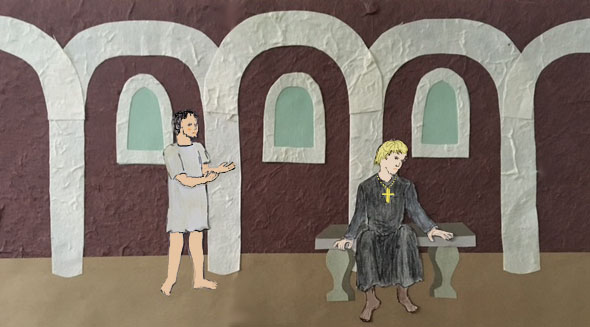
She can’t eat when her face is covered in bee nets. Eve sits on the hearthstone near the coals smoldering under the kettle. There is a bed but no chair. The soup is hot and good. But she has only one bowl and one spoon in this house and that was offered to me while Eve just  watches through her veils.

         “Have you no bowl for yourself? The broth is quite nice, but it would be better shared.”

         “It’s fine Papa. I told Ezra I would give you supper.”

         “Eve, maybe the missing detail of the story where Jesus ate at our table was about everyone eating together. Maybe I should build you a board and bench and get you some bowls so that you can share in the meal and not just give another a bowl of broth and sit and watch.”

         “I’m so sorry Papa.  I wanted this to be a good supper for you. It was I who asked Ezra if I could serve you. It was my idea. I wanted you to come here. I’m sorry it’s bare and lonely. I can see you would be much happier with your grandchildren. I thought if you came for supper it wouldn’t seem lonely.”

         The net that is supposed to keep me from seeing scars is the same veil that keeps me from wiping her tears away.

         I know my thanksgiving for finding my son and daughter was that they turned their hurt to empathy for others who were hurting also. But now I know better of that grace. Here is Eve known to herself and others only by her hurt.  Where is her empathy for the feasting and her joy in joining into the song? How will anyone ever again hear her silly child giggles after each skip of the stone her brother tosses on the water? Does happiness not need to be celebrated with the shared empathy also?

         Dear God, Thank you for revealing this emptiness and help me into the miracle of seeing by your light. Help us to know Eve as you know her, beautiful, cheerful, enjoying the simple giggles of belonging again. Amen.

         “Papa, you stare with worry.”

         “I was thinking a prayer.”

         “Well, please don’t pray for me. Tomorrow you can sup with Ezra and Colleta and the children. It will be fine. I promise it will be better tomorrow.”

         “You notice my worry well. But my prayer was for something else. So tomorrow I will be busy with a project. And I will eat again here with you.”

(Come again on Tuesday, December 17)

Post #3.5, Wednesday, 12-11-2019

Historical setting: 561 C.E. Gaul

“Papa, are you telling me that it was your own father who was the Pharisee with the dreaded skin disease?”

         “Yes, it was my father who, just like you, had the scars from the pox. The priests of the temple would not declare him clean even though he was well and in good health so he had to leave his work at the Temple and set up a new trading center in Bethany where our family prospered for all the rest of the years of his life.”

         “So tell me of his healing?  What did Jesus actually do that brought him his healing?”

         “Eve, that is another part of the story you have miss-remembered.”

         “What do you mean?”

         “My father was never ‘healed’ of his scars. In the other gospel’s telling of it he still had the scars. No matter how many different ways writers twisted the stories of our family it was never said that Simon the Leper was healed.”

         “Did you see your father with the scars?”

         “I would suppose I never in my life saw his face without them. But when I remember him now I don’t even imagine the scars so much as his smile and his bright eyes. He had the kind of dancing eyebrows when he was deep in conversation just like your brother’s. I never thought of his scars, but for the stories told in other gospels where the look of his skin seemed the most important thing about him. They didn’t know him.”

         “There was no healing, Papa?  I was sure that story was of a healing miracle.”

         “There was a healing miracle to be said of that story, Eve. But it was the people who knew him who were healed. We could see him as he was — a beautiful Creation of God. Jesus and his friends ate with him. They weren’t afraid of him.”

         “That isn’t a help to me. I’d rather think there is still a Christian secret in that healing. It’s no matter I guess. So, please, come around to the door at my hearth when it is fully dark, Papa. I have some hot broth and a biscuit for you.”

         “Thank you Eve. I’ll be there soon. I fear I still won’t have an answer for healing but I do want to eat with you and broth sounds very good right now.”

         Dear God, Thank you. Amen.

(The story continues tomorrow)

Post #3.4, Tuesday, 12-10-2019

Historical setting: 561 C.E. Gaul

         “Eve you have asked me to tell you the details of the story of the ‘pagan’ with the ‘dreaded skin disease.’ It did happen in Bethany, so I know the telling of it better than did the other gospels where it was written in different ways. It was a story my family told in early Christian times and it was known so well by all of us.

         “The story is of a Pharisee said to have some version of leprosy, a term often used then to mean any kind of scars or disease of the skin. Jesus and his friends ate often at the table of this Pharisee, Simon. I can see why you would think he was a pagan as it was told. Gospel speaks of the Pharisees as enemies of Jesus so in our times maybe the Christian foe would be the pagans. But the Pharisees were sort of the opposite of pagans. They were Jews who kept careful obedience to every letter of the law as written in the Torah. They were also the usual ones doing the business in the market place.”

         “So, I was wrong about that, Papa, calling Pharisees pagans. Does it even matter? What I really want to know is about the healing.”

         “I only mention that error because my own father was a Pharisee and maybe that makes me a bit too picky about the details also.

         “So Eve, the way healing worked then for the Jews was that the priests of the temple determined when someone was healed and cleansed of disease. When someone had been contagious or ill and then they recovered they went to show themselves to the priest to be declared clean again. The priests were a different political group than my Pharisee father who worked in the open markets in the porticos of the temple. So when my father was afflicted with a disease that probably came to him from the trade caravans he dealt with in his work he recovered and was well again. But when he went to the priests to be declared clean they wouldn’t do that because my father had scars from the pox that never faded.”

(The story continues tomorrow)

Post #3.3, Thursday, 12-5-2019

Historical setting: 561 C.E. Gaul

         I’m asking Eve who is hiding her face from me, “Does that answer your question? Did you need to know that the stories I know best are written in the Gospel of John?”

         “That wasn’t really my question, Papa. I really don’t care about that; but it was the priest who seemed obsessed with naming true gospels. I just needed that clue to ask the proper question. But I still have the question.”

         “What is that?”

         “I want to know the details about the nature of the healing when Jesus healed the pagan with the dreaded skin disease. I know the message of the story was that Jesus loves even his enemies and eats meals with bad people. But I want to know the actual facts – the nature of the healing.”

         Dear God, I know she is begging to be healed of the scars. I know my answer is empty of that. Please be with us and heal all of us who know Eve to have eyes for seeing her beauty as you see her. Thank you for your gift of love. Amen.

         “My dear child Eve, I think I understand now the Christian secret. Even though you are called a pagan you already know the secret well because you love and care for others even in their most difficult need; that kind of care for the sick and least beautiful of us is what is asked of all of us who claim to be Christian. Scars disappear unnoticed to those who see persons as God sees them. You don’t need the veils any longer for Ezra and for the children. After the first look they know you as the person not as the scars. I can overlook the scars too if you let me see your face.”

         “That’s not really helpful Papa. It is too important to me to have a papa again and I won’t take that chance on you seeing my face and screaming and running at the very sight of me. Please just tell me that story of the pagan with the dreaded skin disease.”

(Story continues next Tuesday, December 10)

Post #3.2, Wednesday, 12-4-2019

Historical setting: 561 C.E. Gaul

         Here I am in the loft and my daughter is hiding her visage from me below harboring a curiosity or maybe a care for a Jesus story. I have stories to tell aplenty, but why would she want to hear it?

         “Papa, when we were little children you would tell us Jesus stories as though you were Jesus’ own friend and as though you were really there in the stories.”

         “And you don’t think that was true?”

         “Ezra told me your secret so I know it’s true. But of course the priest I visited at the St. Maurice Church with my question had no thought of that. I was already being called a pagan and he thought I had no Christian privilege to know the stories. He wanted to know ‘which gospel I was quoting.’  I don’t know what he meant. So I just left and the Christian secret is still safe there with him unless you would reveal it to me.”

         “There isn’t a Christian secret in the stories of Jesus, Eve. Probably the priest didn’t know how to answer you so he hid in a veil of pomp. Priests do that sometimes I’ve noticed.”

         “So the secret is the dearth of truth.”

         “That does sound pagan said that way. But maybe it is that the teachings of Jesus are simple to speak but hard to live. That is no secret. That’s a dare. What’s your question?”

         She takes after me and answers with a story.

         “Do you remember the story you told of the blind man who was healed?”

         “Yes.”

         “When I heard it taught by Christians it wasn’t as you told it because they made Jesus seem a magician who healed with magic and not with nature. But when you told it, the magic wasn’t in the healing but in the change to the people who were watching. Jesus did the healing with dust and spit just as I do to heal swollen eyes when a child is brought to me with stings or rash.”

         I am starting to understand. “So that is probably why the priest wondered which gospel. Jesus was from Nazareth and not from the place where our family lived; so some of the gospels are of things known to his followers from there. When he came to Jerusalem he and his friends often stayed at our family home in Bethany. So to answer the priest’s question you would say the stories I told were Bethany stories and that would be in the Gospel of John.”

(The stories continue tomorrow)

Post #3.1, Tuesday, 12-3-2019

Historical setting 561 C.E. Gaul

         It was a long journey from Poitiers here to the Liger Valley keeping watch through the night then traveling on most of this day. The donkey is resting in his stall below and I am able to find a fine rest in the straw of this loft. Now someone has come to the donkey shed side of this house.

         “Eve, is that you?”

         “Yes, Papa. Don’t come down. I’m not covered. I just wanted to talk with you.”

         “I hope it is alright if I make my bed in the loft here.  Your brother thought that would be okay with you.”

         “It’s fine Papa. I have a blanket to give you. The nights are cold now and you will want a blanket. Your dinner tonight will be at my hearth. I’m a better cook when I can share with someone. I need to talk with you Papa but please don’t come down.”

         “Dear Child it’s alright if I see you. I know you have scars from the pox. I have seen scars before. I won’t be put off by it.”

         “So you say, Papa. But we don’t know do we? I want to talk with you.  But I want you to know they call me a pagan now, Papa. I hope you will not hate me for that.”

         “Eve, you are my child. There is nothing others can say of you, or that you can think or say or become that could ever make me not love you.”

         “So you say, Papa. I will try not to strain your good intention. But I have a Jesus question and the priest says it is a Christian secret and it should not be revealed to a pagan.”

         “I can’t imagine what could be a Christian secret.”

         This is an uncomfortable conversation, me in the haymow and my daughter staying intentionally out of my sight as we try to work through nineteen missing years of relationship changing and hurting, hating and now speaking of differences of faith and of belonging as family once again. How can I be a loving parent to a shadow?

         “What is your Jesus question, Child?”

(Tomorrow she asks)

December Chapter, “Stories in the Dark”

Family is always the odds and ends of old friendships sometimes with precisely matched DNA and sometimes only a wide openness to one another’s ethnic tradition: Pagan, Roman, Republican, Islamic, Democrat, Orthodox, Zealot, Heretic …  The chasm of politics and the distances we hurdle to make this all work out so we can simply eat together at the same table is the dare we accept in order to find God’s miracle through the creative chaos of it all.

            The December chapter of https://Lazarus-Ink.blog visits a few morsels of Gospel “Stories in the Dark” to bring this fictional 6th Century family to the holiday table of celebration of Christmas miracle. May this little storytelling come to you as a snippet to glue into the collage of your own family’s gathering.

Post #2.12, Thursday, 11-28-2019

Historical Setting 561 C.E.

Ezra’s story continues. “I had no idea where to search for Enola.  I called her in the dark and of course there was no answer. I asked Colleta to call too so that she would know she was welcome to come back inside and she could stay with us. Colleta called into the darkness with her own forced words of acceptance. And of course we heard no answer. Colleta told me to search the cold and damp places that I knew of because trolls and ogres live under bridges and in caves and holes.

         “I reminded her Enola is not actually a troll or an ogre. It were only rumor that made her seem so. But when I searched behind our old cottage lot where we had dug a cave for roots — where Eve and I had played as children — I found her. She had been the whole night sobbing alone in that earthen hole.  She was curled in a ball with tears and vomit through her hair.  I helped her wash her long hair in the cold well water before I took her on to my cottage.

         “Colleta had made her a bed by the fire…”

         “A kindness.”

          “And she had prepared a net to cover her face.”

         “Oh.”

         “So, turns out I built the new cottage in the place where our house had been but it were Enola who Colleta sent to live in it. My wife said she had already made a home of the old cottage once of our neighbor’s and besides the neighbor’s cottage is larger and better for the children who were soon to start. I made the second room of the new building opened to the back to make a shed for an animal or two, with the loft above for a haymow. And we planted the whole of Enola’s gardens and bees all around that cottage so Colleta can stay a comfortable distance from Enola and my sister can do her work in remedies as she chooses.

         “So can you stay on with us Papa? That loft over the donkey’s stall could be a fine roof and room for you.”

         “Thank you. I suppose I’ll have to. My cell at Poitiers was sealed for plague so I hear. I’m probably not welcome back there.”

(Come back again Tuesday, December 3 for the next Chapter “Stories in the Dark”)

Post #2.11, Wednesday, 11-27-2019

Historical Setting 561 C.E.

Ezra’s telling me this story, but let me comment here. “I can imagine starting a marriage bringing home a sister-in-law who is the known ogre of village gossip. That would be a bit of a challenge for a new bride. I mean, you said your bride had to leave her own family behind and move into that dumpy old cottage of our neighbor’s.”

         “You make me seem a terrible husband, Papa! I fixed the cottage. And I had already promised to build Colleta her own cottage. But you are right. You imagine what had never crossed my mind. I hadn’t the slightest thought that taking in Enola would be a challenge for Colleta. After all Colleta was beautiful and Enola was ugly. Colleta was chosen and Enola assigned. I really didn’t understand.”

         “I’ll bet that was a pithy chat for a pair of newlyweds with a spare sister already at hand.”

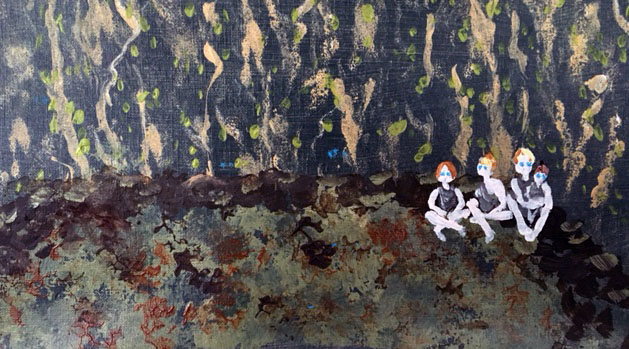
         “Enola was understanding.  She quietly left and went out alone into the darkness. Colleta and I argued late into night until we both noticed each had smothered separate hopes and fears in the same bucket of misbegotten angry words. All either of us wanted was to hold onto family. In the midst of our raging I produced your drawing on the rock of us as children and suddenly Colleta took it from my hand and said she knew the girl! Suddenly I was the only one arguing.

         “Colleta recognized Eve as the hag’s assistant who came along when her own mother needed help with the difficult birth of her baby brother. Suddenly Enola was the exact person who could quell Colleta’s own unspoken fears of motherhood when her own mother might be far away in the city.”

         “So where did Eve run to in the dark that night?”

(find out tomorrow)

Post #2.10, Tuesday, 11-26-2019

Historical Setting 561 C.E.

Ezra continues his story. “We are only family again because Eve was so patient in bringing me through my selfish thoughts and fears. In my mind I could tell myself the horrific visage was indeed my beautiful little sister, twisted and re-formed by hard pits of pox scars. But were I to accept her, the actual monster of the rumors as my beloved sibling I would need to dismiss my own ignorant howls of fear simply to save my honor. Others would righteously excuse me from my rebuke of her if I claimed this was no sister of mine but a cruel hoax of a demon. Throughout my thoughts of abandoning her again she simply held my hand and begged me not to look at her face while we talked. I could do that. We were alone in the garden. I didn’t have to account to anyone but her for my fears.

         “And so we talked.

         “It was no different than when we had last talked in the shadows of a rainy day, two children on straw mats lying side-by-side in the healing place where we had been delivered to grasp onto one more thread of life.  We shared our hopes to see our father again, and even our mother if there were a heaven and we would be there.

         “Then a priest came. He spoke to the hag outside; then she came to us and touched us each for fever and pronounced us well. She told Eve they could only use a boy because the work was tending vineyards. I just felt proud and chosen as I marched out of there with the priest.  I could hear Eve crying out to me not to leave her alone, and the hag comforting her – ‘you will be fine.’ ”

         “And now here was Eve again, Enola, all grown up and changed, but still begging me not to leave her alone. How could I? I helped her gather the starts for her new garden and took her with me in my cart.

         “My new wife was horrified.”

(Come again tomorrow.)