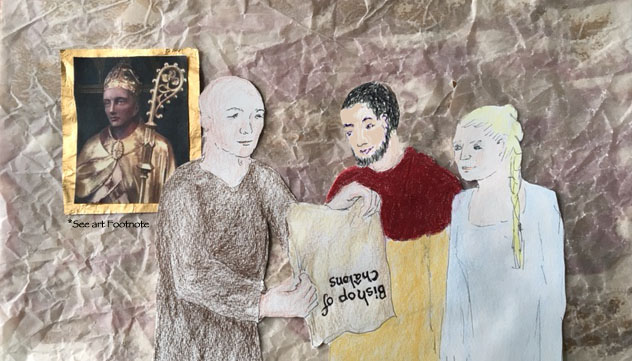
Post #30.11, Weds., March 23, 2022

Historical setting: 589 C.E. The cottage in the mountains

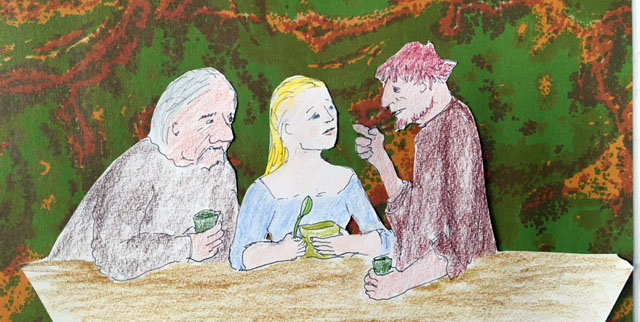
         I’ve always imagined finding Anatase and it would be a happy reunion, abundant gratitude and endless hopes fulfilled. I’ve done nothing here but stare into the deep sky and I feel like she’s blaming me for all her hurt just because of my gender.

         “Sorry Laz, I didn’t mean all men seek to own and manage women; its just the ones I know of – I mean in these times.”

          “It’s okay Ana, I understand I’m a lot of trouble for you and I bring only bad news. I’ve come here shattering your hopes. 

         I yammer on, “For me it’s so good to see you strong and well, grown to be such a beautiful and wise woman.” I can see this was another wrong thing to say but I have no idea why. “What did I say, Ana?”

         “Beautiful and wise you say as though you caught a glimpse of sea at sunset. Wise and beautiful is my anathema!”  It’s always these conspicuous holy gifts that cost me any possibility of a good life with a trusted and loving family. Wise as a small child, my own mother feared me because I was longing for learning. She sent me away and it was only by God’s grace that Daniel borrowed me from the pagans so I could taste the virtues of family in my teacher’s service.

         “And beautiful you say, so the men I would loathe most lust after my breasts and ravage and rage to find a place to plant the phallus without the slightest nod to my nature and even to their own natures, as God’s good creation. So for that gift of beauty my teacher never even saw, she was slain and I was taken from that one loving home. These perfections I was born into seem to be my curse.”

         My answer now is a long and hungry silence of words. It is my unspoken prayer of thanksgiving for Ana and her beauty, and for the healing I’ve been granted here by her wisdom. Maybe it’s the spirit of her teacher that pangs my longing to be her trusted and loving family. Or maybe I’m excusing my own lust for her lips and her breasts by thinking of my own virtue.

         Dear God, I find here that my own sexual desires could be an earthly metaphor for holy love. But it is a complicated maze. Is that by holy design? Probably it isn’t my place to know. May I receive your own rule, as Ana already knows the rule for women just by her very nature.

 (Continues tomorrow)

Post #30.10, Tuesday, March 22, 2022

Historical setting: 589 C.E. The cottage in the mountains

         Awake again, the brother servant and Ana are having biscuits and porridge. Brother Servant says he will be going back to Annegray right away, and offers to help take me to a straw bed closer to the fire before he goes. That is a kindness.

         I wish not to cause them trouble.  Maybe I could’ve just gotten up and gone over to the bed with only a little help from Ana. But Ana is giving us so many explicit instructions all about which way I am allowed to move to protect the stitches.  For one who would drop a bowl on the hearthstone, she seems way too cautious over the possibility of jostling her needlework.

         Now I find this bed comfortable. The linen wrap intended as my grave cloth becomes a fine fresh bed sheet, and here is a feather pillow like my childhood days in my rich father’s villa; except there we had a roof and the winters weren’t as cold.

         The monk takes the empty bird cage and has gone now as Ana moves the bench near me to serve the porridge. She has questions.

         “The father’s servant monk said you’ve come with sad news about my teacher.”

         “We’ve been grieving her death, and for all this time we also found no closure, only fears and worries over your safety. It’s so good to find you again and to know you are well — a grown woman now.”

         “But who is it you’ve found?  I’m hardly the bold, ever-daring Anatase, the child ready to take on any challenge. I’ve learned deep fears and now loss. Father Columbanus said I would be a blessing to a convent but how could I ever live under such a rule?”

         “Probably all that reading you did from Brother Nic’s pages put a sour odor on the Rule of Benedict, but other communities have different rules. I think the regimes of prayers and psalms, the guidance for solitary monks learning to participate in community is for many a trustworthy structure.”

         “Maybe that’s the problem. Men crave the structure they impose on women, and women already have patterns of nature to structure their lives.”

         I fear we’re not discussing monastic rule anymore. Silence seems my best reply.

 (Continues tomorrow)


Post #30.9.1, Friday, March 18, 2022

The Bridge to “Once We Were”*

Historical setting: 589 C.E. A Roman Ruin

         What is it about ancient times that lets Roman bridges stand firm on old roads long after the empire has fallen?

         History, we know, is nearly always skewed by the perspective of now. The same hymn attributed to Saint Patrick several centuries gone, comes with two different stories. Was the Patrick of this legend a warrior or a pacifist?  Whichever image of courage defines his heroism depends upon if you are standing next to Jesus when he heals the severed ear of the Roman guard [Luke 22:50-51] or if you are a monk safely sheltered in the Sixth century by a Merovingian King who wields a mighty sword. The names of heroes become facts of history, but the nature of hero, and the values driving the story are mere temporal gasps in the snare of time.

         If our longstanding bridges to the past were only paved with facts of names and dates, battles fought and treaties signed, telling history would be easy. But history is most truly told by the storytellers. They know the human hearts of all of those who crossed over on the frozen rivers with Detriech or Attila, or lived in the ruins of Rome with Chilperic or Columbanus. And they might tell you who were their lovers and their friends.  How were the common people saved from the despots? What were their prayers? Did they plead with a god they’d never met in person, or did they pitch tents for a transfiguration?

         Old bridges are surely a path into the old ruins. Is it any wonder the bridges into history are so often feared and forbidden?  What if we found we were the same human species as the ancients? Its easy to say the throngs following Jesus must have been illiterate, or at least not as brilliant as we, so Jesus was talking down to people when he told us to love our enemies. Of course we believe we are smarter than that now. But what if we aren’t?

         What if by knowing our history we recognize ourselves as despots and masters, slaves and serfs, haters and lovers, fighters and pacifists, winners and losers, liars and prophets…  What if knowing history requires confessions and restitution and peace making?

         Crossing the bridge to “Once We Were” is indeed, a fearsome dare. Dear God stay close. Guide human eyes to see what is true and then let us love others as we learn to love ourselves anyway, any way.

            *[Blogger’s personal note] We first sang “Bridge over Troubled Water” plunging into the unknowns of marriage ahead, imagining a roiling and rollicking dangerous future as we were promising away our fears.  Today these five decades of marriage are comfortable nostalgia that smells like a wet dog after a passing shower. Good to be with you today Tom remembering all our dogs and bridges of years past.

(Lazarus story-line Continues Tuesday, March 22)

Post #30.9, Thursday, March 17, 2022

Historical setting: 589 C.E. The cottage in the mountains

         “I once heard the ancient legend of Patrick told by a pagan druid. The pagans accept myths of shape-changers and, in fact, all varieties of magic of which Jesus knew nothing.  So when I heard the druid legend it seemed all about the magic.

         “Celtic Pagans wanted to rid the Island of Christians so the pagan priests gathered an army to ambush Patrick and his monks in what Patrick thought would be a peace negotiation. The druid’s men lay in wait until nearly dark, then they heard a strange lowing sound, like the lullaby of peaceful cattle lowing softly to their calves. Then the pagans saw a huge heard of deer walking slowly through the wood. There was no war that night only a peaceful passing by of monks in song.

         “The next day it was said, Patrick and his followers won a fearsome war against the druid’s army. But these followers of Patrick were pacifists, so I suppose the battle was mere legend.”

         Brother Servant added, “In the monk’s story Patrick and his followers were shape-changed into a band of wild bucks, leaping and dashing antlers against the attackers to win a war against the Pagans and Ireland for the Christians.”

         “But I still believe, even if they changed into antlered bucks they would pass by peacefully in prayer, in Jesus’ way. The prayer is called ‘Patrick’s Breastplate’. Do you know that song?” I asked the Brother Servant monk.

         “Of course I do.”          Brother Servant chants it to me in a whisper, [Footnote]                 

         [Footnote][The Lorica, called the Faed Fiada, or Deer’s Cry* attributed to Patrick, for protection  (Seumas MacManus, The Story of the Irish Race, 1921 Koneky & KoneckyOld Saybrook, CT (4th Rev. Ed.) p. 114. MacManus’s note regarding this English Translation – This Dr. Sigerson’s rendering of the hymn is in the same measure, metre and rhythm of the original.)]

(Continues Tomorrow (Friday) with a special post)

Post #30.8, Weds., March 16, 2022

Historical setting: 589 C.E. The cottage in the mountains

         Brother Servant and I are talking quietly. Ana is resting in the next room.         

         He tells me, “Ana has been anxious to hear what has become of her teacher and her home by the Loire. She saw smoke rising behind her as she was being abducted, and she fears the worst.”

         “It was a great loss.”

          He tells me she’s had no closure though she grieves.

         I can say it to this fellow more easily than I could tell Ana, “Her blind teacher, Eve, was killed swiftly by sword. As she heard Anatase screaming she wandered into the darkness calling after her and she was struck down. As they carried Ana off the marauders torched the house.

         “Eve was buried in a family place by her mother’s grave along  with Anatase’s gift of pages of herbs. It was a gift she had given her blind teacher when she was yet a child offering something to touch and smell of the garden the teacher most loved. Loosing both Eve and Anatase was is a terrible grief for our whole family. We didn’t know if the kidnapping was by a pagan tribe or pirates, so we searched among the pagans simply because we knew where they were. I feared if the pirates had taken her we would never find her.

         “Coming from his own island you must know well, when St. Patrick was stolen by pirates his family never saw him again.”

         The servant answers, “You know of St. Patrick?”

         “I’ve thought of him often as we’ve been searching for Anatase. My prayer was that she would feel God’s presence with her always as St. Patrick had known it.”

         “It’s amazing to me that even in this barbarian wilderness Patrick is still known.”

         “Not by all, even in these times. I learned of that island when I was a shipwrecked there, but I saw the footprints of Saint Patrick everywhere. So here in Gaul when the pagans told me of a Celtic Christian who had a following of Irish monks I set out in search of Father Columbanus. I found some pagan hunters who know these mountains and I hoped they would guide me to Annegray. You see how that worked out. One of them mistook me for a deer. I should have remembered the Celtic weakness for ignoring the distinctions between deer and Christians.”

         “How do you mean?” he asks.

         “Surely you’ve heard the legend, coming as you do from Patrick’s island.”

 (Continues tomorrow)

Post #30.7, Tuesday, March 15, 2022

Historical setting: 589 C.E. A cottage ruin in the Mountains

         Ana answers the door of this place with the sky as its ceiling and she welcomes Brother Servant. He’s come with a cart and a wrap of linen apparently to gather up my remains for burial.

         She invites him in so I choose to keep still here and just play the part of the table I’m lying on.

         Brother Servant sits down on a bench and Ana offers him a biscuit and some tea.

          “It was a very long night here. I lit torches all around so I could see to work, and I was able to learn a great deal about mending a deep wound. And now by God’s grace alone he lived through it all.”

         Brother Servant comes near.

         Ana offers the prognosis, “He may yet get his strength back. But I think it would be dangerous for him to be taken too soon for a long  cart ride back to the infirmary at Annegray.”

         “Would you like me to stay here then?”

         “That won’t be necessary.”  

         “Do you feel in danger should he become stronger and rise up?”

         “I’m safe with him. He was my teacher’s family, and I knew him when I was a child. In a waking moment now he has already remembered me. I’m pretty sure neither of us will need to report for confession while he is healing here.”

         I hear a bowl drop onto the hearthstone and shatter and Brother Servant goes to help her pick up the pieces. Helping her seems to be his assignment always.

         “It’s been a long night for you, saving a man and then making fresh biscuits.”

         “I seem to be clumsy from sleeplessness.”

         “Would you like me to keep watch while you get some rest?”

         “Thank you that would be kind of you.”

         “I’ll finish slicing the carrots for the porridge pot.”

         “Thank you, Brother. You’ll just have to stay for the noon sup then.”

         As Ana goes out through the door by the hearth I ask Brother Servant if she has a room in there, “with a roof.” He seems surprised to find I am aware, and assures me that she does sleep under a roof. Now he has moved the bench closer, so that we can talk in whispers as I seem to do this day.

(Continues tomorrow)

Post #30.6, Thurs., March 10, 2022

Historical setting: 589 C.E. The ruin of a mountain cottage

         At this waking cold sunshine finds no roof over me. The deerskin is a warm blanket.  Looking around the room there are walls and doors and even a window, just no other ceiling but the sky. There is a shelf near where the roof would be where the bird cage sits. It is surprisingly warm for a late winter’s day, and now I see that on the wall at my head is a grand hearthstone, blazing with a well-tended cooking fire.

         Anatase in a simple flaxen dress and tattered surplice apron comes in a door near the fireplace and she tends the fire. She dips from the caldron into a tea pot. Her flow of golden hair surely belongs on a child I remember.

         I close my eyes again to try to remember another day and put this all together. I had nearly found the child. The taller monk, and the shorter monk were on the seat of the donkey cart. But when we came up from the valley only the servant monk and the bird were there. The servant monk got down to walk the donkey up the climb back into the sunlight. I remember how I hoped …

         She is right here, a woman now, her long fingers reach around my wrist for a thump of life. I choose to keep my eyes closed simply imagining the face of a weathered and weary woman with the familiar sparkling eyes and smile – the precocious child who already knew how to read but who pretended to let us teach her anyway.

         “Good morning, Laz. I hear they call you Ezra now. I wish I could say my surgeon’s skills saved you, but of course, healing is a gracious gift of the Creator of life herself. I have a bowl of tea for you, if you can take a sip now.”

         I can’t speak to answer. Dear God, thank you for this beautiful morning. Amen, So be it. Were this really true, I would lust for a  forever of these mornings. But as dreaming, I dare not open my eyes for a waking.

         “Ezra? Laz, look at me now. I have some tea for you. It would be good if you could take a sip.”

         “It is good. Thank you, Ana…”

         “It is just Ana, now. I’m called Ana.”

         “Thank you Ana.” What more is there to say, but everything of all these years.

         I offer, “Ana, I will build a roof for your house.”

         She smiles, “Maybe another day.”

 (Continues Tuesday, March 15)

Post #30.5, Weds., March 9, 2022

Historical setting: 589 C.E. In the Vosges Mountains

         Brother Servant comes with a donkey cart. He also brings the good news that the rumored ‘angel of Annegray’ is indeed Anatase.

         He said, “She took the little sickle and pressed it close to her as a treasure. I told her you had the dark hair and eyes of a pirate. She seemed delighted. She calls you ‘Laz,’ after the bible guy Lazarus, because you were from a town near Jerusalem. That matches what you said.”

         Thank you God. The ropes are loosed from my ankles, and I feel empowered climb into the cart. I’m surprised it demands so much strength just to move.

         Brother Crathius notices my nose bleed. “This is a very bad sign. It means the wound was deeper than the bandages could cover, so this bleeding is from the depths and nothing can be done now to save him.”

         A bird in a cage is set in the bed of the cart so Brother Crathius can have the seat next to the brother servant. The bird just stares at me.  The long ride is somber and silent. Brother Crathius is let off to follow the pilgrim route then the cart continues on into a deep valley and up a steep rise into fresh sunlight.

         Here we stop. Anatase touches my face laying her fingers on my neck for pulse as Brother Servant sets the birdcage off the cart and offers to take me on to Annegray for prayers and burial.

         “No wait,” she says. “I can see why you would be so certain of his death. But this death is a terrible hurt for me first hoping then loosing. And I believe this may be my holy calling to give purpose to my sorrow.”

         “May God dry your tears,” answers Brother Servant.

         Anatase explains, “I’ve read about it and studied it but I have no experience with these deep wounds from swords or arrows. I would be unpracticed were there ever a war. Please put him on the table so I can practice mending this kind of wound with scalpel and stitches.”

         “He is probably already with God.”

         “I know. But it would give purpose to this death, that my skills could be honed to save another person on another bad day.”

         Dear God, stay close.

(Continues tomorrow)

Post #30.4, Tuesday, March 8, 2022

Historical setting: 589 C.E. In the Vosges Mountains

         At this waking I see the contents of my travel bag spread out on the ground and Anatase’s sickle is missing. Brother Crathias is still here, and I am lying on my back on a fleece with only my ankles tied now.

         “Good morning, Pirate. Brother Servant will return soon with a cart from the monastery to take you somewhere you can’t escape from in case you really are a pirate. But I don’t think you’re a pirate. You’re teeth are good.”

         “Thank you. I’m definitely not a pirate.”

          “But you know lots of young women and boys have been kidnapped by pirates to be sold for wives and slaves off in distant places where they can’t be found again. That is probably what happened to the girl whose child’s toy you happened to have. It seems unlikely the same woman you lost would be the one they found.”

         “Coincidences happen. Anatase is strong and clever.  And of course there is that possibility of synchronicity.”

         “Yes, Good Pirate, but you might have had a better chance to free yourself had you not given Brother Servant such a unique item to prove your hunch.  Because if she’s not that woman then it will prove you really are a pirate and things could go very badly for you.”

         “But the truth is I’m not a pirate.”

          “I think Brother Servant mentioned an old quarry pit behind the tattered fort of Annegray where they can keep you captive until Father Columbanus decides what to do with you. I know about Annegray because I was there last year at Lent and I saw that it is a ruin of an old fortress that the Irish monks only pretend is a monastery. It has lots of scary hiding places.”

         “I know,” I can speak more easily now, “I’ve even heard rumors from the pagans it is a haunt for the creatures of the underworld. But I wondered with beasts and rumors, and a hard climb to reach it, why would it be so popular for Christian pilgrims?”

         “Christians give no thought to the fears of earth, at least they shouldn’t say it aloud if the do fear, so being haunted surely adds to the challenge. And tattered and hard to reach is what sincere Christians gladly accept to assure the significance of the spiritual challenges they have taken on. And then, of course, Father Columbanus is beloved.”

(Continues Tomorrow)

Post #30.3, Thursday, March 3, 2022

Historical setting: 589 C.E. In the Vosges Mountains

         As the two very different Christian monks continue explaining themselves to one another I gather both a terror and a glimpse of hope. Brother Servant explains why he was chosen as servant because a trusted eunuch was needed.

         “I serve as a messenger back and forth between Father Columbanus and his followers when he is in his solitary wilderness place, but I also am messenger for a woman who followed some monks in a clandestine way. She is in hiding now, never trusting a man and always living in fear of pirates. She was raped and beaten by pirates that captured her on the River Loire. She’s followed that little band of monks all this way from the port at St. Milo and here she trusts me alone among men for her peace and solace.

         “I’m always alert and watching for pirates who would be searching for her. I think we should bind his hands and feet in case he would be able to get himself up.  We must assume he is a pirate unless he can show us otherwise. First we should check his bag for a blade.”

         Dear God, thank you for amazing synchronicity.

         The servant monk kneels here and draws my hands behind me — a terrible hurt to the wound. I try to plea while I can speak. “I’m not a pirate, but I am from the family of Ezra, who owns the vineyards on the Loire. There was a pirate abduction of a girl, surely a woman now; she’s named Anatase. She was apprenticed to a healer in my family.”

         The servant monk is listening as though we share some knowledge of a truth. I tell him more, “I have proof that I am from her teacher’s family. When you search my bag for a blade you will find one. It’s a small hammered blade, a legionnaire’s dagger forged into a child’s-sized sickle. Take that to the woman who was abducted and ask if she has ever seen it before. If she is Anatase she will tell you it was made into this tool as a gift for her when she was a child – it was given her by the monk who taught her to read. His name was Nic. She will know this. Please tell her we’ve been searching for her.”

         With wrists and ankles bound I’m turned again and I can’t speak.

 (Continues Tuesday, March 8)