Post #26.11, Weds., Nov. 24, 2021

Historical setting: 588 C.E. Forest Primeval

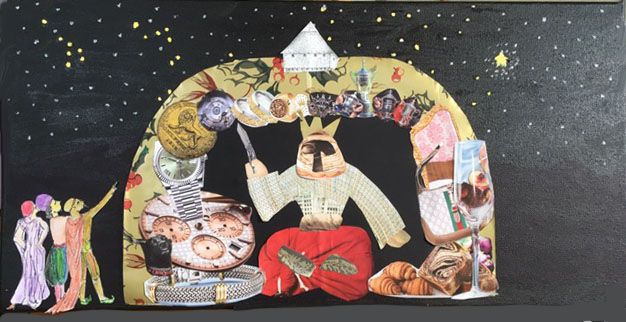
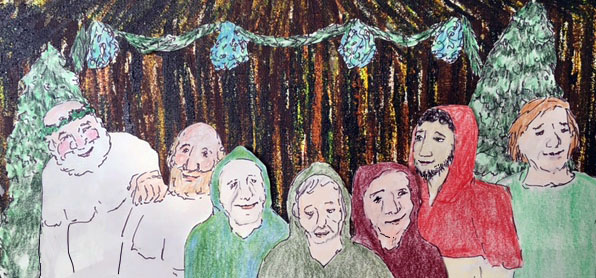
         The long board for men dining at this feast is in the main hall amid a décor of a sword and the yellow banner. I’m seated here mid-table with this multitude of men.  Count Bertigan is at the head. The women here will join us later for the biscuit and the cup when we have all finished the rude gorging of the meats.

         Thole who calls me Ezra at his father’s demand asks if I’ve heard any stories of our war?

         “Only Rumors.” I answer.

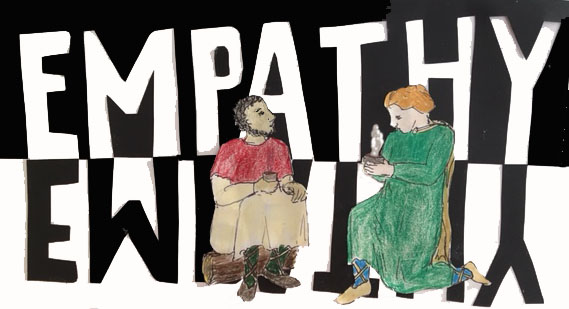
         Thole confides this war should be about our loss and so few of us even knew Eve. He is stewing in the hurt of betrayal.  “No sooner is Auntie Eve in the ground than my father is off with the widow of Saumur. He loved Auntie Eve! He begged for her marriage not for her utility, she was blind after-all, but he begged for her as a woman. All my life long he waited for her then in the moment of her death, there he is with another. He doesn’t give her a second thought.”

         “Thole, I just think it is Jesse’s way of grief. I’ve seen it before.  On the night you were born Eve walked back home in the sleet and snow, all alone, sorrowing that she couldn’t save your mother; yet on that very night with your mother just wrapped for burial, your father begged Eve to be his new wife. She told him to buy a fresh nanny goat to provide for his child. She feared that if she married your father she would live her whole life only as substitute for your mother.”

         “Well, she certainly came through as a mother for me. I was with her through all of my childhood. But we could have been three of us as a family – complete, not just me and her.”

         “You must surely know that she was never one to be ruled by anyone else’s expectations. If she didn’t have one foot on the Pagan side of the river, and the other on the Christian she wouldn’t be Eve. She would be pecked over like a wounded hen by the likes of Colleta, don’t you suppose?”

         “My Papa would save her from the gossips. He wouldn’t let Colleta come near her.”

         “So then, you’re saying she would always have been alone.”

         “She would have me.”

         “I miss her too.”

         Dear God, you bring solace to the banshees and the ghosts, please stay with us through this strange maze of grief.

(Continues tomorrow)

Post #26.10, Tues., Nov. 23, 2021

Historical setting: 588 C.E. Forest Primeval

         I ask Colleta what the rumors tell of our encounters with the banshee.  She seems to know all kinds of new things about our so-called war against the Pagans but there is no mention of the banshee. Colleta’s rumors are spun stories not facts.  Legends are shaped by rumors purposed by ancestors seeking connection with a valued history; or in this war it is a mother who wishes accolades on her children. But when it comes to the banshee she seems to have no idea what I am talking about; and it was the Pagan idea of a banshee that most touched our hearts and thoughts that night.

         This terror, this voice of a woman up from the dead keening for lost souls struck the chorus of all of our hearts together through the night. [Footnote] Some of us are missing Eve and others just know a woman’s throat was slashed and a child was stolen. So we went there as a band of swordsmen set on vengeance yearning any destruction we could call justice. We went to have our mountains of hurts smoothed over into some kind of blissful flatness named “even.” That was all this war was about. We rallied for a slashing, a kidnapping and a fire.

         Then came the chanting and howling of the Pagan ritual. It was at our campfire where we heard the response to our own hurting grief. The ritual of a keening banshee sharing our woes was the chance to pour our own suffering out in the wailing songs. On that night, every name of our grief was spoken, Pagan names and Christian names, names of murdered children, names of elders dead of plague, the name this father came to hear spoken — that name of my own daughter ‘Eve.’ A mother was screaming her grief for a Pagan name we didn’t know, or maybe she was named “Blessed Mary” weeping for her children.  The deep world of earth and heaven wept with us, as God is always a parent grieving for her child.

         The feast of victory: There is a separate dining board for the women in the hearth room as is custom. In that room Celeste is the host and Colleta the grand matron. Daniel has a guest at the women’s table, no doubt hearing of his dragon slaying. And Thole’s father, Jesse, also has a woman here.

         At both tables are the rumors.

[Footnote] Rosen, Brenda, “The Mythical Creatures Bible: The Definitive Guide to Legendary Beings.” 2008, New York: Sterling p.202.

(Continues tomorrow)

Post #26.9, Thurs. November 18, 2021

Historical setting: 588 C.E. Count Bertigan’s estate

         As the great victory feast is being prepared rumors of our so-called war are swirling. I can hardly affirm any truth to the rumors – I was there. I saw we had a campfire all night and watched and listened as the Pagan tribe performed rituals of Samhain on that night of the rising, when the dead are said to cross through the haze from the otherworld deep in the earth where the gods of the Celts have their home.

         Colleta wants my affirmation of rumors to serve her children’s interests. I can only agree that Daniel would be slayer of a metaphorical dragon as he is surely a good man.

         As for her other child, Celeste, she wants my advice on fixing up the meat of gossip that surrounds Celeste’s husband, Count Bertigan.

         I ask Colleta what she’s heard of Bert’s adventure at warring.

         Her answer, “He was near death, and he said the Pagans summonsed his dead mother up from Hell.”

         “I’m not sure the pagans would say it was ‘Hell.’”

         “Where else would you think they would find his mother? Don’t argue. At any rate, Celeste was concerned, and she went to the village priest.  She could have gone straight to the bishop with something this important, but she only asked the priest.”

         “And what did the priest say?”

         “He said it was the Pagan influence on Bert’s vision. Bert is a fully baptized Christian, so it would not have been a visitor from Hell, but more likely it was the Virgin Mary herself.” (Colleta makes the sign of the cross.) 

         I answer, “It was hard to see in the smoky darkness whose mother it was who brought him the cup of tea that healed him.”

         “Oh, it was the holy mother Mary of course. How could you have missed noticing the glow around her and the golden crown?”

         “It was dark and smoky, and I might have drifted off – it was late after a long day, but I really didn’t see anyone glowing with a crown. All I saw were Pagans and us.”

         “Of course you wouldn’t recognize her anyway. Just don’t say anything at the feast that might ruin the appearance of the count as the amazing and miraculous Christian that he is. He could even be a saint. If anyone asks about the Virgin, just say you were sleeping.”

         “So, what should I say about the banchee’s screams in the night?”

(Continues Tuesday, November 23)

Post #26.8, Weds., November 17, 2021

Historical setting: 588 C.E. The vineyards of Ezra

         Colleta is reciting rumors of the war so I won’t refute these details with actual fact. “We’ve heard you encountered a dragon. And we’ve heard that my son-in-law Bertigan nearly suffered death. And that my own son Daniel was the dragon slayer.”

         “Are you asking me if the rumors are true?”

         “I know what is true. My son is a hero. I knew that before he ever went into battle; but now everyone knows it. He’s been courting the daughter of a wealthy and literate aristocrat in Tours. Daniel, tall and handsome, intelligent and wise only needed the credential of war hero to be granted the hand of that maiden.”

         “Are you asking me if the rumor is true?”

         “I’m telling you that what matters is that it is believable. And I’m telling you dare not challenge that it is said that Daniel is a hero.”

         I mean to change the subject. “Do you know, Colleta, what is the substance of dragons?”

         “’Substance’ you ask.  I know of substance as that which is the same in the Father and the Son, God and Christ.”

         “Yes, Colleta, I thought you might know that. And so a dragon is of the substance of metaphorical beast. It breathes, not the breath of God but the breath of evil. The substance of a dragon is fear and lies, and the hurtful hates invented from rumor and skewed values.  Didn’t you wonder why we didn’t bring back the meat of this monster or at least the head to parade on a pole?”

         “For a moment I wondered what became of the carcass. But more important is that Daniel is a hero.”

         “I don’t deny Daniel is a hero. I’ve always known him to be kind and honest and true. And even in my world of metaphor, that kind of hero conquers dragons. But what slays a dragon isn’t more lies and rancid rumor. The Ephesians knew Christian heroes are outfitted in metaphor – ‘the belt of truth the breastplate of righteousness and the sword in the Word.’ [Ephesians 6:10-18] Daniel is that kind of hero.

         Colleta begs, “Whatever. I’m asking you, Papa Lazarus, please say nothing about the missing carcass of the dragon. Maybe in all the celebration of victory there will be no thought at all that there is no dead dragon.”

         She continues, “And you should also know what we all know really happened with Bert away at the war.”

(Continues tomorrow)

Post #26.7, Tues., November 16, 2021

Historical setting: 588 C.E. The vineyards of Ezra

         Now on the home side of the Loire the count has immediately taken the command back from Daniel.

         “We will enter the lands of my estate as the proud victors! Ahead of my horse will go the banner, displayed fully with no tatter. I will ride first of the swordsmen; then continuing single file will be Daniel, then Thole, then the others of you who volunteered and you may arrive in any single file order you prefer.  We will enter the grounds at a proper canter, quick enough to unfurl the flag with the full enthusiasm of victory!”

         After all this instruction we are mounted, ready to make our awesome display of “winning” or at least surviving, and the count adds that we are all invited to a victory feast tomorrow at his table. And so we go along the road those miles and through the gate making a circle in front of the house before we take the horses on to the stable.  Celeste and her children step out to watch us circle around for no apparent reason, yet the count is very pleased.

         It is usually said that history is told by the winners. In the case of this count’s first “war,” the Pagan followers of the druid priest are not telling the history because druids notably don’t keep written records of histories. So everything that will be known throughout all posterity of this victory will have to be sprouted from the seeds of rumor we plant ourselves. And by the time of the great victory feast some of the wandering vines of heroic stories are overgrown and twisting and turning into valor none of us ever knew we had.

         The women of the farms gather for the spinning of wools and flax. It seems the spindle is the true source of yarn where stories are grown. Then Colleta brings these details back to me plotting the retelling, so I won’t say something that doesn’t fit with the so-called truths they’ve discerned. Despite the cold November air, Colleta wants us to walk the grounds of the estate so not to be overheard.

         “Papa Lazarus,” Colleta begins, “I know the truth of the war.”

         “And what have you heard of our so-called ‘war’?” I ask fearing the twists of rumor-authenticated “history.”

         “We’ve heard you encountered pagans, and ghosts, and even a fire-breathing dragon.”

(Continues tomorrow)

Post #26.6, Thurs., Nov. 11, 2021

Historical setting: 588 C.E. Crossing the Loire

         The ferry crossing with Thole and his horse ends in a disasterous upset with Thole and his horse and a ferryman all sliding into the river. The horse swims to shore as Daniel takes it’s rein and guides it onto the bank not far from the landing. The ferryman clings to the ferryboat, now righted and flat on the river again, and Thole is nowhere to be seen. Caught in a current I catch sight of him, and even though the river runs shallower near the shoreline he is floundering and calling for help.

         The water is stunning — near ice — taking my breath away in the first shock of it. The swim is an easy reach to Thole, but holding onto him flailing and fighting is the challenge. I find it is shallow enough that I can get a footing, though the challenge is sharing that calm with Thole, and allowing him to find a firm stance on the rocks beneath the river. It seems impossible.

         Dear God, stay close. I can’t let this fellow go from my grip now. He is the very soul Eve delivered to life at his own mother’s death so many years ago. How would I ever tell Jesse I couldn’t keep hold of him. 

          The ferryman throws us a line and in a moment Thole discovers he is safe though chocking and blubbering on the piece of river he swallowed. We make our way to the slimy bank. The shivers are wrenching and wringing. I left my cloak dry on the shore, and the ferryman stationed on the south side of the river provides a blanket for Thole. The horses and men waiting to follow behind us on the ferry are in panic now, and one horse has decided to make a swim for it with his man clinging to his withers. Seeing the success in that, another follows, and the last of them, until we are all across, so now most everyone is deep in these shivers. Thole had the fire start with him, so we can’t even make a flame.

         The Count is unchilled and firmly in command, raging over the cost of all of this when we could have all just swum it. The ferrymen are trying to make peace with him by providing the warmth of their fire and extra cloaks.

(Continues Tuesday, November 16)

Post #26.5, Weds., Nov. 10, 2021

Historical setting: 588 C.E. the forest north of the Loire

         Now the responsibility for this war falls to Daniel who simply decides we will go back home at first light.

         In the morning the embers of the fire are cold. Some of our band still sleeps, and some of the Pagan tribe are waking while most have gone off to wherever they live. We ready the horses. The count has nearly recovered, though he mumbles details of rescue by the hand of his own mother from that night terror. We offer no words of gratitude or farewell to our hosts; in fact there are no words spoken at all, as everyone is barely awake now. We mount up, and ride in the cold, drowsy silence back through the forest toward the ferry on the River.

         So what is it that makes peace?

         Is peace merely pieces of nothing? Or is peace something? Is it what happens when a war is won? Is this the stillness after the annihilation of everyone loosing or just the sleepy silence of a frosty morning?

         The vineyards of home are a few kilometers from the ferry landing, and that is of course, adding to the travel on both sides of the river. So our near winter trudge is longer than a summer’s one would be, with a fording place nearer our home. And at the ferry landing we must wake the ferrymen who fatten their till, and flatten the count’s purse collecting the tolls for each separate crossing of the eight of us.

         One-by-one each horse with its man steps with unsteady courage onto the flat deck of the ferry. The calm of the river today allows a smaller crew with no need for a line held at shore, just a pole man on the deck is needed. For horse and man this seems more tenuous, and at the mercy of the currents, as one-by-one we cross; some cross with terror, others with ease.

         Daniel crosses first, then the Count, who has already paid the toll for us all. And I have crossed, and now, with the sun high, and the morning well upon us, Thole is crossing. His horse panics as the ferry nears the shore. Thole’s horse breaks the temporary stall mounted onto the deck and slides to the side of the little raft as it tips up nearly vertical to the water, sending the horse and men sliding into the froth.

(Continue tomorrow)

Post #26.4, Tuesday, Nov. 9, 2021

Historical setting: 588 C.E. by the fire of Samhain

         The moon has set and the pagan ritual goes on and on with incessant chanting, and calls from the druid and responses from his gathered. They all know the words to say. The druid’s movement is near dancing. A teller has tales steeped in tradition… and the seer is still attempting to locate the spirit of Anatase in the smoky thin place of this night. Maybe, in fact, I say this hopefully, the spirit of the child that Eve loved is elusive to searchers among the dead because she is still living.

         No one is arguing aloud or brandishing a weapon just now, not even the count who still believes they have Anatase tucked away in their midst.

         The count is bundled in his new silk cloak sleeping near the logs by the fire. Despite the apparent intensity of this ritual our band of men is dozing off, even snoring. It’s a three-day festival, and here we are drowsy on the first night.

         Suddenly the Count is shouting out in his sleep in unintelligible glossolalia.  He has a fever. The soothsayer hears it as message from another world. The druid reminds Daniel that we promised to send them a practitioner who is needed now.

         We brought nothing of a healing potion for our fevered leader. We don’t even have any meal leftovers to share.  All we have in each of our packs is a small wedge of cheese and a biscuit. We’ve come for a fight, and other than our swords and horses and the yellow banner we are completely at the mercy of our hosts.

         Apparently, the village of this tribe isn’t far from our campsite. So throughout the night one or two of the Pagans at a time goes and comes with a warmer wrap, or a basket of apples to pass around among us all — hardly an act of war.

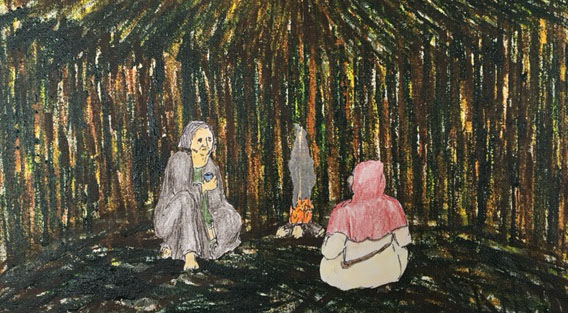
         The druid sends one of the women back to bring Count Bertigan a cup of healing tea. She returns with a bowl still steaming in the crispy air. Bert wakes and receives the kindness of the cup from the old woman. But in all his confusion he thinks she is his mother and he is yet a needy child. All this is happening in the haze of fever and the smoke of ritual that seems to have pierced the warring dragon and twisted our leader’s angry courage into something conciliatory.

(Continues tomorrow)

Post #26.3, Thurs., Nov. 4, 2021

Historical setting: 588 C.E. by the fire of Samhain

         Dear God, what do you make of this spiritual milieu? Is it alright that we make borders around our prayers and pray only to the facet of Spirit each of us already claims? Are we of one spirit despite our differences? But if we are not one, and are of separate tribes by religions, which of us do you love?  Amen.

         It’s acceptable that the seer of the Pagans breaks into the quietude to assure us the spirit that bound Eve to each of us in our own ways isn’t raging just now, but longing for the child she has lost. I do also feel the loving presence of a mother. I know God herself to be mother, and I know God’s child Eve is wandering in death. It is God’s love that gives me comfort. Yet this pagan soother assumes Eve was  an earthly mother, calling back from death for her own child.  Without words or language spirit surely confuses things by ignoring the plotline. With us right now is a loving presence but we each seem to give it different names and expectations.

         “So what of the lost child?” asks the druid.

         Count Bertigan assumes they feign innocence in the child’s abduction. But I think this band of withering Pagans has no idea they are under attack from us. Here they are offering their powers to “see” into the world of the dead to help us in our stated mission to avenge the death of Eve and perhaps to find the child as well.

         Rumor skews fact. I believe they had nothing to do with the slaughter of Eve or the kidnapping of Anatase. None of this ragged group of mostly old women is even brandishing swords and surely no one but our little band is prepared to do any slashing of throats.

         Yet, the rumor held as fact by some of us is clearly leading the belief that they have Anatase hidden away and we must battle to win her back from the Pagan grip. What if that were so, then what? She will be with us grieving, and she will have no teacher nor will the Pagans have the young practitioner of healing we promised to return to them. Any way we think of this, it’s Daniel’s promise to return the child that has been broken. And this tribe we thought was our foe seemed to know nothing of the tragedy we are avenging until we told them of it. And now they have empathy.

(Continues Tuesday, November 9)

Post #26.2, Weds., Nov. 3, 2021

Historical setting: 588 C.E. Forest Primeval

         We’ve found the druid and a band of the pagan tribe; maybe we found them by coincidence or perhaps by the synchronicity of the holy. The druid asked Daniel if we have come to join in the festival of Samhain.

         Daniel answers, “We’ve come to pay homage to the dead, rightly enough. As if you didn’t know my aunt was brutally slain, and it is our mission to avenge her death.”

         “Your aunt, you say? She is the practitioner of the healing arts to whom we loaned the child?”        

         “Indeed.”

         “That’s very tragic. So what’s become of the child?”

         Count Bertigan flourishes his sword. “You tell us.”

         “I have to admit” answers the druid, “I have no idea, but we have in our band a soothsayer able to listen to the voices clamoring from the depths of the world of dead this very night.”

         The pagan priest calls forward a very old woman from this line of unarmed and mostly elderly pagan woman.

         The druid offers, “As we were preparing to make our own fire your smoking embers called us here for the festival then we heard the piercing wail of the banshee, keening through the woods.”

         The Count, whose scream of terror they surely heard asks what?

         “The bean-síghe,” the druid answers, “it is the fairy banshee who weeps through the night for the dead. Surely the spirit of your woman of medicine is wandering and lost between the worlds on this night. But we have a soothsayer among us who can bring peace between the living and the dead.” [Footnote]

         The elder woman who is known to listen through the thin places, steps toward the smoky fire at the center of our gathering. She invites all who are standing just to crouch down and to listen in quiet. There is a silence of near prayer. For me, it is a familiar atmosphere where I am often for my prayers to the one un-namable God of my childhood. It’s not my need in this moment to demand some kind of uniformity of spirit among others at worship here because I know of God so vast to include us all in the creative love. Somewhere in the nature of God’s holy love we are one. So maybe some here are listening to the spirit they name as gods of earth rising into the thin place of this night, or maybe it is the spirits of the dead, or maybe it is the Christian’s bidding for angels from above and a holy triptych Godhead.

[Footnote] https://en.wikipedia.org/wiki/Banshee, retrieved 8-10-2021

(Continues tomorrow)