Post #12.13, Tuesday, September 29, 2020

Historical setting: 563 C.E., the Inn at Bragda

         Back at the inn now, and it’s the disappointment I’d feared.  The Rose is not in the stall. Nic’s things are already gone from the loft. The innkeeper says he paid ahead for me and my horse for this night and he will pay more if I need to stay longer. He left no message for me at all. But Nic’s kindness was nearly said to this innkeeper with the same words as in the story Jesus told of the stranger who was rescued by an eternal enemy-Samaritan-“neighbor” whom tradition has renamed as “good.”

         With Nic gone from the loft and no other travelers here to offer their peaceful chorus of snores this night is too silent for sleep. The sharp spear of moonlight jabs a path between the loose tiles of the roof and I know I won’t sleep at all.

         Dear God, stay near to Nic wherever he has gone. Forgive my wanderings. Amen.

         The rising on this new day is muffled by my own sleepless fatigue. There is nothing to drive me to journey except the nothingness of here. I mount my gelding named for the dull color he is, but in that simplicity he offers a wideness of solace; so we set our faces East to follow the river, Umber and I.

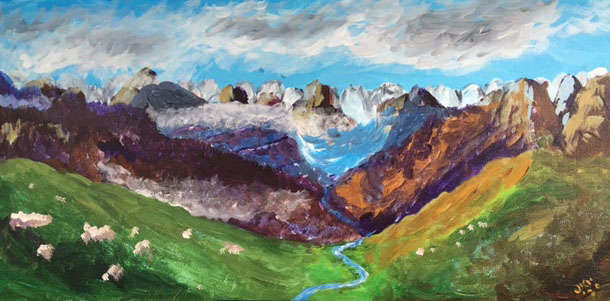
         I remember this path by the river. It is easily a two-day journey to the villa, but along the way, after the place where all those years ago I passed through the Suebi army on my way back to Bracara with the warning, I found a place where the river slowed and spread to soften the earth for a pasture land of tender grasses. That was where I rested then.

           In the days after the raid I followed this trail along the rivers as I am now, to return to the villa, the tabula rasa of a war field.

         After that raid when I came back to the ruin I found the full silence of devastation. The gardens were ashes, and the outbuildings gone with wafts of smoke still rising. That last wagon in the flight had no one left to drive it and no beast to pull it. Both the horse and the driver were still in their places stricken by arrows. I buried Susannah, then I buried her father along with his sword in what seemed to me the family burial ground outside the villa. But the woman of the cult Susannah was trying to rescue was not amid the ruins of the wagon. And the villa itself was nearly unscathed.

         In the bishop’s telling of the story I learned what I didn’t know then.

 (Continues tomorrow)

Post #12.12, Thursday, September 24, 2020

Historical setting: 563 C.E., Bragda

After I met with the bishop, after my mind was clear of wishes, and my memories were of grief, now I find Nic is not where I expected to find him: just outside, practicing his horsemanship. He is nowhere to be seen. He left an apple for my horse.  What can I do but ride back to the inn?

         It seems a longer ride alone. Thinking of Nic, remembering Nic. I had asked that this pure and chaste man still harboring his own wish for holy orders help me find my mythical wife with a yellow braid of hair. Then, like the Samaritan saving the beaten stranger on the road to Jericho, he learned that this victim he rescued was his own enemy, The Jew. He shed prayers begging strength to forgive like the sweat pouring off his scalding skin on the ship’s deck adrift in the hot still waters of summertime on the bay. He forgave his enemy. He offered me his friendship.

         Dear God, help me to forgive his soldier ways, if he should ever agree that we meet again. Amen.

         But now, I’ve laid on him tangible proof of my strange nature– my odd gift of physical life after life.  There’s no intricate theology to be spun from the miracle to say it is every person’s fate in resurrection. There are no others of my kind peopling this earth. And I offer no excuse from earthly mortality. I’m just a strange sign to make a physical metaphor of a spiritual truth. No wonder he chose to leave.

         My secret wish as I go back to the inn for one last night before I  gather my things and ride on to the villa, is that when I take Umber into the stall, there, also will be The Rose. Then I will go quietly into our space in the loft and I will tell him I understand I have made it all so hard for him. What can either of us say? Maybe he will speak or maybe he will just quietly get up and leave then. Over and again I have put him into hard places.

         The ride back is a tangle of strange dialogues in my head.  What can I say? What has been said? What is known now that was hidden before?

(Continues Tuesday, September 29, 2020)

Post #12.11, Wednesday, September 23 ’20

Historical setting: 563 C.E., Bragda

         Here in these Holy halls where even bishops tip-toe on marble floors to soften the echoes, I have found a quiet place to take a moment to mesh the stories the bishop told with the fragments of memory and now I seem to know too well the things I have not allowed into my waking thought before this.

         As the bishop told it to me today, it was the story of an imaginary hero, a missionary who saved the people and the gospel too. I know it was no missionary hero but an ever-grieving servant, a Christian pacifist who chooses no sides in these wars. My wound healed more quickly than my grief.

         Now I leave the basilica expecting to find Nic who excused himself from our meeting with the bishop to practice with his horse.

         What will I tell Nic now of my true remembrances? Should I tell him about Susannah, who saved numbers of the people from the war, and was the very one in the first place who demanded the bishop send a missionary to dispel the cult? Should I tell him that my remembrance of marriage to the woman with the golden hair was nothing more than my twisted grief for Susannah beyond the tragedy of her death? It was my own pretending that allowed me to be spared the reality of grief.

         Maybe it is like the doctor told me in Nance, some memories are better kept forgotten in the bandages.

         Now I shall see if my old soldier-friend Nic has learned to vault into the saddle yet.

         Nearly blinded by the glare of autumn sun I find Umber still tethered, but a bit more loosely than when I left him so now he is able to reach down and gnaw at an apple carefully lain at his feet. I have no guess where Nic and The Rose may have gone. I don’t blame him for leaving though. I must be a terrible disappointment to his onetime dream of sponsoring a monk who would be copying scriptures quietly and uneventfully. He meant to be the mighty protector fending off all ravages of evil outside the sacred wall of the monastery, guarding the sanctity of the written and copied word within. He meant, at least, to be a very good man, even if some bishop of old would not see him into the inks as a true God-man.

(Come again tomorrow)

Post #12.10, Tuesday, September 22, 2020

Historical setting: 563 C.E., remembering a villa in 462

Remembering 462 C.E., A very earthly enemy invasion was coming down on us from the eastern coast of Hispania. The first arrow arced through the vines of portico into the midst of our meeting. The next seemed to take an eternity to arrive, though it was only a few seconds. It was the stop of time we needed to realize we were under siege. Everyone, the family, the cult worshipers, the servants, all the able-bodied people who were neither guards nor soldiers crowded into the few wagons and carts available at the stables. As I prepared to ride ahead with the warning of the invasion, the elderly don, with his own sword already in hand, stopped me to hand me the gospel to take it back with me to Bracara for “safe keeping.” Then right behind him was Susannah begging me, before I left, to help get those who were too weak from hunger into the wagons for safety. Arrows were landing all around us like sleet in an oddly-seasoned storm, and we knew in another instant there would be spears and swords and cavalry. We must have already been in their sights, because the arrows were finding marks. Susannah was felled as we were lifting a starving ascetic onto the wagon bed; Susannah died there to save the life of one who had already chosen heaven over earth. I laid both women onto the wagon before an arrow came into my own shoulder.

         I only stumbled for a moment and then was able to mount my horse and go at full gallop toward the west to warn the others, but even then the rumors of war were spreading ahead of me like a torch dropped onto a parched summer’s field, so by the time I neared Bracara I was riding into the mighty storm of dust at the hooves of the Suebi fighters plundering into their newest war which was, for that moment, behind me.

         How I wish, at this remembrance, that the ancient truth wasn’t of her heroic death, but that Susannah with the yellow braid was … What have I done? Have I chased an empty, imagined romantic whim from another century only to be reminded that the single shred of reality left of it all is my own grief? And is this instant of grief what we have come all this way in search of?

         What can I say to Nic?

(Continued tomorrow)

Post #12.9, Thursday, September 17, 2020

Historical setting: 563 C.E., remembering villa near Zaragosa in 462

Here is a quiet place to collect my thoughts as I now have the one thing I was seeking – my clarity of mind. The bishop laid out details of a time in the missing century. And now my own remembrances have become horrifically clear. This is why I’ve kept these things hidden in this smog of forgotten time. I recall the villa and its ancient heretical cult festering like a plague, feeding on fears and longings for an unknown and unknowable abusive god. The God of love and life was unreachable by these cultists expecting, as they did, only sacrifice and punishments.

         I remember we were meeting together on the villa’s warm and breezy portico. Susannah led us in a familiar hymn as though we were all of a single mind and one voice. Then a young cultist asked that we may speak our separate prayers aloud. We heard, buried in each prayer of unctuous words a statement of judgment of earth things and a promise to pay for the “sins of earth” with holy suffering. How is it that God can even hear such a chaos of jangling sacrifice and useless human pain and not send down angels to set it right again?

         I pretended then, my prayer aloud; or maybe it was a sermon for earth in the guise of prayer but it forced onto them the Genesis thought – “After each day of Creation God said ‘it is good’. Thank you God for all these beloved people and for this whole beautiful Creation you have named ‘good.’”

         One shouted out, “So how do you know the mind of God?”

         As I was opening that Gospel of John to the first page, I started to say, “it is written… expecting I would read the part that begins, ‘In the beginning was the …”

         Susannah answered, “Just listen to him!  This man brings us the true Gospel!”

          I had indeed come as a stranger among them and a messenger of the Word assigned the task of freeing them from so much self inflicted suffering, but were I sent down to them on wings from heaven I would truly be a failed angel. Every message of every angel begins, “don’t be afraid” yet there is no edict I could think to announce an honest dissolution of fear. And at that very moment the fear of ethereal awe was immediately changed to an earthbound and tangible fear – an arrow landed in our midst — the unspoken terror was of an earthly war.

(Come again Tuesday, Sept. 22.)

Post #12.8, Wednesday, September 16, 2020

Historical setting: 563 C.E. Bragda

         I meet with the bishop alone, because Nic doesn’t want to hear about my unusual circumstance of having lived in other times. And now he has seen my transcription of The Gospel of John and now he knows it’s true. Nic can’t dismiss my personal weirdness with the possibility that my story is simply a product of a scrambled mind. Yet at this time he has only imagination enough to accept me as a normal human friend. But isn’t that also the whole problem of Christian resurrection?  Was it only Jesus and one other man, Jesus’ Bethany friend, raised from the dead, or is every living person taken by the hand from death by Jesus? Where are the boundaries of sign and symbol in an earth of flesh and stone? I choose not to ask these questions of the bishop. [Blogger’s note]

         “Thank you, Your Excellency, for meeting with me. My friend and patron Nic has chosen to stay with the horses and give us this meeting in private.”

         “I was told you have an interest in the particular copy of the Gospel of John in our collection?”

         “I was wondering about the source of that old codex. My patron and I are searching the history of the Suebi Christian faith, as it was a century ago.”

         The bishop answers, “Apparently that is soon to be a history of little consequence, as the Visigoths seem always to encroach deeper and deeper into Galleacia. We were fortunate to save that gospel from the invasion in 462. We had newly acquired the codex, and it was still in the hands of the missionary who brought it here when the wars first ignited. It was told he was preaching against the heresy at a villa near Zaragosa, the hub of Priscillianism at that time.  We still suffer the ravages of the heresy, though I hope now, since the Council met we have enough structure in place that we won’t be celebrating anymore religious suicides by starvation then mistaking suicide for martyrdom.”

         I have to ask, “Is that villa still the possession of the Suebi family who owned it at the time?”

          “I would have thought that was the stone of history you were turning first and the very thing that brought you here to find the gospel. Have you not visited it yet?”

         “I was only certain of where we would find the Gospel of John. We are still seeking the villa.”

(Come back tomorrow.)

[Blogger’s note] This is a fictional blog – not intending to probe the depths of actual scholarly studies but I have a recommendation. One of my favorite bible scholars (and possibly the whole world’s favorite) does take these questions head-on in the art history book Resurrecting Easter: How the West lost and the East kept the original Easter vision. By John Dominic Crossan & Sarah Sexton Crossan, Harper One, 2018.

Post #12.7, Tuesday, September 15, 2020

Historical setting: 563 C.E. Bragda

         There is a sense of apprehension in Nic as I have asked the Bragda librarian to turn to a particular passage in this one hundred year old copy of the Gospel of John. My own sense of its source was confirmed when I first saw it, but Nic is hoping not to see proof that it was, in fact, the gospel I delivered here myself nearly one hundred years ago. We can all see it is very old.

         I’m particularly interested to observe the lettering used in the places where “The Jews” was really referring to the Sadducees rather than the whole community of Jews. I ask to see John 1:19.  Nic and I can only watch as the assigned monk turns the pages for us. The monk seems surprised.

         “This is the testimony given by John when THE JEWS sent priests and Levites from Jerusalem to ask him, ‘Who are you?’”

         “That’s odd. I’ve never noticed that before. The lettering for the words ‘the Jews’ seems different.”

          The monk flips through the pages and finds it again and again. “I guess I just haven’t noticed that before. Perhaps the bishop will know what this means.”

         The monk assures us we can ask about it ourselves. We have an appointment with the bishop already scheduled. But Nic excuses himself. I know he doesn’t want to hear a declaration that this is the exact book I brought here 100 years ago. He says he wants to go outside and practice with The Rose, mounting and dismounting from the soldier’s saddle.  I know he has a yearning to be a soldier again. I understand.

         I think I was here before I returned to Portiers … to Portiers? Oh, yes. Now I remember, I was sent from Portiers to the port of Arles on the Great Sea to deliver one gospel, and then I went on by ship to Hispania. I didn’t arrive here at first.  I was shipwrecked, and I arrived many months late – after a long healing and repairing the damage of the sea to the gospel. It took finding a scriptorium and then many months of re-inking of the gospel. I was two years late. There was a different bishop then, but the same need.  I can recall these things now. I’m sure I was not here for any recent Council of Bragda in 561.

(Continues tomorrow)

Post #12.6, Thursday, September 10, 2020

Historical setting: 563 C.E. Bragda

Nic sees no need to question my remembrances any further. He is sure I am recalling the Council of Bragda in 561. But I fear my glimpses of remembering may be reaching back one hundred years. I will know if there is any truth to this concern when I see if the very old copy of this gospel they have here is the same codex I repaired after the shipwreck and delivered to them in whatever year I was here before.”

         Nic questions my search. “Why would you think any old gospel would be one you brought here?”

         “I will surely know it when I see it, Nic. Each letter of it was by my own hand. And furthermore, all those details I happen to know that were twisted into the Roman gloss, fixing the ancient words to speak a popular second century propaganda — I wrote those letters smaller, and in caps so that they would look exactly like the patchwork of changes that they are. Subtle, I was, but no less intentional than probably was that second century Roman editor of John.”

         Again this morning we sign-in on the visitor’s list and we are escorted amid the eternal forest of marble pillars back to the apse where books are kept. The keeper of the books meets us for our appointment to view the Gospel of John. And we are told the bishop might be available later to meet with us to answer my questions about the particular villa I visited when I was here before. The Gospel of John is already out on the table.  “This is the volume you asked to see, is it not?”

         It still has the same cover. “Yes, thank you Brother, it is indeed the gospel we are seeking.”

         He explains it to us in more detail, “You will see it is in Latin, but it is very old and it might represent a translation from the Greek before the work of St. Jerome was completed. It is St. Jerome’s translation that is approved to become the orthodox translation. Every translator will make slight differences. Since this is the only copy of this gospel we have we will just have to make due.”

         “Of course.” I wonder if I need to apologize for my translation or should I pretend the flaws were by another hand. I ask specifically to see John 1:19.

(What will they see in John 1:19? Continues Tuesday, Sept. 15.)

Post #12.5, Wednesday, September 9, 2020

Historical setting: 563 CE, Bragda

While we await the keeper of the books to make our appointment with the gospel, Nic is questioning the doorkeeper about every detail of the recent Council of Bragda in 561. He seems so delighted in the assurance that my lost memory might have lapsed only one year and a few months.

         “Hey Laz, you should hear this!  It all makes sense now. It’s like you say, the Priscillianists keep reemerging even in these new times. And the heresy is just as you explained it. You were right. The people who joined that cult were meeting in secret, and they were starving themselves to death in the name of God.  So the Council ruled against changes in the liturgy that could be seen as secret language for belonging. They outlawed meatless meals, in order to rescue the starving victims. And to keep these ascetics from being venerated as martyrs it was ruled that suicides were to be buried outside the churchyard.” [https://en.wikipedia.org/wiki/First_Council_of_Braga. Retrieved,9-23-2019]

         Nic holds onto the high hopes that this rescued monk to whom he has pledged his patronage and friendship can be easily returned to “normal” and our lives can go on simply and usefully all for God.

         On this next morning the ride from the inn with the excellent stable to the basilica is becoming familiar. Two days ago the observations of this jaunt were of distances, elevations and road surfaces.  Now this ride is more about the things that would go unnoticed in our hurry. This morning we feel the gentle rhythm of the horses’ gait, the sounds and smells of a new morning rising in the mist. It is a moment to notice what was lost in our first ride this way.

         Dear God, thank you…

         Nic interrupts my prayer – or is it our gratitude together at this moment. “You know, Laz, when we started on this, the horse thing was a real obstacle for me. Now I’m actually glad we got horses. I mean, listening to his hooves hitting the ground, sorting the rhythm from the taps of the woodpeckers, leaves rustling up to flurry in the breeze, livening the stillness of a hot day to come… I’m learning to like the feel of the horse moving beneath me.” [Author’s note]

         “That’s a good thing Nic, as I fear we will be doing much more of this now. I’m afraid we haven’t really found the easy solve to my scrambled mind yet.”

(Continues tomorrow)

[Author’s note] For information about horses for this writing I asked a friend, Gail Salco, who cares for horses to guide my characterizations of horses, and in one of her e-mails she described a morning ride. I gave her own words to Nic in this place.

Post #12.4, Tuesday, September 8, 2020

Historical setting: 563 C.E. remembering a different time

         I know I wasn’t part of a procession of bishops. We are at the visitor’s desk at the basilica of Bracara, called Bragda now. Nic is urging that we study the visitor’s list from a Council held here only twenty months ago in 561. I know my name will not be on that list. But when I was here, I brought a gospel so I asked the monk if they owned a Gospel of St. John.

         “Indeed, we have such a book. But it’s very old. To lay eyes on it you will need to make an appointment with the one who keeps the books.”

         “Please, then, help us make that appointment.”

         Nic is already assured that I had only lost a year or two of remembering, and we would soon find my wife named Susannah with the yellow hair, and maybe a family longing to greet me and meet him, my newest friend. And he would also feel assured to know that the strange story I confided to him of my life as an earthly friend of Jesus, forever being healed back into life, was simply the product of a once scrambled mind.

         But this encounter at the visitor’s station doesn’t leave me nearly so sure. So few things are as I remember them, and those that I do recall are worn and old, or newly refurbished to hide their oldness. Surely I was here once, but I fear it was in the century of 400’s, and I know this is the year 563. Everyone says so.  No one else even wonders about that. In every language in every place it is the middle of the 6th Century in the year of Our Lord.

         While we wait to make an appointment with the monk who oversees the library, Nic plys the doorkeeper for details. I just wander the Christian marble pillars pretending Rome emulating Greece in Galleacia where now the Suebi rule. Such a mix is the world these days.

         Dear God, it is no wonder my sense of belonging is scrambled. Help me to see your way, and thank you again, for Nic. Amen.

         Nic is anxious to learn all he can about this recent “Council of Bragda” assured, he supposes, that the more we know of it the more my memory will be jogged back into normal time and my weird nature of resurrection can be dismissed with my mind’s scramble.

(Continues Tomorrow)