
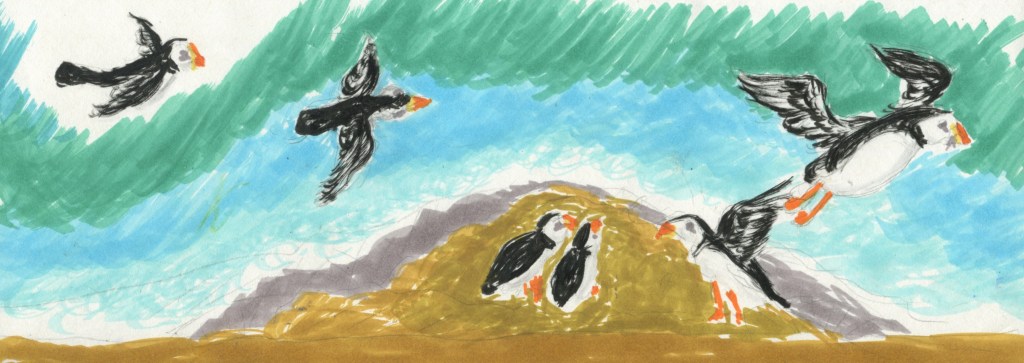
Historical Setting: The Great Skellig in an unknown time
In all my redundant healings, rising over and over again into life always into future times, I’ve never actually discussed my circumstances with anyone but my closest friends and family. Now, I offered it as a homily on the “signs” in the gospel and the questions here aren’t about the Jesus message, they are only asking about personal sins, the kind that are confessed before a priest.
Perched as we are here, just above the nesting place for thousands of birds, our slight human glimpses of holy wisdom don’t distinguish which birds of Creation are beloved and which are doomed to eternal punishment. In birds there seems to be no sorting for punishment and no required penance. In birds, everyone has wings, not just the angels. Then, here are these earthbound monks with all the contrivances of human understanding.
I ask, “What do you say about the birds? Do they sin? Does God measure them by their sins? Or is it only human beings who can sin?”
The monks look to the abbot for the answer, and the abbot is standing a few steps higher, observing, not participating. Pushed by his followers’ expectation he offers scripture for an answer.
“In the Gospel of Matthew, it is said that God knows even if a nearly worthless sparrow falls. And God knows every little thing about us, even the number of hairs on our heads.” [Matthew 10:29-31]
A novice touches the bristles shaven on the fore part of his head, then he reaches his fingers back to the hairs still growing a length. It is a sign that God has less counting to do with tonsured monks. And it is a confusing bit of holy scripture here — this hair counting thing. I think the abbot was intending to use this reference to tell of God’s grace, affirming God’s love for all Creation. He means to be supportive of the metaphor I am drawing. But scripturally, the context is the Gnostic divisiveness between darkness and light, between soul and body. And in that passage part of us may be destined for hell. [In the context of the chapter Matthew 10]
The abbot’s answer doesn’t argue against my analogy but he chose to keep his answer narrow, allowing for grace, amid the more punitive context of the whole chapter.
To the abbot, I say, “thank you.”
(Continues tomorrow)

